

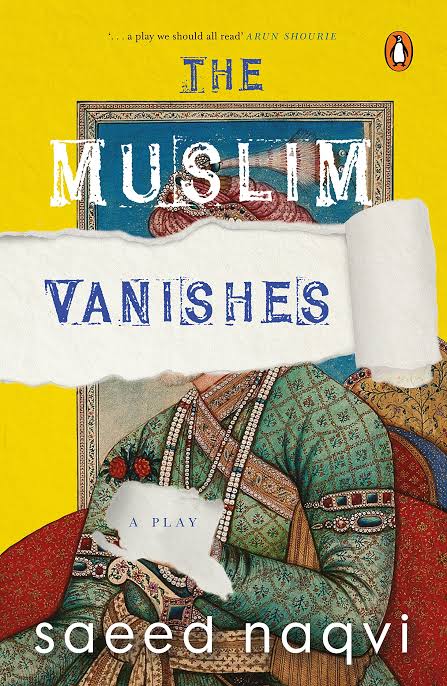
The play written by famous writer Saeed Naqvi, is an imaginary portrayal of India. A ‘Muslim-mukt’ India, an India where one day all Muslims disappear suddenly. They also took away a lot with them, especially the Qutub-Minar. Muslim’s disappearance is eagerly awaited by a particular group who saw this disappearance as a major landmark in the establishment of Hindu-Rashtra. But, instead of turning dreams into reality, this disappearance created chaos.
The differences among the Hindus began to emerge. The lower castes started taking advantageous positions because of their large population. That is why after the disappearance of the Muslims, the upper caste Hindus were opposing the election and wanted to postpone it till the return of the Muslims so that they could find a common enemy again to consolidate the Hindu vote and communalize the elections.
One interesting point to note from the conversations of Hindus is that they are feeling guilty and accepting their wrongdoings as the main cause for the disappearance of Indian Muslims. A character in the play pointed out, ‘You lynched the Muslims, you confined them to ghettos with no jobs, you filled the jails with them, accused them of being terrorists or of siding with Pakistan’.
Another continued, ‘They were treated badly. The Sachar Commission report of 2005, which looked at their plight, was a mirror. It showed us what we have done to our Muslim brothers since Independence. We have pushed them into ghettos and kept them there. We have reduced them to the lowest social rungs of our society—at times even below the Dalits. The carnage of 1947 did not end with Partition. The massacres in Jammu and Hyderabad followed. And after that, riot upon riot: Ahmedabad in 1969, Bhagalpur, Muzaffarnagar, Delhi, Gujarat……we must examine the treatment meted out to Muslims by our people and our system.‘
After the disappearance of Muslims from India, all eyes were on their property and business. People were discussing “200 million have left behind their homes, farms, land, businesses, cowsheds, buffalo sheds, all of which will be worth zillions of rupees. All of this wealth will be the dividend from a Muslim-mukt Bharat, a Muslim-free India. This is the dividend that we must divide among ourselves. It remains to be seen who gets what.”
But lower caste Hindus, a large population, are feeling bold enough to occupy most of the Muslims’ properties. It is a fact that lower caste Hindus have been lured into the property of Muslims for a time. Such rumors were heard especially during the CAA-NRC movement that some lower caste people were waiting for the day when Muslims move to Pakistan or concentration camps and they get the booty.
In such a case, the disappearance of Muslims will be more beneficial for Hindus especially for those who belong to a lower caste because they are getting economic and political benefits while the loss is only cultural. The author has presented Muslims as a cultural group that has some specific cultural symbols including Qutub-Minar, Biryani, Urdu language, etc. and these cultural capitals were more important for them to take away with them and leave behind their properties. The author especially mentions the graves, as if he considers it important enough for Muslims, and particularly, the grave of Afzal Guru. He writes, ‘They have even dug up the terrorist Guru’s grave. They just scooped out the earth and took away the skeleton. It’s missing.’
An interesting point, Muslims took away Qutub-Minar but left the Masjids. A strange incident occurred in one of the mosques known as Padain Ki Masjid. A man describes the incident in his own language ‘Some 20–30 of our brothers are lying in the veranda of the mosque. They had been circumcised, but before they could recite the Kalma, the mullah who was in charge of the procedure disappeared. Their women are now performing Shiv Ling puja, praying that their men may become whole again. This is a most unusual stalemate—they are neither here nor there. They are not ‘full Muslims’. Their women fear that they have lost their Hindu identity as well as their manhood.‘
These people are calling themselves ‘Mohammadiya Hindu’. Others are also following them. Industrialists are investing in new businesses to facilitate speedy circumcision. That means mass conversion to Islam. Someone complains, “The frightening thing is that those who are self-converting are our own people. They are not foreigners, so we can’t call them invaders. We also cannot accuse them of destroying our temples.” These converts can read the Quran and can offer their namaz in their own mother tongue, as told by top Muslim clerics of Nepal. ‘Above all, this new form of Islam will fuse Islam into the Hindu cultural frame’. Oddly enough, the author misrepresents the conversion and gives circumcision too much importance in the process of conversion, which may be the result of being called ‘Katua’ in the real world.
In this chaotic situation, a meeting is held with the architects of the multicultural nation including Khusro, Hasrat Mohani, Jyoti Bai Phule, etc. The discussion begins with the arrival of Muslims in India and extends to various important and unimportant issues. The author tried to present, through the discussions in the assembly of the great men, the composite culture of medieval India as an example to be followed in today’s India.
The plural societies of medieval times where people lived together, they spoke each other’s language, respected each other’s religion and religious traditions. For today’s India, the citation of medieval India as an ideal is a bit strange. We know, many misconceptions have been spread by a particular group about this era and sometimes it is also considered as an era of slavery. So, is it possible for today’s youths to have enough interest in a composite culture that existed in the medieval era ruled by Muslims? Perhaps, for today’s India, we may not have any strong motivation to stay together peacefully and respectfully accommodating different cultures.