

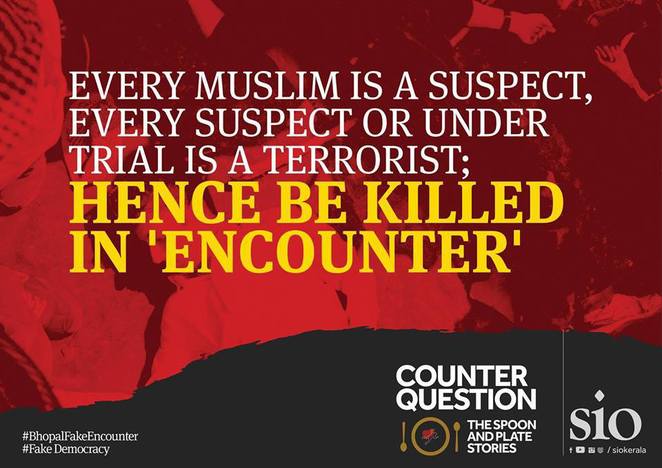
The Madhya Pradesh Police and the home ministry should answer the following questions:
1) Why were all of them KILLED when they had no weapons? Why not even one of them has been taken alive so that co-conspirators if any could be unmasked with evidence?
2) “Weapons” – spoon and plate according to home minister and police! Killed a policeman. How can mere killing of one police man lead to escape from a central prison..! How come when one policeman was attacked no one else tried to stop them?
3) Jail with International Standards – ISO 14001-2004. High security. How did they escape? According to jail manual they must be in lockup and keys should be submitted to Jail office before sunset.
4) Blanket does not reach the top of the hi-wall. And there is no place on the wall where the blanket can be hooked.
5) More importantly, since the court decision on them are about to come in a week, how can you explain the logic behind claiming that they tried to break the jail?
6) According to photos and videos, they were wearing neat colorful dresses – Jeans T-shirt Coat, watch, shoes etc. which is not allowed in central jails. This is allowed to wear while shifting to other jails or while going to court. Where they brought out in that manner..? Or were they purchased at mid night in the deserted wood?
7) All 8 were together while encountered. Even stupidest of criminals won’t wander around together after escape.
8) The encounter took place at a time and place where there were no witnesses apart from police personnel. It was the same with all previous fake encounters…
Questions are being rightfully raised about the suspicious circumstances in which eight under trial prisoners are alleged to have escaped from the Bhopal Central Jail, and then gunned down in a supposed encounter less than 12 hours later, less than ten kilometers away from the jail. Starting with the cases of Ishrath Jahan, Sohrabuddin Sheikh, Batla House encounters and to the recent encounter killings by Telengana police, it has become a routine in Indian police state. Also, while referring about the accused SIMI activists, the chief minister of Madhya Pradesh called them as terrorists, as the fact remains they are under trial, and the court was about to take a decision in favour of them, since the prosecution failed completely to prove any of the allegations levelled against them. The title of the banned organization of SIMI has been used by the Indian security forces to target and terrorize Indian Muslims for the last fifteen years, though there remains serious contentions regarding the legality behind the ban of the organization as well. As Irfan Ahmad analyzes, SIMI is no more than a phantasm to create and perpetuate, in league with Western international relations, the national politics of terrorism because it yields electoral harvest.
Once when it comes to the case of Muslims, he/she always has to prove that they are not terrorists, and even if a trace of such a possibility of proving their innocence is seen, they are hunted and killed down.
Fake encounters has been happening throughout this country, and it is a horrendous truth that the officers behind these are most of the time honored by the state, as the notorious encounter specialist of Gujarat Police DG Vansara received a warm reception at home recently. It is also important to see how systemic killings and periodic hangings are executed throughout this country, especially targeting Muslim communities, and throughout the states of North East and Kashmir. Once when it comes to the case of Muslims, he/she always has to prove that they are not terrorists, and even if a trace of such a possibility of proving their innocence is seen, they are hunted and killed down. If the videos prove to be authentic, then it is a serious violation of human rights and strict action should be taken against the officers involved.
Muslims, as a community is targeted from various faces. Primarily, they are denied adequate representation in the democratic and institutional spaces like legislatives or universities. Also, whenever an affirmative action is taken to support them, there would come the allegation of appeasement politics. Apart from the issue of social backwardness, they always have to carry the stigma of being anti-nationals or potential terrorists. Even in the issue of the mob attack and forced disappearance of Najeeb from JNU, it was followed by the writings in the mess hall, branding Muslims as terrorists and supporters of Pakistan. Muslim identity works always as an Other in this nation, and it is necessary to counter the narratives supporting this mentality. Even in the battle #justiceforNajeeb, there should be efforts to place the issue in this broad perspective and to counter these narratives, and it is high time, we raise the Muslim question in India as a political question.
The battle is not only to ensure safe return and continuation of Najeeb’s studies, but also to make sure those kind of incidents don’t repeat in any place in this country. One has to place it in the context of the series of events and attacks against Muslims throughout this country. Also, it is a time, we have to re-think beyond the narrow binaries of secularism and communalism, and we have to be very clear what those concepts politically mean in the present Indian scenario. We have to seriously re-think on why there is a reluctance from our part on raising the aspect of Muslim question visibly present in the issue of Najeeb, as we could easily talk about the issue of women and their spaces in the context of Nirbhaya Movement, and we could raise the fight #justiceforRohit Vemula as a larger Dalit question. If we still think, just by raising the issue of targeted religious identity of Muslims it would communalize the issue, in fact we are actually serving the larger discourse of Islamophobia only.
Apart from continuing the legal battle and pressurizing the authorities to take action against the culprits, we are yet to raise the issue as a political question, and it is visible in the continuous decrease in participation and the presentation of our political narrative. Indeed, it is a serious issue of a student missing from a campus, and the administration and the police are least concerned, and our struggle is yet to reach the level of response which the gravity of the issue demands. Strong mobilization and campaigning are needed inside and outside the campus, and we have to raise the issue as a broader political issue, failing to which would compromise our any of the future political movements.