

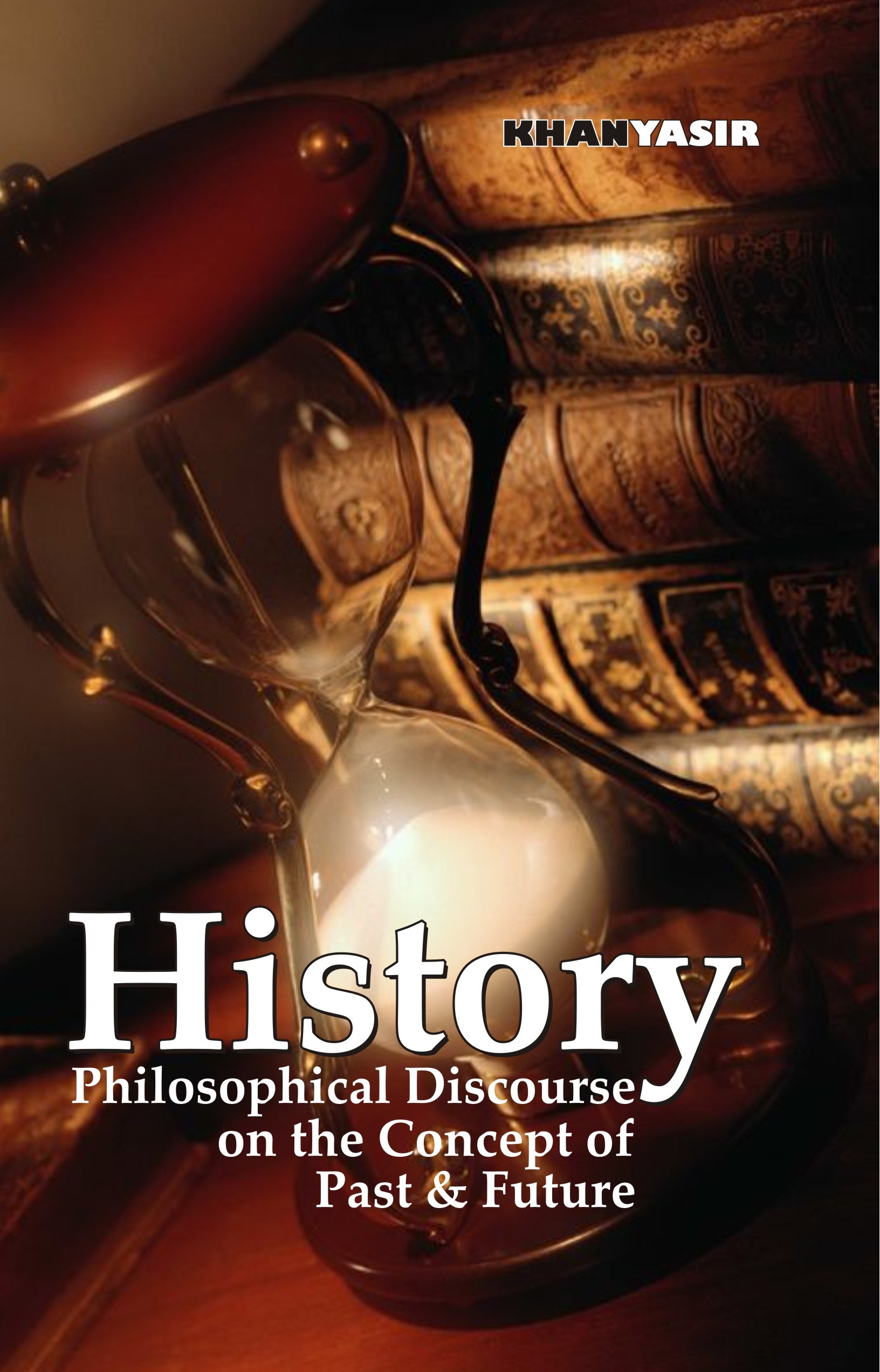
I have always had a foggy opinion about the authenticity of history taught at school. Thanks to which, the bloodied footsteps approaching the Mughal throne, apparently belonging to Aurangzeb shown as part of the school syllabi, barely had an iota of effect on me. The then headmistress, Mrs. Kapoor’s claim that history wasn’t history anymore in reality but just manipulated matter, further compounded my misgivings. Stripping away the veil of dubiety and falsehood, Khan Yasir’s philosophical discourse on History caters to the doubts of such young minds, to whom it is so fittingly dedicated.
The author opines differently on the subject of history and is in favour of a more productive version that just doesn’t require students “to gobble up names and dates and omit them out in examinations”. It was his discontent with his history textbooks that made him often question the blinding hammed up historic tales and contributed to his conviction that history is indeed biased. Drawing a slight distinction between the past and history, he avers, “the image of the past is the historian’s contribution to the future.” One can imagine the horrendous effects of falsely narrated history on children, who are made to learn the same verbatim. The idea of the book generated during his tenure as a teacher at Islamic Academy. The fact that it was his students’ insistence that led him to compile his thoughts on the theme, a very rare instance, will leave the reader yearning for a seat in his class.
The author notes how cleverly James Mill divided Indian History into the Hindu, Muslim and British periods and Mill’s rather preposterous brainwave that the first period was a good one, the later the darkest and that India needed the British to bring about civility in Indians, an attempt to justify colonialism.
One of the unique strengths of the book is how the author unwraps his ideas, from simple yet profound to more complex arguments, that aren’t baffling but whet one’s appetite. He explores the hidden tools used by historians to alter the past, addition and omission being some of the most notorious ones and elaborates each with familiar examples from Indian History. That explains why some of the noteworthy aspects deserve barely a few mentions throughout the length and breadth of a history book while others are all cooked up. The author notes how cleverly James Mill divided Indian History into the Hindu, Muslim and British periods and Mill’s rather preposterous brainwave that the first period was a good one, the later the darkest and that India needed the British to bring about civility in Indians, an attempt to justify colonialism. Of course, he looked through the eyes of the colonizer and not the colonized. If it were told that every period witnessed its own ups and downs, it would sound cliché but if the details of his ‘notorious classification’ as the author calls it, were stated explicitly, it would be the cynosure of history textbooks or at least his description of the Muslim period. “The problem with such classifications,” the author says, “is that it gives an undue importance to as negative an event as colonisation and considers it as a landmark which for sure it is not.” Categorising historic figures into ‘villains and heroes’, which is all we see in History, is another method to alter the truth. He believes that by doing so, the contribution made by many historic figures has been trashed and that the past is ‘made more akin to the notions needed to be popularised in the present’, which is in fact a very valid thought. Some like Kemal, make history unreadable by changing the language itself, while others edit matter so the glorious truth of their ancestors remains out of the newer generations’ reach. As is evident from the author’s erudite arguments, there is no truth nor greatness in the History taught today, and one may reminisce the oohs and the aahs uttered out of surprise or disgust by one’s feeble-minded fellow classmates during a history lesson which many a times sows dissent among students and the teacher being a product of the same kind of teaching happily entertains the same.
In the chapter “Western Philosophy of History and Future”, Khan Yasir describes history from the various perspectives of well-known historians and philosophers, the most notable being Plato’s: ‘Poetry is nearer to vital truth than history’ and J.A.Froude’s: ‘It often seems to me that History was like a child’s box of letters, with which we can spell any word we please’. Carr’s claim that “a historian chooses the facts that he wants to make use of,” his view being that of a historian, bends many rhetorics about history being an accumulation of genuine facts. As the author writes, ‘every historian cherishes different values and standards’ and ‘interprets’ events based on the ‘current prevailing notions of the good and bad’ which often results in contradictory and erroneous interpretations of historical incidents. This belittles the legitimacy, significance and one-sided narration of historic events in history books as well as the enthralling methods used to illuminate the same in the minds of students. To back his argument, the author quotes McNeill, who ‘recognised the problem’, and regarded all ways of understanding the past to be ‘tentative’ in nature. To reconstruct the past is as difficult as telling the future, which requires the historians to look for and consider all ‘probabilities’ and not make retelling of history, a pile of guesswork. Tolstoy castigates the methods used by historians, like, examining selected events apart from others or laying emphasis on kings and ministers, rather than the lives of the people and from his view of history, the author infers that the ‘history we read is a result of complex and often unexplainable human activities of which we never come to know.’ A very cerebral notion but one that might alter the whole absurd painted picture about many historical figures, like Aurangzeb or maybe even Akbar. No matter how neutral academic books seem to be, there is no ‘neutral history’, in the words of the author, since ‘there are no neutral historians’.
No matter how neutral academic books seem to be, there is no ‘neutral history’, in the words of the author, since ‘there are no neutral historians’.
In an attempt to trace the origin of mankind, he reveals how they, despite their philosophical arguments, do not find any pattern in history and speculate how the origin of mankind was an ‘accident or a mere coincidence’. The author deals at length with their idea of evolution of human society and one will find themselves in the midst of the hypothetical early stages of Animism or state of nature, that brings together an odd, despicable picture of humans living in the lap of nature and ignorance, attributing to ‘everyday objects’ a ‘god-like’ nature. Through many such stages, apparently, man grew in intellect and thankfully, his lowly position at this point seems to draw a better picture of our ancestors. The last stage as most historians put it, is the stage where man is either self-governed or governed by science. Marx’s take on the progress of human society too seems to be a little above one’s head.
Since not all historians of the west share the same ambition for history, its purpose also remains ambiguous. Is it a ‘curative science’ or a mere study of artefacts and documents, as some suggest or just a reflection or ‘thoughtful consideration of history’? The answer seems to be out of their grasp.
In the second chapter, ‘Islamic Philosophy of History and Future ‘, the author lays down a list of Muslim Scholars who contributed much to history, most of them never mentioned anywhere as if the Muslim world failed to exist in any of the fields of knowledge or education but only barbarism. Recognising the fact that the influence of the Muslim world in ‘pulling out Europe from its dark ages’ has been greatly undermined, he reveals how Muslim historians made history a science and discovered its laws. As quoted by the author ‘Islam is the first actual movement known to history, that has taken society seriously and history meaningfully’ because it sought ‘the betterment of this world.’ He heads on to describe Ibn Khaldun’s idea of history, who is known to have made the first genuine attempt at defining philosophy of history and its laws. Like no other, he stresses on authenticity and yet another error of historians is discovered here – ‘exaggeration’. Talking about authenticity, the author, in search for an unambiguous philosophy of history turns to the most authentic book known to mankind i.e. the Quran and analyses “its intellectual and philosophical superiority to other conceptions of history.”
Unlike western philosophy, the Quran gives a sane, reasonable account of the origin of man dispelling any embarrassing notions of an ape being our ancestor or one superior over the other. One may try to dodge the reality of Adam and Eve, but a wise person would rather stomach this truth than the conjectured ‘state of nature’ of man or the ‘gloomy and pathetic picture’ that the philosophers paint of the evolution of humans and society. As is evident from the verses, mankind, the best of God’s creations, was bestowed with guidance right from the beginning and has been raised to a lofty position but man’s shiftable character often led him to times of ignorance and wrong-doings, and required reminders and warnings from the Creator sent in the form of Prophets and Messengers. When man gave heed to their callings and made amends, he prospered, while by failing to do so he brought upon himself the imminent chastisement from the Creator. Drawing these two strands together, the author says, ‘it is a nation’s greed, lust, lavishness and oppression’ that ‘leads it to chaos and destruction’ and ‘absolute faith’ and ‘a resolve to change for the better’ brings it to success. In his view, events have not just been described in Quran as in a history textbook, but with purpose, as the book itself claims to have moral ‘lessons’ in them ‘for men of understanding.’ To solve the problem with history and historians, he proposes that ‘complete knowledge and total impartiality is essential for writing true history’. He traces both these attributes to the only Supreme Being, the Knower of the Unseen. Unlike other historical narrations, where one begins to feel sceptical half way through, the Quranic narrations of the past have depth and meaning. His belief that ‘the nature of man does not change’ and ‘the actual reality on the ground today can be more complex but not different’ expels arbitrary claims that look at the Quran as a mere book of the bygone days. Read a little further and one will find proof in the verses the author quotes as examples to elaborate how related it is to the present as much as it is to the past and in turn, perhaps the only answer to the origin of mankind, and the laws and purpose of history.
In the third chapter, the author analyses the works of Shibli Nomani, a well-known historian known to have ‘revolutionised’ historiography in Urdu. His study of history can be classified as one of those that are often underestimated in worth and intellect due to lack of translation and dismissed as being outmoded. The author’s review, however, breaks through the barriers of language and debunks some of the many concocted fallacies written all over in red in history textbooks, the first being that of Jizya.
In Shibli’s arguments, Europe and the like, who proudly wear the tag of ‘religious tolerance’ have had a grim history of intolerance, and if one can remember, the banning of prayer calls, or the veil or head covering and constant protests and pleas in favour of the banishment, is also done by the same people who claim to be secular and tolerant towards religion
The term, often muttered as if in disgust hounds the Orientalists as a phantasm. As preposterous as it may seem to a person acquainted with Islamic fundamentals, this ignorant view of Jizya seems true in every sense to a student who is still a learner. In the facts ascertained by Shibli, the author finds that Jizya ‘existed even before Islam.’ To summarise some of the undisclosed facts, it was ‘not taken from anyone above the age of fifty or below the age of twenty’ and from ‘women, the handicapped, mad and poor ‘ and was taken as a ‘protection-tax’ which was ‘minimal’, and as the author notes, at the most ‘twenty rupees’. Since in an Islamic state, the non-Muslims, by Islamic law – the same law that faces foolish criticism – are not bound to serve the army, it was required of them to pay the tax as ‘compensation for exemption from the compulsory military services.’ They too were exempted from paying jizya, if they wished to serve the army. The author further elaborates through examples how Muslims enrolled in the army, not just to protect themselves but their non-Muslim counterparts as well. In his analysis of the rights granted to non-natives in the Islamic state, one will find how not oppressed they were, proven by various testimonies and other evidences. In the treatises signed by some of the Muslim commanders – let that word ‘Muslim’ be stressed as much as possible – statements like ‘your protection is our duty… till the moment we defend you, we have a right to Jizya’, ‘whatever we had collected from you was on the condition that we will protect you from your enemies’, or ‘blood of the zimmi (non-native) is our blood’ and many such noteworthy points like ‘when some of their enemy attacks them, they will be defended…’, ‘they will not be coerced in any sense to abandon their religion’, ‘their lives will be protected’, ‘their wealth will be protected’, ‘Muslim armies will not enter their area unless invited or permitted…’ and so on and so forth, shall tug at the reader’s heart, considering the all prevalent corruption and insecurity of possibly everything today. The author adds that the Caliph as well as the Muslims could not by any means buy land from a conquered nation let alone taking it by force. If one digs deeper into the arguments, facts, and narration, one will find that such ideal principles of ruling formed the basis of the Islamic state, and they fought with all their soul and blood to preserve these, hence, ‘principles were not just a showpiece.’ Considering all the above, only someone of a rank naiveté would criticise one who legalises Jizya or praise the other for abolishing it. The authors view of ‘complete impartiality’ is nowhere more evident than in his acknowledgment that despite the just principles, there were some, very few, countable ones who took undue advantage of Jizya, but they were justly dealt with later. Declarations in treatises like ‘their churches will not be demolished, they will not be proscribed from ringing conch, and neither will they be stopped from taking out religious processions…’ or perhaps the testimony of a Christian patriarch, ‘Arabs whom God has granted kingship of the world, do not oppress Christianity, on the contrary they help our religion, respect our patriarchs and sacred things and grant gifts to our churches and monasteries’ may cleanse the misconception of religious intolerance that is so cleverly associated with Islam. As the author notes in Shibli’s arguments, Europe and the like, who proudly wear the tag of ‘religious tolerance’ have had a grim history of intolerance, and if one can remember, the banning of prayer calls, or the veil or head covering and constant protests and pleas in favour of the banishment, is also done by the same people who claim to be secular and tolerant towards religion but look daggers at Islamic principles that in actuality formed the only law that demonstrated religious tolerance in every sense of the word. The historical myth of the destruction of the famous library of Alexandria by Muslims, as proved in Shibli’s research, does not even have a strand of authenticity in its sources or narrations. He cites Mohammad Fatih’s conquest of Constantinople and Egypt’s conquest by Muhammad bin Qasim as ‘shining examples of Islamic tolerance.’
One may wonder why these pages from history books went missing, even when these could have been used as effective tools to impart the same morals as were practised by the rightly guided Caliphs, but instead, we choose to teach how barbarism, violence and ignorance pervaded the Muslim Era giving a little credit to art and architecture here and there, and pat historians for a job well done. Such a mismatch of incidents and contexts is in reality a shame on the very subject itself which only pretends to be illuminating minds with the glory of the yesteryears but in fact presents it with lacunae filled with falsities. With this being taught in possibly every class in schools, how wise would it be to expect students to grow up into all responsible citizens spreading the message of brotherhood, which very frankly, is taught in bits and pieces through history?
Of course, the compilation of historic events that we are presented today is an effort of the historians who have been rewriting history since a long long time. Its intriguing to know that despite their intellect and freedom to look into Islamic history through more authentic sources, they fail time and again to reveal the truth. Some of the problems in Orientalist historiography, as the author notes in Shibli’s criticism, are ‘misunderstanding’, ‘prejudice’ and ‘not distinguishing between Islamic ideals and Muslim practices’ and their idea that ‘western civilisation is supreme’ and without them, civilisation would be unimaginable.
In the later part of the book, the author comments on the inevitable question of the Future through Fareed Zakaria’s best-seller, ‘the Post-American World’ that explores ‘the future of the world’.
One of the most noteworthy points in Zakariya’s work, as the author finds it, is his view of a ‘large population’ in a country. He very surprisingly links it to a positive economic development and how ‘human capital’ helps India in its growth.
The author presents a clever analysis of Zakaria’s jottings, which carry the scent of a raving American blinded by ‘US hegemony’. Although Zakariya acknowledges the decline of The US with a few reservations, he doesn’t seem to come to terms with it. As the author notes, he is more interested in ‘prolonging the stay of America at the pedestal of superpower of the world.’ His comments on things pertaining to the Muslim World seem to be expressed as if in a state of delirium, especially so when he relates ‘women clothing’ with ‘modernity’ and presumes Muslim women to be lagging behind, a proof of his ignorance in the matter. Among the many notions and arguments he poses with reference to the future, his views relating to the Muslim world stand out clearly. He very expectedly, banters on about ‘Islamic threat’ and ‘terrorism’ and the war on terrorism. With a very false view of Islam, he makes up some ‘divide-and-rule suggestions’ to deal with ‘Islamic threat’. Well-acclaimed for favouring a more moderate version of Islam, his repeated mentioning of ‘Islam’ with a very discouraging ‘threat’ reveals his little sanity for the subject. Before relating the two he might as well have had studied the subject of Islam, given his seemingly amusing intellect. He claims that ‘Islam presents no competition to the Western originated model of modernity’. Very frankly ‘claimed’ but let’s get to a more caustic truth – Islam cannot be competed with – it civilised human thought and behaviour while modernity, time and again made man into a reckless ‘ape’. Read a little further and one will find him spewing words like ‘crackpot Imam’, ‘nutcase who glorifies martyrdom’ and so on, although, one may find some sense in his criticism of ‘ideological watchdogs’ ‘exploring documents of jihad’ and ‘those who lament population increase of Muslims in the West.’ And then again like a blow, it all falls to pieces, when he claims that their population in Europe ‘will probably plateau’ after 2025. One of the most noteworthy points in Zakariya’s work, as the author finds it, is his view of a ‘large population’ in a country. He very surprisingly links it to a positive economic development and how ‘human capital’ helps India in its growth. The author criticises the constant lamentation in textbooks on India’s oversized population and suggests that policy makers of the nation ‘curb’ their population control measures in view of Zakaria’s observation. He then takes effort to point out the probable reasons for the changing attitude towards the west – US and Britain. Of course, not all fancy them. One of the reasons he can tell is the one sided American narrative of the world history which portrays the west to be heroic and others shoved into a corner with a little say here and there. He deals in detail with the success story of China and how it ‘compressed the west’s two hundred years of industrialisation into thirty’ and then India’s story of democracy and the major flaws. The author however finds his reference to Indians as ‘Hindus’ a little problematic, considering the secular nature of India. Despite all the arguments, Zakaria invariably tends to establish a safe position for the US, or in the words of the author, is more interested in ‘prolonging the stay of America at the pedestal of superpower of the world.’
Whatever the nature of Zakaria’s arguments, one will learn better from the author’s view of futurology. Many in the past have tried to tell the future but as the author notes, their ‘guesses and speculations seldom hit the bull’s eye.’ He draws two lessons from his study of the past; the first being, ‘humans cannot predict the future’ and the other being the fact that although its out of our reach to tell what the future has in store for us, humans can ‘sculpt the present’ to make a better future, and this, the author opines, ‘should be the aim of futurology.’
Throughout the book, one will find himself immersed in a sense of identification with the author. His writing is not mundane, as one would expect a book on history to be, instead, his arguments are rich in universal truths and just long enough to hold one’s attention. The realisation of injustice pervading possibly everything that is documented and the need to check the spectre of falsehood, contributes greatly to the author’s writing. He ambitiously aims to bridge the gap between historical facts and truth through his thought provoking insight. His convictions leave an imprint on the reader’s mind, debunking the many facts taught at school and satiating the many more doubts one may have had since then with his lucid and transparent take on history.