

The name ‘Bollywood’ is a combination of Bombay (Mumbai’s old name) and Hollywood and it is often used to summarize all movies produced in India. While Bollywood is the center of the Hindi movie industry, movies are made in other regions and local languages as well. India has been the largest movie producer worldwide for the last few years, releasing more than a thousand films each year. There were two thousand multiplex theaters in India as of 2015.
Among the film industries around the world, Bollywood is one of the famous and the strongest industries. The influence and strong impact of Bollywood has increased and almost reached at hegemonic level. A movie of three hours in that dark room has the power to make the impossible possible like the popular lies can be exaggerated and converted into truth and if it is done in a systematic way it can shape or change the public opinion. Bollywood has successfully adopted this pattern. This engagement of Bollywood with portraying Muslims as in special focus can be observed.
Changing approach
Before Independence, Muslim characters were portrayed as ‘royal and aristocrat’ with a clear accent of English and Urdu. As partition took place, it portrayed characters of Muslims with the dilemma whether to move Pakistan or not. The gradual but systematic portrayal of Muslim characters in the Bollywood films silently tells the story how Muslims have fallen places in the Indian society. We can observe shifts in portrayal of Muslims in Hindi cinemas from Badshahs, Nawabs and aristocrats to tramps and gun totting Jihadis. Numerous movies prejudice against Muslims and Islam. Plenty of films show the disloyalty of a Muslim and this leads to the Hindu-Muslim hatred. The characters of Muslims are always inflicted with some wrong notions towards their country only because of the troubled legacy of partition. Most of the Bollywood films have depicted Indian Muslims through negative lens in the name of fiction and entertainment.
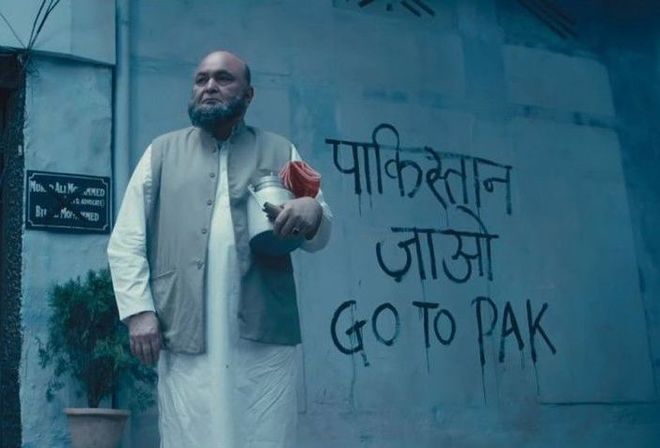
Apart from misinterpreting and prejudices against Muslims and Islam, at the end of the 1980s, an aggressive right wing fascist movement began taking shape. A new narrative was being constructed in Hindi movies which started seeing civil Muslims as suspicious and their engagement to prove their love for the country. Many Hindi films wear the suspicious lens and then portray the character of Muslims. And because of this lens, characters like Murad Ali Mohammad (Mulk) and Kabir Khan (Chak de India) always struggled to prove their love for the nation.
Kabir Khan in chak de India loses the match with Pakistan. The moment in sportsmanship he shook hand with a Pakistani player, he got labeled as a traitor who should go to Pakistan and be hanged. He had to leave his house where he belonged and had been living since generations. He then waited for an opportunity to prove that he is an Indian and then he took the charge to train the Indian women’s hockey team which cannot do anything except household things according to the Committee. But he trained the women’s team and finally they won the world cup under his training. In between he faced many criticisms and then he says “Lekin tumse haarne ka afsos nahi hai mujhe. Afsos is baat ka hai ki main apne mulk se haar gaya. Jisko mera khoon pasina dil jaan dekar bhi yakeen nahi hota ki main uski team se khela tha aur zindagi bhar uski team se hi khelta rahunga. (The regret is not that I lost to you. It’s of losing to my country, which refuses to believe that I played for her and will continue to play for her).
Murad Ali Mohammad’s nephew young Shahid in Mulk executes a bomb blast in a bus and gets killed in a police encounter. His family in Varanasi faces a social boycott and is even charged with abetting the terror act. He refuses to accept the dead body of his nephew. In court when the Hindu public prosecutor whose hate for Islam clouds his arguments in court with the data of social-media and demanding the love for India from Murad. The whole court turn towards Murad to prove his patriotism and then after losing hope he asked his daughter in law who is Hindu to fight for him “Tum saabit karo mera pyaar mere mulk ke liye warna mai ye bahas haar jaunga. ( You have to prove my love for my country otherwise I will lose this debate ). Murad has to prove his patriotism not just to the police or the legal system, but also to his own friends and associates.
Bollywood has the power to change perceptions and expose popular lies because of its sheer reach and in these times of blatant communalism Bollywood needs to play its role in bridging the ever growing chasm between Indian communities. The industry which is known for its liberal and secular views and ideas has though gifted us with some great movies. However, we would like to see more films that promote secular views.
In both the cases Kabir and Murad have to prove their love, loyalty towards the nation only because they chose India over Pakistan. No one ever asked the news reporter and others who blamed Kabir or never asked Santosh in Mulk to prove their nationalism. Films are being made to show how Muslims are‘also’ patriots. My simple question is that why there is a need to prove that; why is it even necessary? Why Bollywood picks stories with Muslim protagonists where they have to prove their love for India and hate for Pakistan? Why Bollywood is not coming with a role of regular Muslim like Farhan Qureshi in 3 idiots (2009) and Iqbal in the film of the same name (2005).