


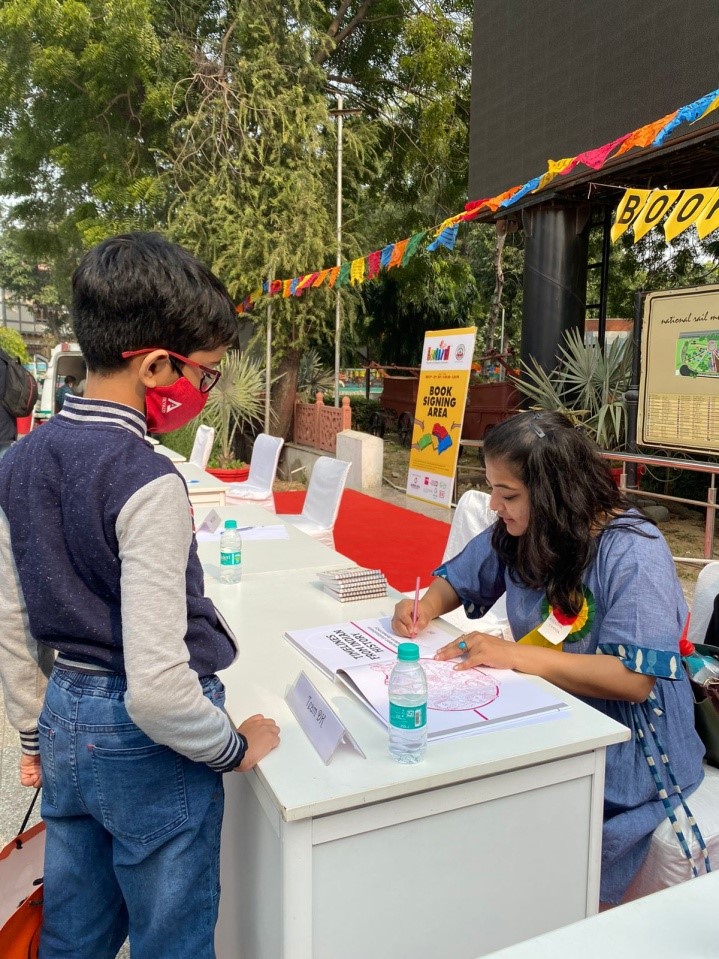
Dr. Anurima Chanda is currently working as an Assistant Professor in the English Department of Birsa Munda College, North Bengal University. Before this, she was associated with the Centre for Writing and Communication, Ashoka University, where among other things she extensively worked with English Second Language (ESL) students and students with learning disabilities, trying to devise teaching modules according to individual needs. She has completed her PhD on Indian English Children’s Literature from JNU. She was a pre-doctoral fellow at the University of Wuerzburg under the DAAD Programme “A New Passage to India” working under Prof. Isabel Karremann. She is also a literary translator and children’s author (published with Scholastic and DK). With her recently published book, ‘Timelines from Indian History: From ancient civilizations to a Modern democracy’, we sat down to converse with her to bring to you this exclusive interview.
Q1) Dr. Anurima, please begin by enlightening us about this new published book of yours?
My latest book, ‘DK Timelines from Indian History’, is an attempt to trace Indian history right from the formation of the Indian subcontinent down to the pandemic today. Aimed at 9-year-olds and above, the book uses full page illustrations, carefully curated photographs, charts, graphs and many such interesting techniques to tell itihaas.
Q2) So how was it that you dealt with Indian History in this book, given that different sources could have different perspectives on certain events throughout history?
The attempt was to stay focused on the ‘story’ rather than the ‘perspective’. Yes, of course, your own perspectives inevitably get tied up to any act of story-telling, but our idea (I say “our” because it was a collective effort – an entire team was working with me) was to keep that as inclusive as possible. This was how we tried to navigate through different perspectives.
Q3) I often wonder why is it that Children’s Literature is still a field that is not being heavily focused on in University research circles, if Children are the biggest asset that tomorrow has, what is your take on it?
I feel like there has been a change in the tide. Children’s Literature is no longer treated as a field that is unworthy of academic seriousness. More and more universities are introducing courses on it and research is also on the rise. Perhaps, the only thing still lacking within Indian scholarship in this field would be a focus on contemporary literature. Otherwise, it is not looking too bad. In just the last couple of months, I have had the opportunity to share my research at a number of webinars (all of them with a focus on Childhood Studies) organised by Universities around the country – from Doon University in the north to Christ University in the south. I was also invited to hold interactive and book reading sessions for children at literary fests and other online events. Even a couple of years back, when I was beginning my research in this area, this would have been unimaginable.
Q4) Why did you feel that Indian history needed this new perspective of outlook to be presented to children, when we already have numerous books detailing our history?
We always look at history as this dry subject, which requires one to remember dates and names. I, myself, was not a huge fan of history as a subject during my school years because of this reason. Therefore, when I was offered this project, I was immediately taken in by the idea of being able to engage with history in a much more fun interactive manner. Plus, the fact that the telling would be accompanied with illustrations, charts, archived photographs seemed like an added bonus. There was also the opportunity to move beyond the usual suspects within Indian history and foreground voices unheard so far. This is what convinced me to take up this book.
Q5) As a scholar, university teacher and writer, what are the challenges you have faced in dealing with Children’s Literature?
Dearth of good secondary material, lack of libraries, poor archiving, lack of funding for research of this kind, a reluctance among scholars/academics to move beyond the classics – oh so many! I remember, I was once denied entry into a notable children’s library for not having a child accompanying me!
Q6) What are the elements that you feel make a good Children’s Literature book? And how far have methodologies come forward and how far do they need to evolve for this genre?
The category of Children’s Literature, as we understand it today, is a western import. This could have a homogenising effect, especially while representing childhoods from other culturally divergent regions like say India. In addition to that, the element of appropriateness that dictates this genre can also be very limiting by erasing out multiple voices that do not align with the mainstream idea of childhood. For me, good children’s books are those that can transcend such impositions and be representative of different childhoods. In the west, such a new-realist shift was noticed from the 1980s onwards. In India, this shift is fairly new – say the last 20 years or so – mainly championed by these small independent publishing houses who have used the changing market dynamics to their advantage to tell tales of different childhoods. The principal buyers are still unsure about such experimentation with these new voices, but at least the change has started.
Q7) What would you suggest young readers and scholars in terms of reading and creativity that they should explore?
To move beyond! Beyond ‘Amar Chitra Katha’, beyond Ruskin Bond’s works, beyond the Enid Blytons. This is not to say that we have outlived them, but that there is so much more that remains to be explored and must be.
Q8) Who have been your own role models both academically and in writing?
There have been so many wonderful people who have inspired me in this journey, both academically and creatively. My friend Teesta Guha Sarkar (currently with Pan Macmillan) who introduced me to the new works happening in this field, my supervisor Prof. GJV Prasad who has been so encouraging throughout, and fellow academics working in this field. I have also been greatly inspired by these contemporary authors and publishers, who are doing wonderful work and who have informed much of my vision as a children’s author. One of them would be Shals Mahajan, whose Timmi in Tangles (2013) never fails to make me laugh. The matter-of-fact fun way in which she tackles the issue of broken families, is something I can only hope to emulate from. I would also like to mention Anushka Ravishankar and Sayoni Basu (founders of Duckbill Publishing House, now Penguinsters) – people I will stay eternally indebted to – for not only expanding the horizons of Indian English children’s literature by experimenting with issues that have so far been considered as taboos within the genre but also for being so generous towards young writers like me.
Q9) What other projects can we hope to see from you?
All the next couple of projects I am working on are translations of Dalit texts – Bengali and Marathi. These voices, which have mostly been relegated to the margins, tell tales of an alternate history that most of us are unaware about. That’s why I am so excited about these forthcoming releases!
Q10) How can one stay updated with books and events revolving around you?
While I do not have a personal web page yet, I try to stay as active as possible on social media. That’s one of the best ways to stay updated about my books. My publishers too are really active in this regard. Most of the time, they are the ones taking a lead in this by organising promotional events and other such interactive sessions that help spread the word around. So, one can definitely look out for those.