

India has a problem with racism. It suffers from it and it practises it.
In a map of a survey released last year by The Washington Post, India was ranked as one of the most racist countries in the world.To be more precise, I would refer you to two such incidents which have just occurred in our country.The two recent incidents against people from Africa which came into limelight from social media have deeply disturbed many. The brutal incident of beating up Nigerian residents and vandalising their cars and Kenyan woman dragged from cab, beaten by locals in Greater Noida have rightly generated much condemnation on social media. Such incidents of discrimination based on racial grounds must not only be condemned but also must be strongly flagged to enable serious deliberation on why such discrimination occurs frequently even though such acts are not permitted by law. Most of the time, this kind of momentary outrage dies down without any serious enquiry into the rampant persistence of racist abuses. Let’s focus on the two incidents to see what really happened with them:
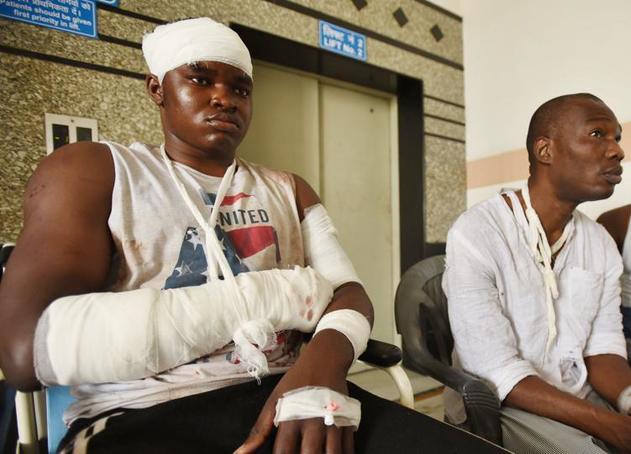
First incident: Following a candlelight protest march for a 17-year-old who died las Saturday, four Nigerian students were attacked and severely injured, as locals alleged that the boy died after the Nigerians forced him to inhale drugs. “I got off the auto rickshaw and seconds later a mob attacked me. They beat me up with sticks. I don’t know what they were saying. I lost consciousness for sometime and vaguely remembered how police brought me to the hospital,” said Imran. Imran is among four of the nationals who were attacked allegedly by a mob at Pari Chowk and the adjoining Ansal Plaza mall.
Second incident: A young Kenyan woman was allegedly assaulted by locals in Greater Noida on Wednesday, police said, the latest report of violence against Africans from the region this week. The woman, identified by police as Maria Burendi, alleged she was dragged out of cab, slapped and beaten in the abdomen without any provocation by the locals near Alstonia Apartments in Sector 1&2.
Union Minister of External Affairs Sushma Swaraj who immediately ordered a probe into the matter and Uttar Pradesh Chief Minister Yogi Adityanath have assured of a fair and impartial investigation into the matter.
Meanwhile, a group of African students demanded protection in India claiming that the beating up of Nigerians was an incident of “hate crime”. They alleged that the incident was fueled by local youths who do not want Africans in their areas anymore. Samuel Jack, President of Association of African Students said that these incidents created an issue of safety concerns for African students who may not want to come to India for further studies anymore.
Today, in the era where we talk about globalization and modernization these kind of incidents bring a feeling of shame in our hearts. Still the minds of people are somewhere fixed in race, caste and religion
Need for Social Movement :
Many people claim that strong anti-racial discrimination law will eradicate this problem. However, strong laws can give protection to persons affected by these acts but it cannot eradicate underlying social malaise. All that law and redress mechanism can do is to create a strong deterrent to racist behaviour but it cannot generate the much needed consciousness which can ultimately bring change for the greater good. It doesn’t mean that such laws are not desirable but its limitation is that it will only act as a preventive measure rather than eliminating the cause itself. Hence, there is a need for a vibrant social movement on the issue of racism which challenges this unequal social relation.
No one is born a racist, but it is the norms/behaviour which society inculcates in a young mind that gets reflected in her/his daily social interactions. So, if such a behaviour can be learned then it can also be unlearned. There lies the role of a strong social movement which challenges this unequal power relation and can sensitive and bring consciousness among the population against racism. We need to collectively embrace this vision of a racism-free society but the lack of a strong social movement against racism in India has negated all possibilities to generate such awareness. Occasional cases of scattered and short-lived outrage are bound to fizzle out. Social problems can only be addressed through collective social efforts. So the option left is to raise our voice and fight against it collectively or remain silent and suffer this discrimination forever. The choice is yours!