

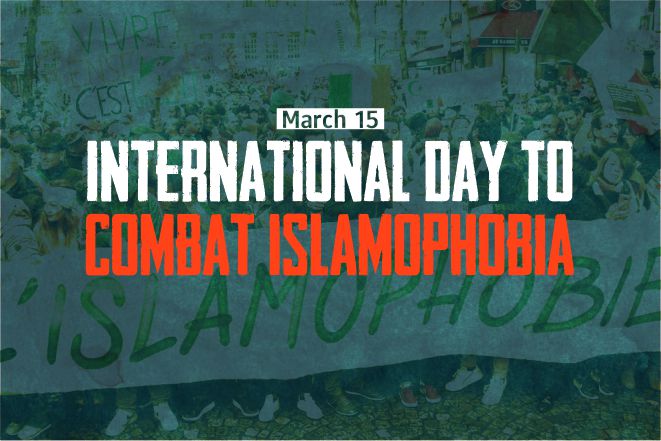
The United Nations has called the world to observe Anti- Islamophobia day every 15th of March from now on. This was considered by the UN after the proposal submitted by the Organization of Islamic Co-operation (OIC) to observe it on March 15 as it was on this day the Christ church masjid massacre in New Zealand was held. The resolution was supported by 140 countries.
It is important to note that the Chief Minister of Tamil Nadu MK Stalin put his word out through social media “History is replete with odious acts of discrimination & persecution of minorities that remain a blot on Humankind. On International Day to combat #Islamophobia, let’s resolve to fight the systematic oppression of minorities & protect their rights in line with constitutional values”.
The Indian government on the contrary refuted the resolution and did not acknowledge it on International Islamophobia day. Many international personalities have condemned Islamophobia on public stages. But why does this proclamation stand apart is it because an international organization has recognized Islamophobia as a problematic phenomenon that otherizes Muslims racially, ethnically, and culturally on the basis of religion?
It was after 9/11 that the marginalization of Muslims gained a greater pace, followed by the inaction of the “War on terror” by the US. 22 years since 2001, the US is still running occupation over Muslim lands in the name of fighting terrorism.
Islam and Muslim bodies were restricted to the definitions of the west. “War on terror” was an excuse to exercise power on the Muslim lands and to curb their economy. Along with it, we also saw Islamophobia gaining the audacity to question the very existence of Islam and to undermine its moral base as well. All these summed into a kind of prejudice that was very much particular against the Muslim bodies. From there on, we saw many hate campaigns against Muslim identity, nationality, etc. The countries that are considered Muslims had gone through a political crisis due to some serious internal disturbances. Those Muslims who were and are a minority witnessed serious communal backlashes and various forms of ethnic cleansing. To get the broader picture, one may look into the experiences the Muslim ummah had to face in these years. It is here we find the significance of the call to observe Anti-Islamophobia day.
In the “Guidelines for Education on Countering Intolerance and Discrimination Against Muslims” published by UNESCO in 2011 to address Islamophobia through education, they refer to Islam as a “broad cultural heritage and framework in which someone was born”, and somehow puts that the phobia is towards the possessor of the aforementioned “cultural heritage” but looking from the experiences of the Muslims and Islamism, we see that the phobia does not rest at the cultural heritage. It also spreads over the very framework of the spiritual ideology itself. As Muhammed Asad puts it in ‘Road to Makkah’, the values of Islam are close enough to those of the West to constitute a potential challenge for many Western concepts of spiritual and social life.
Anyways, the proclamation has brought the idea and debates over Islamophobia into the limelight once again. It’s a fact that the United Nations is still within the hold of the US and lacks actions that go beyond her likes. Nonetheless, as an organization that has participants from almost all countries, the recognition of the existence and dynamics of Islamophobia will again bring the debates over Islamophobia to the forefront.
The Author is currently pursuing his bachelors in History at Hindu College, Delhi University.