

The whole fiasco began in suburban Kanpur earlier this month. During the Eid-Milad-un-Nabi procession in Rawatpur, local Muslims put up a banner with the words “I Love Muhammad ﷺ.” For them, it was a simple act of piety and a public affirmation of reverence during a festive season, which no one in their right mind would think could orchestrate a national issue. The banner was, however, torn down by the authorities, and an FIR was filed with about two dozen people criminalised.
The heavy-handed response gave the words a life larger than intended. Millions of Muslims across the country began sharing a template of the same slogan on Instagram and other platforms. What was once a single poster in Kanpur was suddenly replicated in millions across social media. An insignificant event that would not even cause headlines in the very town it happened became national news and a matter of importance for millions.
On September 9, Kanpur police registered a case against 24 people, nine of them named and fifteen unnamed, alleging that the banner was unauthorised, that a tent erected alongside it obstructed the route, and that posters belonging to another community had been torn down. The charges invoked were those of “disturbing communal harmony.” No violence had occurred, yet the state deemed it necessary to criminalise an act of festive devotion. This cannot be a neutral enforcement of the law but is selective policing that transforms a minor expression into an offense.
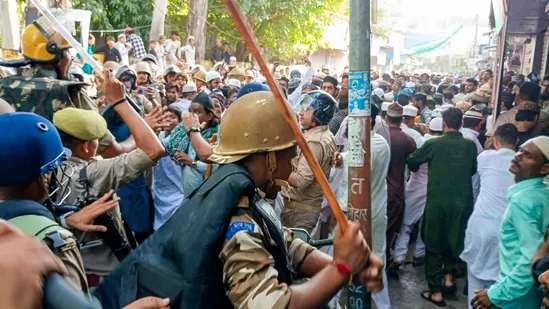
The escalation since has been far out of proportion. The Association for Protection of Civil Rights reports that more than 1,300 Muslims have been booked in 21 different cases, with at least 38 arrests. The majority of the bookings and arrests have taken place in Uttar Pradesh. In Bareilly, police action to remove similar banners triggered stone pelting and baton charges on 26th September during a protest march after Friday prayers. In Davanagere, Karnataka, the presence of a flex banner led to clashes. In Uttarakhand, police used facial recognition to identify and punish the demonstrators.
AIMIM chief Asaduddin Owaisi criticised the police actions, pointing out that love for the Prophet ﷺ, a core tenet of Islam, cannot be equated with a crime and that punishing Muslims for a peaceful expression exposes the majoritarian bias of the state authorities. His words echoed the sentiment circulating among Muslims online: if such a phrase can be punished, then the very right to religious identity is at risk.
The explanation lies in the broader political climate of contemporary India. Over the past decade, the ruling party and its ideological machinery have learned to thrive not on governance but on a perpetual atmosphere of communal mobilisation. The most trivial issues are deliberately magnified to sustain the impression of a civilisational struggle. A banner, a slogan, a choice of food or dress—each becomes raw material for political frenzy and a manufactured competition of sorts between the two communities.
This banner controversy exemplifies that very design. By criminalising something so small, the government sends two messages at once: to Muslims, that their public expressions of faith are always in suspect; to the Hindu majority, that the state is vigilant and will keep Muslims “in their place.” The law is not applied to protect order but to manufacture an enemy and otherize an entire community.
This method is not new. From the policing of Friday prayers in Gurugram to campaigns against halal meat or hijabs in classrooms, the script remains the same: take a minor Muslim habit or action, magnify it as a challenge to majority comfort, and unleash state machinery upon it. The Kanpur banner case must be understood as part of this continuum.
The consequences go beyond arrests. Such incidents foster a climate of fear, where Muslims learn to censor themselves and mould their way of living in anticipation of harassment. The message is that even an expression of love, fundamental to one’s religion, can be turned into a crime. It is this atmosphere that keeps the communal frenzy alive, serving the ruling party’s larger project. Instead of debating unemployment or inequality, public discourse remains consumed by symbolic controversies that pit one community against another.
What is striking is how efficiently the machinery works. A local issue in Kanpur is picked up by sympathetic media, amplified on social networks by right-wing groups, and echoed by politicians who frame it as an assertion that must be checked. By the time arrests are made in Karnataka or banners removed in Uttarakhand, the original event, or its intent, barely matters. What matters is the narrative: that Muslims attempted something new, that it was stopped, and that order was restored. It is a cycle designed not to resolve disputes but to constantly generate them.
India’s tragedy today is that politics no longer requires real provocations to sustain communal mobilisation. Even the most insignificant gestures are inflated into existential threats. A banner was never a challenge to law and order. It has been recast as one. The problem is not the phrase or the procession but the deliberate choice of the state to turn it into a looming controversy and feed it into the machinery of hatred.
The repression in Bareilly has ignited fierce criticism from political voices and clerics alike. Kairana MP Iqra Hasan observed that while offensive remarks might invite dispute, affirming love for the Prophet ﷺ—who stands for peace and brotherhood—should never be treated as a crime. She warned that such authoritarianism exposes the government’s disregard for constitutional rights rather than silencing believers. That disregard was on full display when police brutally lathi-charged Muslims who had peacefully gathered to submit a memorandum, injuring several, including children. The subsequent arrest of prominent cleric Maulana Tauqeer Raza, detained alongside seven others and branded the “main conspirator,” only deepened the sense of injustice. It has been reported that he is being shifted to Sitapur jail where prominent leader Azam Khan spent 23 months. With 11 FIRs filed in Bareilly alone, the state has turned a devotional expression into a law-and-order spectacle of intimidation.
Anything done by a Muslim can cause disruption, and trigger surveillance and harsh punishment. It is not social order that is being defended but a politics of hate that is being institutionalised. This issue has been inflated into a chaotic spectacle and a tool for harassment. This inflation is the real story, and it reveals the deeper truth of India’s present condition: the easiest way to keep the communal fire burning is to treat even the smallest Muslim gesture as a threat.
Until this pattern is recognised and challenged, the cycle will continue. Each time it will be a different issue, perhaps more insignificant than the last. And each time, the purpose will remain the same: to remind Muslims of their vulnerability and to reassure the majoritarian masses that the state is firmly on their side.