


I was a semester into my bachelors program in a liberal college run by Jesuits (a religious order of the catholic order). One fine morning as I was gallivanting around the campus with a few friends my father rang my phone and asked me to meet him at the professor’s staff room. I was astonished to see him there and it is then that my father told me that my class mentor had called him up and asked him to meet her. A little later my professor showed up and asked my father to take a seat and she herself sat adjacent to him. I stood simply astonished on why she would call him out of the blue and curiously waited for her to speak.
My professor then told my father that I’m a very ‘conservative, patriarchal and misogynistic’ individual who still stood by dark age notions such as the hijab. She kept rambling on my about such things and that is when I noticed that my father had a smirky smile on his face as he set his gaze fixed on the wall of my professors’ cabin. After she was done, my father said pointing to a portrait of Mary, carrying Jesus that hung beside her “My son is just a huge fan of the dress code that Mary dresses by”. Now a blushing smile consumed my professors face as she stood confused and muzzy.
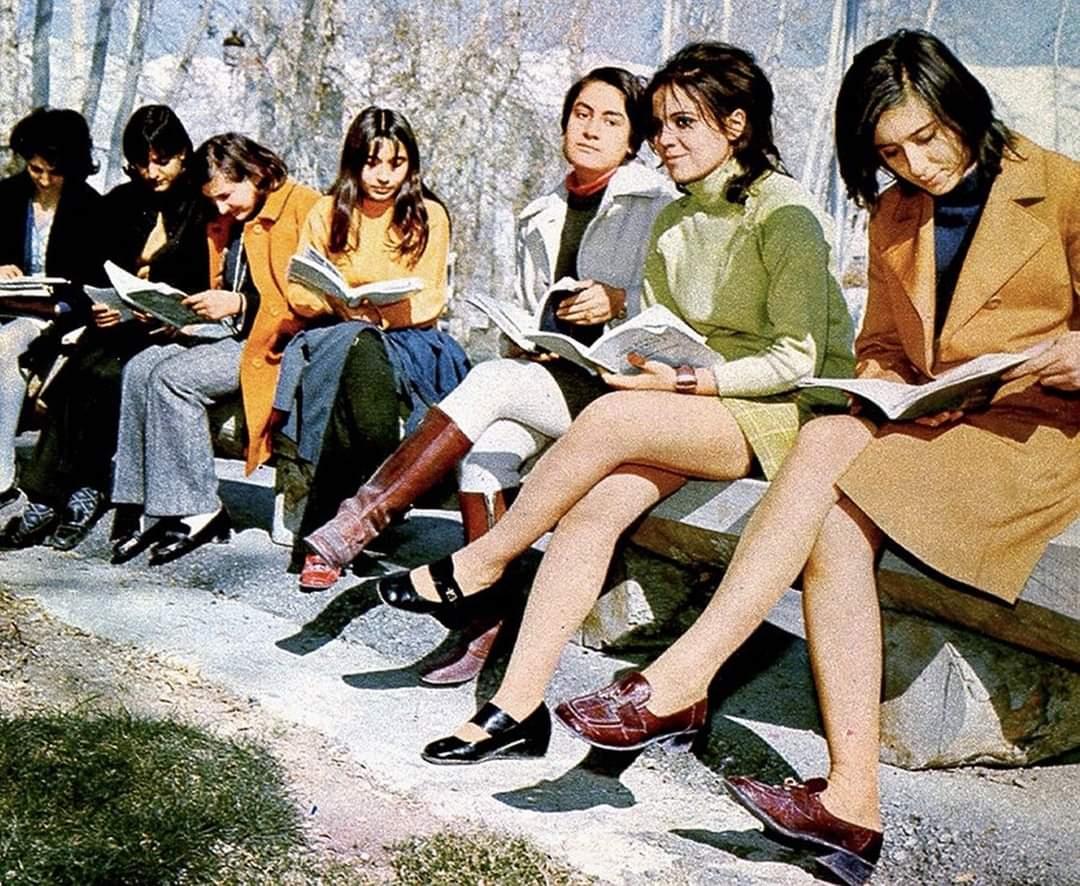
The intent of this narration is not to stereotype or demean any individual. It is simply to put forward the notion that liberalism in its nature is not all encompassing as it may seem but rather carry its own definition of ‘freedom and choice’. A mere glance at the western media would tell you that the hostility with Iran is not about the police brutality but relatively with the term ‘Islamic Republic’. Photos of women prior to revolution studying in skirts were featured by the BBC as if to imply that post the revolution mandate on hijab was a hindrance to the educational progress of women.
The death of Mahsa Amimi has sparked protest across Iran. Some women went on to burn their hijab and cut off their hair in protest. A global churn has erupted supporting the protests. However, after Friday prayers on 23rd September, thousands gathered rallying in support of the government.
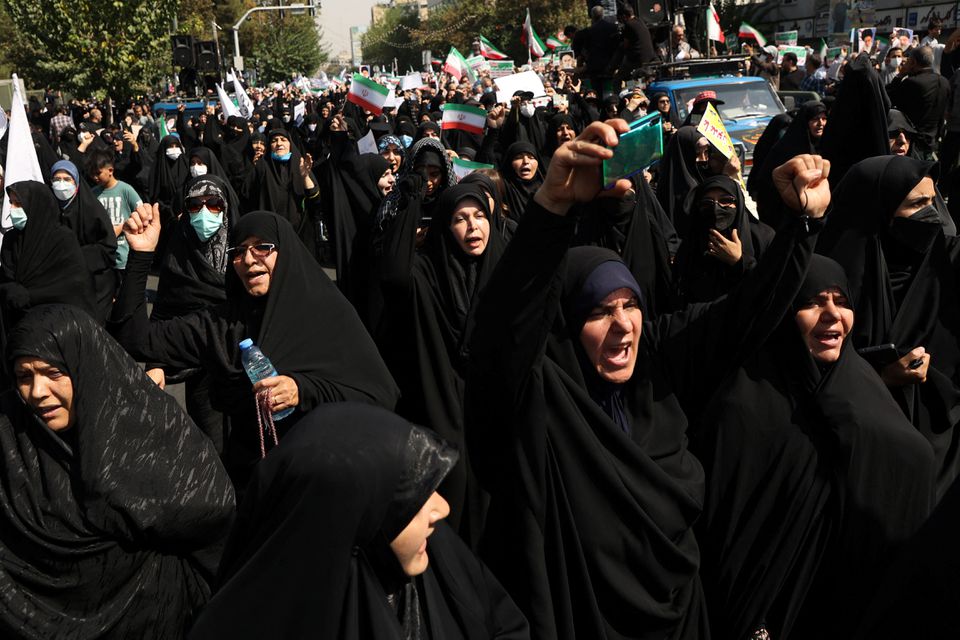

Nevertheless, a lot needs to be addressed in the slides of Hijab, Morality, Choice, Islam and Iran. To address this topic one needs to dive into the background and geo-politics of Iran and the theological understanding of the Quranic verses addressing the issue of hijab.
The Iranian Revolution and Women
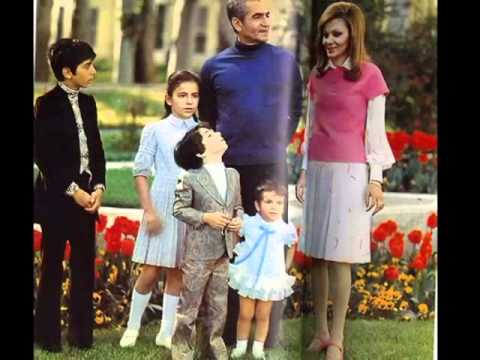
In 1953, Iran’s democratically elected leader Mohammed Mosaddeq was overthrown by a coup; orchestrated by the CIA and British intelligence. He was then replaced by a sycophantic dictator Reza Pehlavi also known as the ‘Shah’. A puppeteer for the US just like his monarchial father before him who had imposed the Kashf e Hijab in1936. A coerced ban on the hijab was implemented in Iran following on the footsteps of Ataturk. The shah would even attend graduation ceremonies with the queen and his daughters wearing a skirt to promote a European model of ‘Women liberation’. The west rallied behind the shah and cheered him in this project of Neo-Colonialism.
In 1979 Iran immersed into something that would change the course of history. Imam Khomeini had overthrown the shah’s regime to bring about the Iranian revolution. He called upon women to actively participate in the movement and had supported women who came in hijab to express their disgust with the Shah’s licentious policies. He went on to say “You ladies here have proved that you are at the forefront of this movement. You have a great share in our Islamic movement. The future of our country depends on your support”.
During an interview soon after the Iranian revolution, Khomeni said “Women have taken part in the recent struggle in Iran to the same degree as the men. We will give women every kind of freedom, but we will prevent [moral] corruption and, where this is concerned, there is no difference between men and women.”
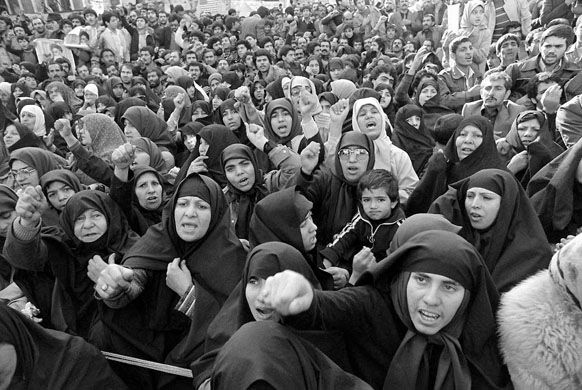
In 1981, two years after the revolution, the hijab was mandated to be worn in public. While there are different manifestations of hijab across the globe as Islam integrated through various culture, the Iranians adapted the ‘chador’ (A long shawl wrapped around a person). It has ever since evolved with time.
Throughout the Middle East, Arab spring could not produce a single successful revolution that could last even a decade. And yet Iran is the only country in West Asia to have brought upon an Islamic revolution, sustain and survive the economic sanctions from the US and the rest of the world in general. It has withstood the US embassy crisis, Iran-Contra scandal, its passenger plane being shot down by the US in 1988, Iran-Iraq war and the recent assassination of Qasem Suleimani. Iran is a country that needs to be admired and commended for long withstanding attempts from the west and Israel to destabilise it.
While the success and promises of the Iranian revolution maybe debated, Iran’s social parameters indicate that women empowerment has scaled up since 1979. Sex ratios to literacy rate of women are far better than that of a country like India. Women occupy over 16% of the work force and play an active role in the society.
Islam, Hijab and its clash with Modernity
The word Burqa or Hijab is not inscribed in the Quran or the sayings of the Prophet (Ahadith). After the establishment of an Islamic state in Medina, the Quran primarily addressed the men to lower their gaze (to not look at women with lust) in order to mend the manners and etiquettes of gender interaction in society. The Qur’an then addressed the women
“And enjoin believing women to cast down their looks and guard their private parts and not reveal their adornment except that which is revealed of itself, and to draw their veils over their bosoms, and not to reveal their adornment……” [25:41]
The word used in this verse is ‘Khimar, which was traditionally a cloth that Arab women would hang backwards from their hair. The verse commanded that women would use the khimar to cover their bosoms and head.
Almost all across the globe, women used to cover their heads while entering places of religious worship. While modernity may have eradicated this practice, it still persists. I visited an English church whose attendees were relatively modern and wore short skirts. A month or two later, when I visited it again, a board at the entrance read “You are in the house of God, please dress modestly”. While most religion have confined modesty to religious places, Islam does not. Modesty is a virtue that is quite central to Islam and it is why men and women were directed to adapt certain virtues for a peaceful co-existence in society.
While many believe that the purpose of hijab is to confine women to homes, it is quite the opposite. The very purpose and nature of the verses with regards to hijab was to address the fact that women would play an active role in the society. If women were to be confined to their homes, there would be no need for the hijab.
Hijab is a dress code and a code of conduct prescribed for Muslim men and women to function in society. While the Hijab is a symbol of submission to God, it also has socio-political implications in society. Hijab symbolizes modesty and dignity.
In the age of globalization and an era of clash of civilisations, the western (modern) style of dressing has engulfed the culture and lifestyle of all civilisations. Now civilzations from the Japanese to the Chinese adhere to the western norm of dressing; the only one in agitation against it is the Islamic civilization holding onto to the Hijab. The veil in times of imperial feminism is a wall to the waves of modernity that seeks to objectify women.
The friction between Hijab and modernity dates back to colonialism. This is what Edward said termed ‘Imperial Feminism’ in his book ‘Culture and Imperialism’. He defines imperial feminism as “the phenomenon as part of “Orientalism” that claims European scholarship, culture, and society have perpetuated stereotypes about non-Western civilizations’ culture, practices, and society as morally depraved and backwards in order to establish control over them”. A resurgence of imperialist feminism can be witnessed in the invasion of Afghanistan, when the US announced that it was going to ‘liberate women from their veils’ in Afghanistan.
The Dilemma of Choice
The intermingling of morality and choice is a complex knot. All institutions in the world adhere to rules and regulations. In work place and universities, one is bound to a code of conduct pertaining to dressing, fashion and in general domains attributed with human behaviour and interaction. Let me demonstrate this phenomenon through an example:
Suicide by all rights should be legal. Because it is the choice of an individual to do so with one’s life as they please. The state has no business interfering in the choice of an individual who can decide whether his/her life is worth living anymore. There is no moral justification to criminalize or even call it wrong. However, it is religion that entails that life is given by God, and one cannot take matter into his own hands. If choice is the central basis for all decisions and rules and regulations are hurdles to it, then we descend into anarchy.
Note: This is simply an example to ascertain the complex relationship morality and choice share and in no way intends to support suicide.
The state of Iran is an Islamic republic and it is well within its constitutional bounds to enforce a dress code for men and women. In Germany, women can go topless in public pools. In Saudi Arabia women have to wear dresses that cover their bodies from neck to knee bare minimum. In France, men and women are not allowed to dress in a manner that would assert one’s religious identity. These are dress codes instigated within the rules and regulation of the state’s institutions.
Feminism seeks the emancipation and liberation of women by primarily eradicating the concept of femininity. From chopping of hair to the abortion rights movement is testimonial to this phenomenon. And yet it is why feminist in the west despise the hijab. There are 16 countries that have enforced a ban on hijab and 2 that have enforced the hijab. Among the countries that have enforced a ban on hijab are Austria, China, France, Denmark etc; countries that are the epitome of freedom and enlightenment.
Misinterpreted and Misrepresented verse:
One of the verses floating around that is widely misrepresented is:
“There is no compulsion in religion. Verily, the right path has become distinct from the wrong path”.
These verses were revealed soon after the Quran narrates the war between David and Goliath. This verse was revealed to discard misconceptions that Islam seeks war against the unbelievers. It indicates that Islam cannot be enforced upon non-Muslims by force or in other words it prohibited forced conversions.
However, once an individual has come within the fold of Islam, one cannot cherry pick his likes and dislikes on the ordains laid by God.
Conclusion:
The death of Mahsa Amimi is to be condemned to the highest order. Police brutality is an act of oppression, irrespective of the reasons or even if one is guilty or not of any serious crime. One cannot be criminalized for not ‘wearing the hijab properly’. In an Islamic state hijab is a code of conduct for both men and women that needs to be implemented. Not abiding by it must be dealt with advice, teaching and education. Throughout the world law and order is the means to maintain public decorum and any violation of is resulted by a fine. Public urination, littering, spitting in the road or immodest dressing are all violations that come under the same scale in an Islamic state.
Gasht-e-Ershad to what the western media has called ‘morality police’ is simply translated as ‘guidance patrol’. The primary task of this force is ensure that dress code and moral conduct is abided by both men and women. Moral values in a society needs to be instituted through education and not through force. Abiding to methods of imprisonment and torture is un-Islamic and needs to criticized. In a legal language, not wearing the hijab is a civil violation not a criminal one.
Islam envisions a society that is coherent and peaceful. It implements its rules and regulations to dignify and uplift humanity while modernity demeans the dignity of women. It is as Nobel Laureaute, Tawakkol Karman says “Man in the early times was almost naked, and as his intellect evolved, he started wearing clothes. What I am today and what I am wearing represents the highest level of thought and civilisation that man has achieved, and is not regressive. It’s the removal of clothes again that is regressive back to ancient times”.