

NO SPOILER ALERT!
Midst the ongoing bouquets, brickbats and overflow of controversial responses, Mahesh Narayan, the director of ‘Malik’ recently said in an interview that he feels to repeal the movie. In an interview to Madhyamam online news portal, he revealed that he is suffering a great deal of criticisms adding up the mental stress that he even considers to take back the film. While the list of facts and fabrications is discussed, the lives of victims still bore the history unleashed at Beemappalli 11 years ago. And as we once again witness the truths in their countenances, it’s not too late to realize that Malik has somehow occupied our hearts already, a pure occupation of art in its truest sense. Though the film has untouched many of the underlying truths, it has succeeded in audaciously representing an unsung history which has been suffocating between communal and state narratives.
Beginning in media res, Malik features the tension and curiosity from the beginning to the end, freezing the audiences who are intermittently thrown to a series of prototypical breakdowns. To mention at any cost, as a fictional narrative which can be ‘fair to the brim of bias’, Malik has revealed the unseen and unsung albeit indirectly and sometimes not at all. The police firing on May 17, 2009 at Cheriathura, a coastal region in South Kerala claimed the lives of 6 men and injured around 52 for lifetime.
The region inhabits Latin Catholics and Muslims, both minority communities whose sole life saver is the sea. At this juncture, parallels can also be drawn from the history of India. When the need of a conflict between minority communities was the primary aim of colonial occupation or more precisely after independence, the need came into the annals of power politics. On the same grounds, the praxis of Malabar revolt was once again applied to the Praxis of incessant random police firings foreshadowing the claim of Communal riots.
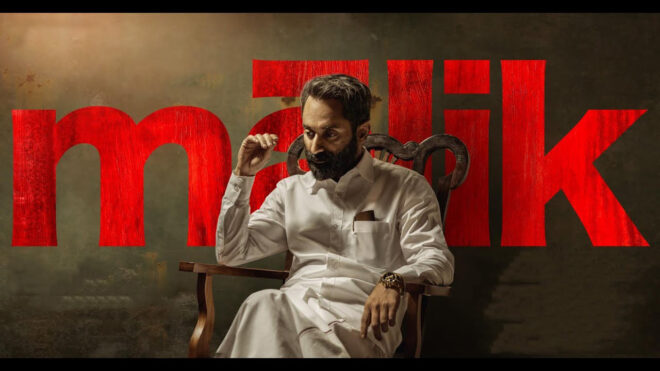
Malik undoubtedly will have an inevitable space in the Malayalam Movie industry, with its heroic version and strong women characters who takes the lead and course of the movie. The protagonist Ali, played by Fahad Fazil is neither a villain nor a hero, but is portrayed as an accidental victim, an accidental hero and villain at the same time, which coldly breaks the right and wrong notions of the status quo.
The prototypical breakdowns are the significant highlights in the film to which we are not focussed on judging the good and bad, blurring the line demarcating orthodox and liberals. Yet, the inclusion of communal symbols and the calling of ‘Allahu Akbar’ is seemed to be inalienable at a communal misuse of power and terror. Roselyn, Ali’s wife and Jameela, Ali’s mother can be sometimes viewed as balancing characters of both the communities. Nevertheless all women characters including Roselyn and Jameela, have an unwavering sense of boldness in responding to the setbacks. The choice of post modern narrative to the women characters is a remarkable step unlike the typical conception of women especially from marginalised regions who are often portrayed as the ‘brooding’ and ‘wailing’.
On the other hand, Malik blindly leaves aside the role of the then D.G.P Jacob Punnoos who openly supported the firing, Home minister who did not want to arrest the infiltrators. District collector Sanjay who openly who was found to direct the firings is portrayed as a mediocre official, an understanding character and a victim himself. The depiction of the region as the hub of illegal activities and communal sensitivity remain unchanged but to an extent outlives the fictional plot brilliancy.
Eventually, when Malik culminates in the dramatic irony where audience realize the play of communal politics, the film leaves an open end to many of the unanswered questions and perhaps to the real malik, the God. But none of the ends underestimates the temperament held by Malik, even when Ali fall down as a tragic hero. As a fictional narrative which has to confiscate its power upon a protagonist and at the same time focuses on the incident and its seminal causes, Malik is a breakthrough to the forgotten history, to the courage to slip over the status quo, to the literary leanings and to definitely find its voice at a time when the gratification at the beginning of a film has to be given to a Chief Minister of the same ruling government when the incident happened.