

Last summer, the day following my last day of internship at Lucknow Bench, Allahabad High Court, I stood outside the gate of that “temple of justice” waiting for my certificate that was supposed to be handed over to me by a man who was running this errand for the lawyer under whom I had been an intern for the past few days. I was in my abaya, a lengthy flowing gown worn by Muslim women; that I did not wear in the days of my internship owing to the dress-code that lawyers and interns have to comply with, inside the Court premises. I had followed the dress-code with an additional headscarf throughout the training period. However, when I decided to get my certificate from the lawyer’s chamber I put on the abaya for the fact that I was now going to the Court not as an intern but as a commoner who does not have to go by the dress-code.
So, as I walked past the gate that day just like how I had been doing in the past few days, the guard called me from behind, asked me to stop and started posing questions. Who was I? What business did I have getting inside the Court? What was the name of the lawyer under whom I had been an intern? He then asked me to stay there and ring her up to send the certificate at the gate. As I waited, he continuously kept an eye on me with suspicion (or so I thought!?) I withdrew myself a little away from the gate and wondered: What is so different today? Why only me? After all, I had been walking past the same gate in uniform in the past few days and nobody asked me what business I had getting in. I saw people walking around me walk in and out (in casuals and uniform alike) with nobody stopping them and questioning their identity. What was it that made them think of me not as an intern that had been a regular to the Court but as a ‘suspect?’ I was dressed like one (?) Though I am privy to the fact that trickle-down effect of Islamophobia has empowered bigots on the street to spit at Muslims and get away with it and what I faced was just an inkling of what thousands face each day, what left me thinking is the setting in which it took place. Court of law! Sounds interesting, doesn’t it??
Speaking of law, why call this age an “age of lawlessness?” Just because I saw my right, to step inside the Court regardless of my dress, conferred by law; die an ironic death at the entrance of what is supposed to be a “temple of justice?” I, for one, am not so naïve so as to arrive at such a sweeping conclusion based on one personal experience.
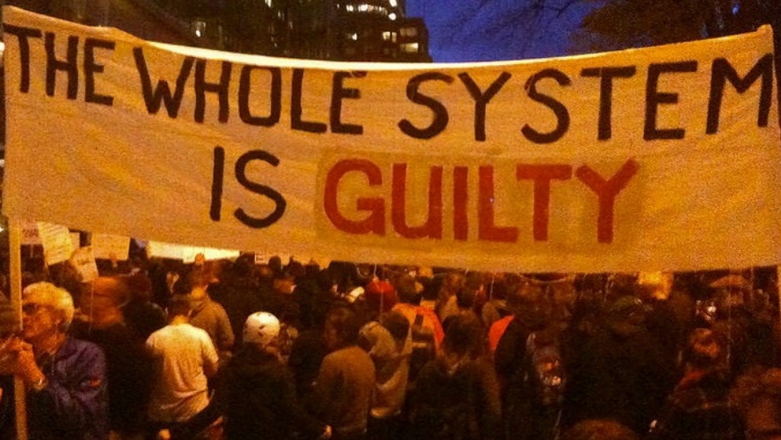
If one explores into the incidents of recent past that have taken the nation by a storm, law seems to have got scant attention. Consider the case of Mohammad Akhlaq who was killed not too long ago by a lynch mob for allegedly slaughtering a cow, an accused of which was draped in the tricolor in blatant violation of paragraph 3.22 of the Flag Code of India, 2002 which states: “The Flag shall not be used as a drapery in any form whatsoever except in state/military/central para-military forces funerals hereinafter provided.” Paragraph 3.58 further provides, “on occasions of state/military/central para- military forces funerals, the flag shall be draped over the bier or coffin with the saffron towards the head of the bier or coffin. The flag shall not be lowered into the grave or burnt in the pyre.”
In the case of Najeeb Ahmad, a student of JNU who was reportedly beaten up before he went missing, it purportedly took as long as twenty days for the police to question the accused persons. Punishment seems to be distant dream even as they are said to have been found guilty by a proctorial enquiry. The recent case of an encounter of eight under trials in Bhopal raises substantial questions of law. Mired in heedless rhetoric with little knowledge to back it up, we often tend to sideline the legal position and ask questions on those lines.
Consider the case of Mohammad Akhlaq who was killed not too long ago by a lynch mob for allegedly slaughtering a cow, an accused of which was draped in the tricolor in blatant violation of paragraph 3.22 of the Flag Code of India.
On the issue of encounters, “a remarkable full bench decision of the Andhra Pradesh High Court recently held, the correct procedure is to first register an FIR against the police officer causing death. If the criminal investigation revealed that the officer had fired in self-defense, a closure report would be filed before the magistrate and the case closed by the magistrate, not the police. If the investigation showed that a case under IPC 302 (murder) was made out against the police officer, a charge-sheet would be filed and the trial would proceed. The crux of the matter was the filing of an FIR against the police officer in all cases of encounter killings… The full bench decision of the Andhra HC was regrettably stayed by the SC on an argument made by the counsel for the state that the policemen who risk their lives nabbing terrorists would themselves face legal proceedings. The argument is more rhetorical than real. If the law mandates that any person who causes unnatural death must have an FIR registered against him and be subject to a criminal investigation where he may take the plea of self-defense, and if the law makes no distinction between a civilian and a person in uniform, then so be it. The irritation caused to a policeman who takes part in a genuine encounter can be obviated by commencing the criminal investigation on the spot, quickly recording the statements of the witnesses, including independent witnesses, and then filing a closure report before the magistrate, who would then close the case. This is a small inconvenience compared to the larger good of the rule of law applying equally to civilians and policemen,” writes Colin Gonslaves in his article “Showing Weak Judgment” (published in The Indian Express, September 25, 2014.)
Furthermore, “the Criminal Procedure Code authorises the police to use force to the extent of killing a person in only two situations — to disperse an unlawful assembly that cannot be dispersed through other means and poses imminent danger to life and property, and to arrest a person who has committed an offence punishable with death or life imprisonment but is resisting arrest. Since this was not a case of using firearms in self-defense, the police would have been justified in their action if they had tried to arrest the fugitives and met with resistance. There is no evidence to show this.” (G. P. Joshi, ‘Getting Away With It’, The Indian Express, November 5, 2016).
Talking of the topic we do not get tired of discussing these days: Demonetization. We have either split it in the binaries of good versus bad in the economic sense or as a political stunt versus beneficial in “larger public interest.” These are all questions of a subjective nature. However, how legal is the step is a question we have conveniently ignored. Indira Jaising, a senior Supreme Court advocate and former Additional Solicitor General of India, broke the ground on November 18, 2016 by laying bare the grounds on which the step is illegal in her article ‘Demonetisation-Strictly, the PM didn’t go by the law’ published in National Herald. She states the following: “While I unambiguously support the policy of removing black—untaxed—money from the hands of those who have it, I question the legality of the manner in which it has been done.
To begin with, let us examine what is the status of the currency we hold in our hands. Section 26 of the Reserve bank of India Act 1934 (“RBI Act”) states as follows:
(1) Subject to the provisions of sub-section (2), every bank note shall be legal tender at any place in 4[India] in payment or on account for the amount expressed therein, and shall be guaranteed by the 5[Central Government].
This means that the money you and I hold in hand or in the bank is a debt guaranteed by the government to us. Currency thus represents a ‘public debt’ owed by the government to the holders of the bank notes, you and me.
The notification issued by the Central Government on 8 November 2016 has been purportedly issued under Section 26(2) of the RBI Act.
Section 26(2) reads as under:
[Government] may, by notification in the Gazette of India, declare that, with effect from such date as may be specified in the notification, any series of bank notes of any denomination shall cease to be legal tender 7 [save at such office or agency of the Bank and to such extent as may be specified in the notification].
The first legal question which arises is what is the meaning to be ascribed to the term “any series” in the above sub-section. ‘Series’ in plain language can only refer to the series number on the denomination of a bank note. Going by this meaning, the government under this power can only scrap the legal tender of a series of a bank note of any denomination.
If the Legislature had intended that the government was to be invested with the power to withdraw the legal status of all bank notes of a particular denomination, as has been done in this case, the use of the words “any series” would be entirely superfluous, and redundant. Hence I conclude that Section 26(2) was never intended to be used as measure of dealing with the withdrawal of black money form the economy, nor was it meant to withdraw legal tender from all bank notes of a particular denomination.
That may have been the reason why previous attempts at demonetization have been undertaken by the Ordinance route, followed by a Legislation. Demonetization of 500 and 1,000 rupee notes by a executive fiat appears to a first of its kind procedure and raises fundamental questions on the authority and jurisdiction of the Executive to do what the Legislature has not permitted.
The matter can be looked at from another angle. Article 300A states that, “No person can be deprived of his property except by authority of law.” Thus a person cannot be deprived of his/her movable and immovable property except with the authority of law.
Demonetization amounts to extinguishment of the public debt owed by the Government to the holder of the demonetised note. A currency note is movable property in the hands of the holder. The Supreme Court has held in a series of judgments that deprivation of property by State jurisprudentially speaking could have three dimensions (a) a ‘taking’ of property by the Government as in the case of land acquisition, (b) it could be in the form of an ‘extinguishment’ of right in the property as happened during land reforms where the tiller became the owner, (c) in certain situations even modification of property rights could amount to deprivation of property.
Interestingly the Supreme Court in Jayantilal Shah Vs RBI AIR 1997 SC 370, while upholding the validity of the High Denomination Bank Notes (Demonetisation) Act, 1978, held that demonetization results in extinguishment of a public debt which amounts to deprivation of property and therefore could be done only by law.
The Notification dated 8 November 2016 thus appears to be entirely outside the law laid down by the Supreme Court. It is completely without authority of any law.
Further, the restrictions imposed by the Notification for withdrawal of legal currency are again completely without authority of law. Section 26(2) of the RBI Act by any stretch of imagination does not permit the Executive to restrict the rights of citizens to withdraw their own tax paid money from banks. The restrictions imposed by the Notification on a person’s right to withdraw from the bank are therefore seemingly without any authority of law.”
A man emerged from a throng of people that was clearly looking for someone. I walked a few steps in anticipation almost sure that he was the one with the certificate. He recognized me by a certain identifier that he must have been told and handed it over to me. As I walked back, I stared at the magnificent building that seemed to echo the words of Justice Holmes, “This is a court of law, young man, not a court of justice.”
And, I agree justice is huge. Can we just expect to see the ‘law’ in action?