


Girls Islamic Organisation(GIO) Kerala is conducting a two day academic event under the title ‘Muslim Women’s Colloquium’ (MWC) on the Muslim women question to facilitate an autonomous conversation of Muslim women and her allies at JDT Islam Campus, Calicut on 25th– 26th February, 2017. MWC is a platform for discourses on Muslim women and this includes discussion on Islamic texts, the politics of Muslim women, the history of Muslim women lives, the experiences of Muslim women from different regions, the socio-political and cultural backgrounds of the Muslim women question, and the analysis of various Muslim social movements
There is a need to interrogate the public discourse happening around Muslim women from different socio-political perspectives. This includes the debates on Muslim women rights, identity formation, issues of representation, etc. On the one hand, there are stereotypes circulating around victimized and suppressed Muslim women primarily by men in their community. On the other hand, there is an idealized representation about Muslim women which argues that they are completely free from the issue of power from her own community. New studies on Muslim women and the activism of the Muslim women social movements have questioned this binary to bring forth a nuanced critical approach for understanding the Muslim women question.
It is only recently that the issue of Muslim women started to receive public attention in this part of the world especially in academic studies on gender. However, during the 1980’s , a number of powerful Muslim women social movements emerged in different parts of the world, and these movements played a significant role in shifting the debates around Muslim women . Girls Islamic Organisation (GIO) in Kerala is also a part of the historical legacy of the Muslim women’s movement that emanates from that period.
The larger context of the knowledge production around Muslim women question is influenced by the postmodern / post structuralist/postcolonial turn in social theory realizing the limitations of the western knowledge politics of gender. The new shift in social theory challenged the way Islam is represented in binaries of modern/traditional, secular/religious, public/private, progressive/conservative etc. These explorations in contemporary knowledge politics have taken the debates forward by analyzing the Muslim women question shaped by the politics of religion, race, class, coloniality, caste, gender, sexuality, region and so on.
In the contemporary Indian scenario, the so called ‘victim position’ of Muslim women is used as a sophisticated tool against the Muslim minority community. In this context, Muslim women need to come out and speak about Muslim women rights without the mediation of the dominant paradigm of knowledge production and the cultural/political elites in the Indian public sphere.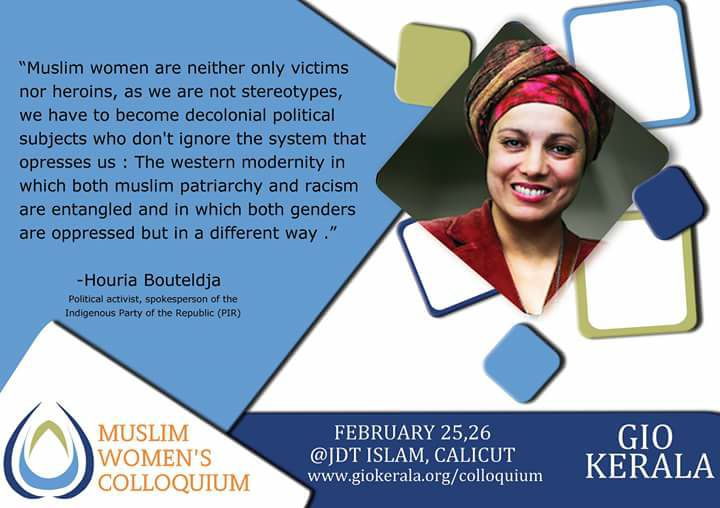
GIO is conducting the programme mainly centred on five themes and they are as follows:
1. Muslimah Theology and gender hermeneutics of Islam
2. Epistemology , tradition and question of authority in Islam
3. Identity and representations of Muslim women
4. Decolonial and critical Islamic feminist approaches in relation to Muslim gender politics
5. Muslim women lives and biographies.
Eminent scholars like Flavia Agnes, Varsha Basheer, jenny Rowena, Sherin B S, Ajith Kumar AS, R Yousuf and Inshah Malik will be addresiing the audience in different academic sessions and research scholars and active learners from different Universities will be presenting their papers in the event. There will be a special interactive session on Muslim Women Engagements in Campus Politics in this new political context in which activists from different movements and university spaces will be participating.
To prepare for the conference, GIO conducted two workshops on June 26, 27, 28 at Al Jamia Shanthapuram and August 13,14,15 at Irshadiya College. Book talks, Table talks, Symposiums and Seminars were conducted in district and area levels in accordance with the main event. GIO is looking forward to a long term engagement with public sphere on gender discourses of which MWC is a mere beginning.
The detailed schedule of the conference can be found here. Schedule MWC