

“ O Romeo, Romeo! Wherefore art thou Romeo?
Deny thy father and refuse thy name.”
“ Belonging to a man. O, be some other name!
What’s in a name? That which we call a rose
By any other word would smell as sweet.
So Romeo would, were he not Romeo called,
Retain that dear perfection which he owes
Without that title. Romeo, doff thy name,
And for that name, which is no part of thee
Take all myself.”
(Juliet to Romeo in William Shakespeare’s Romeo and Juliet)
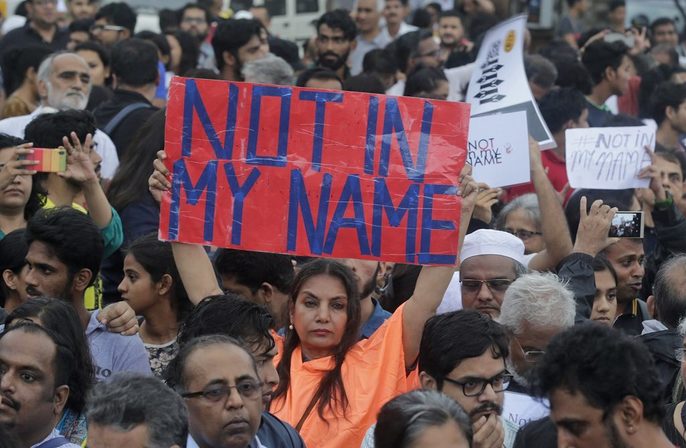
Though I do not know for sure if it is “thoughtless, smug and self-righteous” as Ashley Tellis remarks about a critical piece on #NotinMyName by Rajesh Rajamani, it does point to an identity politics that is not getting us to places that some of us dream of, a Begampura that keeps evading us. Neither is it a new edifice as Ashley calls it but a community of interpreters, activists, and intellectuals who refuse to offer new interpretations of a Brahminical edifice which is not static but dynamic. By we and us, I refer to persons who identify themselves as part of progressive and democratic groups whether Bahujan, Ambedkarite, Left, Left of Center, pro-minorities, secular, queer, et al. or identify as individuals not affiliated with any group who feel the need to end the endless privileges enjoyed by Brahmins and the elites and end the perpetuation of a certain idea which provides them access to power at a time when the oppressed groups are hounded like dogs, as the assault on Adivasis, Minorities, Dalits, and Women are on the rise through governmental and cultural policy shifts, taking place on a larger scale.
Surely, #NotinMyName as a name and event does in certain ways imply an assertion of one’s place in mainstream elitist spaces. This type of naming is indeed veiled and nuanced, but there is a problem to see this as entirely Brahminical and thus absolutely evil. It surely reminds us of erasure and appropriation of the left-dominated public sphere and the taking over of the minimum spaces available for Dalits, Adivasis and trans-persons by secular and liberal Brahmins and those non-Brahmins who subscribe to their privileges by being complicit in their ideas and practices. Whether it is the academia in Delhi, Hyderabad, Madras, Bangalore or the activist spaces in JNU, DU, and HCU that reflect a history of mainstream-left’s appropriation, especially the Rohith’s movement that became diluted or ‘transcended’ into struggles for freedom, democracy, anti-fascism and a (JNU) brand of ‘Azadi’ where any one can dance to a techno number versus the Azadi where your limbs are broken and eyes blinded for being a Kashmiri. Well, that is why and how the appropriation of struggles and names of the struggles, the greed for power at all costs is so costly. Thanks to Brahminism, power is so casually transferred to the status quo from the efforts of Bahujans, obviously not from the efforts of Bahujans alone.
That said, Brahminism tagged to every act of both solidarity and erasure by Brahmins makes the problem look one-sided and attacking a criminal and evil Brahminical ideology head-on can rarely be through a narrow vision of Brahminism. Brahminism is still taken as a static and forever and merely as a reference to the privileges enjoyed especially by the Brahmins, and also the non-Brahmin dominant castes, who are caste Hindus, caste Christians, caste Muslims, caste atheists, et al. of this country.
Let us look into the other version, or rather manifestation of Brahminism. Consider the following Bahujan Samaj Party’s candidate equation of the 2017 Uttar Pradesh (UP) elections. 87 tickets to Dalits, 97 to Muslims, 106 to OBCs and 113 to upper castes (66 for Brahmins, 36 for Thakurs and 11 tickets for other upper caste candidates) and 23 of the BSP candidates had criminal cases against them. Have a look at these surnames in the candidates’ list: Sharma, Verma, Chaudhry, Mishra, Gujjar, Uphadhyay, Chaturvedi, Yadav, Dwivedi, Ahmed, Ansari. So that is, 66 tickets for 10% Brahmins versus 87 tickets for the 21 % SC-ST population in UP.
I could not easily find 15 visible names who could be women in the list. Forget, whether it was a Dalit Muslim woman, Dalit Christian woman or a Scheduled Tribe (ST) woman. Though by default, BSP as a pro-Dalit, pro-ST and a D.Woman-led political party is supposed to provide a fair, rather I should say proportionate representation and participation for Dalit/ST men, especially for Dalit and ST women in the state of UP and beyond UP. If we need to locate Brahminism, then this should be a case of Brahminical privilege decided and implemented by someone who follows the ideas of Kanshi Ram, one of the foremost political thinkers of post-independent India, who worked for the liberation and political power for the Bahujan masses.
Fast forward Dr. Ambedkar and Kanshi Ram saheb’s politics of anti-Brahminism, should we only and often refer to Hindutva Brahmins and Liberal Hindu Brahmins, Savarna Muslims and their actions as perpetuating Brahminism (?) as the most democratic and most radical of the anti-caste intellectuals want everyone of us to believe. Or, do we shift the debates of Brahminism from its static sense to the contemporary equations ? Recording here for the sake of anti-amnesia, it was not so long ago when a Bahujan Muslim intellectual called for cutting off ties with ‘upper’ caste Muslims and stated that “Pasmanda movement believes in engagement and not withdrawal from the state. So they will engage with both the BJP government at the center and U.P”. The Bahujan radicals were in a silent mode on this statement.
Because cow-protectors do not ask you whether you are a Pasmanda Muslim before lynching and when the gau-rakshaks won’t ask whether you are a privileged Dalit before the murder, for eating beef. This is the time to come together, which is the way forward while contradictions among us will often remain unsettled. While I wish the Brahmins to take a sabbatical from their privileges, I ask the critics of #NotinmyName to be generous in expanding the definitions of Brahminism. If we do not stop whatever is possible, that dreadful day is not far when a Dalit who is a Hindu will start lynching a fellow Dalit Muslim because the former was more Hindu than he was a Dalit and the latter was Muslim first and thus a lesser Dalit in the former’s eyes.
It is apt to end with Sudipto Mondal’s words “I am going for #NotinMyName because my name is Sudipto not Aklakh or Najeeb or Bilal. Because no security guard will look at me twice to check if my face matches the photo in my ID. Because I and my people can still slip through acting like we are Hindu when there’s a riot. Because many of my people are still steeped in ignorance and call themselves Hindu. Because a party I love once supported the Sangh. Because I will not let this one be appropriated by people who see a problem with Hindutva and not with Hinduism”