

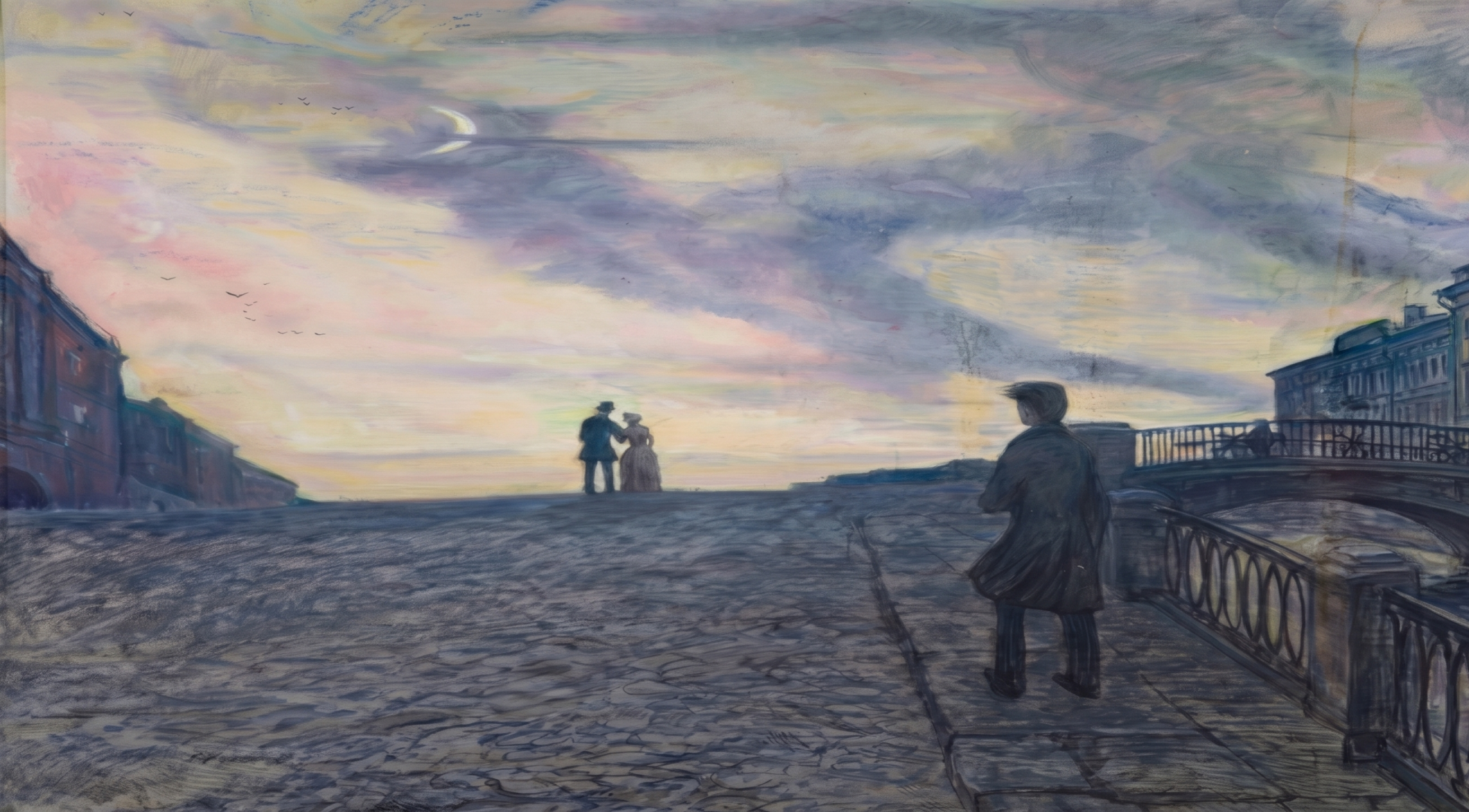
“Her name appears 138 times and he remains unnamed” – a popular reel a romantic reader might come across on their social media page (This number is prone to change based on specific translations and other sources), this reel is in reference to the deeply emotional short story – White Nights and captures, in a single line, one of the story’s most striking elements: Nastenka is given a name, while the man who tells us her story remains simply the “Dreamer.”
White Nights is a timeless short story by Fyodor Dostoevsky that has captivated readers across generations through its deeply sentimental narrative and sensitive portrayal of human emotions through the characters. Written in the first person, the story unfolds through the experiences of its unnamed protagonist, the “Dreamer,” over four successive nights and one morning. His unexpected bond with Nastenka forms the centre of the story, allowing Dostoevsky to explore themes of loneliness, love, hope, and the fleeting nature of human connections. Set against the twilight of Petersburg’s “white nights,” the story’s setting becomes more than a backdrop—it reflects the temporary and fragile nature of the characters’ emotions and their brief encounter with happiness.
The story is written with such vividness and sensitivity that it allows the reader to feel the emotions of the characters as they read along. Not only does this captivate the reader – it connects them to the characters and the setting of the story. It draws them into the characters making the emotions of love, joy, sadness deeply intimate.
The novella centres around the Dreamer, who believes himself to be acquainted with almost every corner of Petersburg, despite rarely engaging in genuine conversation with anyone. He is deeply aware of his own tendency to withdraw into an imaginative inner world and openly accepts himself as a “Dreamer.”
His life changes when he encounters Nastenka, a young woman who, unlike him, is more trusting and emotionally expressive. She embraces her feelings as they arise, and the connection that develops between the two over the brief span of four nights allows the reader to explore various themes as intended by the author .
The story also features Nastenka’s lover, who appears only briefly but remains central to the narrative. Alongside him is Nastenka’s grandmother, a relatively minor but significant presence whose strictness and protectiveness help provide context for Nastenka’s circumstances and her longing for independence.
The First Night
The First Night introduces the Dreamer as a deeply solitary man whose sense of self is closely tied to his surroundings. Although he claims to know Petersburg intimately, his knowledge is largely observational: he knows its streets, houses, and inhabitants without actually conversing with them. Even the smallest alteration in his familiar environment unsettles him, suggesting that stability in his surroundings has become a substitute for human connection. This makes his response to Nastenka especially significant. Despite his attachment to the familiar, he readily welcomes the possibility of change when it comes in the form of companionship.
His relationship with Petersburg is almost imaginative. He gives personalities to houses and claims to recognise their inhabitants through their appearance, clothing, and mannerisms, yet these people barely know him. His disappointment when they leave for their summer villas is therefore revealing: he feels “forgotten” by people who have never truly known him. He desires belonging while remaining socially detached. Nature, unlike the houses, is not quite a companion to him, but it profoundly affects his emotions. His description of spring Petersburg as a girl suddenly overcome with beauty and life, only to return to her former sorrow, mirrors his own existence. His statement that his “night was better than my day” captures how brief moments of beauty and emotional intensity can illuminate an otherwise lonely life, while their temporary nature makes their disappearance more painful.
This sensitivity becomes even more apparent when he encounters Nastenka. He immediately responds to her distress and seems capable of feeling another person’s emotions almost instinctively. Yet his sensitivity also makes him an unreliable interpreter of events. A glance, smile, blush, or tear acquires enormous significance in his narration. Because everything is filtered through the Dreamer’s perspective, it is difficult to determine whether Nastenka’s gestures are actually as emotionally charged as he perceives them to be, or whether his imagination amplifies them.
His language towards Nastenka similarly reveals how quickly he forms an emotional attachment. Expressions such as “my unknown lady” and “my girl” suggest a sense of connection that seems disproportionate to how briefly they have known one another. His intentions also remain ambiguous: at times his words appear romantically suggestive, while elsewhere he speaks of wanting merely “sisterly” sympathy. Perhaps what he desires most is not simply romantic love but the recognition and companionship he has been deprived of.
Nastenka, meanwhile, is more direct. She tells him that she likes his timidity, yet she also establishes boundaries when she senses him interpreting her words too deeply. Her final warning—that he must not fall in love with her—is therefore significant. The First Night ends with the Dreamer entering a relationship that already exists partly in reality and partly in his imagination. Nastenka has given him something he has long desired: companionship. But she has also introduced uncertainty into the carefully constructed dream-world in which he has lived.
The Second Night
On the second night the focus changes from the excitement of their first meeting to a more profound inquiry into who these two people really are. There is at once an interesting contrast between them: while the Dreamer is all day long restlessly thinking about when they will next meet, Nastenka takes a more practical approach, telling him that they must act sensibly. However, as they start to talk, the line between a normal social conversation and something much more intimate starts to vanish.
When Nastenka inquires as to his life, the Dreamer finds it difficult to give an answer. This is because he has spent a great deal of his life in the role of observer rather than that of a participant. The detailed account he gives of what a ‘Dreamer’ is turns out to be one of the most insightful sections of the novella; it seems less like an explanation addressed to Nastenka and more like the Dreamer at last working through and explaining himself. The lengthy digressions, memories, comparisons, and imagined experiences reveal a man who has built up a whole emotional life inside his mind since he has so little of it in reality. In my opinion, these passages are essential for an understanding of the novella and are more effectively appreciated than they can be summarised.
What is so interesting about the Second Night is that Nastenka is in no way very different from him; she too confesses to having her own dreams and fantasies. Their relationship thus does not arise through the normal way of slowly getting to know one another’s lives, but rather seems to skip over ordinary social distance and go straight towards emotional openness. Nastenka confides in him about the more personal parts of her past, and the Dreamer replies with great sympathy and support.
The Dreamer’s emotional openness is just as noticeable. Once his feelings become strong enough, he appears to be incapable of holding them in. The fact that he cries and is ready to express himself makes him vulnerable in a manner which his single existence had never permitted. Nevertheless, Nastenka’s presence also affects the way he views himself; at a certain stage he realises that he may not be exactly the person he had believed himself to be, as if merely being seen by someone else has started to change his self-image.
Nastenka’s story also presents another interesting contrast: she talks about love starting with something as simple as exchanging glances, which shows that strong emotional bonds need not be the result of long acquaintance. The fact that she places her trust in the Dreamer and tells him this past enables us to see that there is a complex aspect to his character—he is emotionally attached to her but at the same time is ready to help her in her attempt to reunite with the person she loves.
The Second Night is therefore less concerned with what takes place between the two characters and rather focuses on the unusually swift way in which they come to know one another. Although their relationship appears improbable according to normal social standards, it might be exactly this that is important. Dostoevsky seems to be interested in the remarkable speed at which two lonely people can recognise something familiar in each other; for the Dreamer in particular, Nastenka’s presence changes companionship from something which he had only imagined into one which he can finally experience.
The Third Night
It is on the Third Night that the Dreamer’s inner conflict is most clearly shown. Although he thinks about the happiness and kindness that Nastenka shows him, he is now different from before in that he is not entirely unaware of what these feelings mean. He questions how he could have been “so blind” since her affection in the end stemmed from her wish to share her happiness with someone else. Though he comes to understand his situation, that understanding does not make it any easier for him to accept it.
It is especially distressing when Nastenka takes his hand and talks about how much they care for each other; the expression signifies true affection to her, but has a completely different significance for him. Their relationship thus serves as an example of the way in which the same connection can mean two very different things to two individuals. Nastenka is not intentionally deceiving him; she does genuinely care for him, even if her feelings do not necessarily have the same meaning as his.
In this section Nastenka becomes more complex: although she appears to notice that the Dreamer is about to confess his love and stops him from doing so, she still goes on seeking his company and comfort. The fact that she says he might be better than her lover, even though she still loves her lover more, is especially telling. It shows that love cannot always be reduced to a simple rational comparison of qualities. Someone might be kinder, more understanding, or even more suitable, and yet still not be the person we love. Love does not always obey reason.
The Dreamer’s reaction to Nastenka’s distress only serves to make his emotions more complicated. Although he attempts to comfort her and even looks for possible solutions, he is aware that all she really wants is the person she is waiting for. It is precisely because he is willing to support her even though he has his own feelings that his affection goes beyond simple romantic desire.
The Third Night is thus a night marked by emotional contradiction since the Dreamer has a clearer view of reality than previously, yet he still holds out hope. The fact that his mind keeps on thinking about “tomorrow” shows this very clearly: even though he has come to realise the limits of his position, he is unable to give up on the possibility altogether.
It may be in this instance that his character as a Dreamer becomes most important; for although he is by no means unable to perceive reality, he does so and yet continues to dream beyond it. The fact that he constantly returns to his home and his inability to settle down show a man who is caught between acceptance and hope, thus making the Third Night one of the most clear portrayals of the novella’s main tension between dreaming and living.
The Fourth Night
The emotional peak of the novella occurs on the Fourth Night. When the Dreamer gets there, he thinks that Nastenka has at last received the letter which she had been waiting for, only to find that she is still all by herself. The feeling that immediately comes over him is one of guilt; he believes himself to be to blame for rekindling what he now regards as her lost hope. Her first hostile reaction is therefore not mainly due to anger towards him but rather a result of how hard it is to face disappointment. Similarly, her statement that she no longer loves her lover can be seen as an effort on her part to convince herself that she has come to terms with the situation, even though her feelings are obviously more complicated.
When attempting to comfort her, the Dreamer eventually reaches a stage at which he can no longer hold back his own suffering. His remarks become exceptionally strong, stating that her actions have an effect that both ‘tortures’ and ‘kills’ him. The strength of this expression lies in the fact that he is not blaming Nastenka for deliberately injuring him; rather, he is conveying the reality of his emotional pain having always put her feelings before his own during the entire relationship. The confession thus sounds less like a deliberate statement and more like something that has finally reached the point where it can no longer be contained.
The fact that Nastenka replies in this way makes the scene all the more touching. She says that she had already realised what his feelings were, even though she had understood them in a different way. At that point she starts to re-examine the assumptions she had previously formed about him. This exchange shows how easily emotional boundaries can change between two people who have become so close in such a short time.
The fact that they might now be together also shows that the Dreamer has a tendency to feel emotions strongly and right away. Just moments after, the despair of the evening is replaced by hope and the prospect of a common future; yet this happiness is still fragile. The coming of Nastenka’s lover once more alters the emotional situation.
The effectiveness of the Fourth Night lies in the continual shift between hope and disappointment, selflessness and desire, reality and possibility. During that one night both characters go through deep emotional changes, which causes the reader to feel the instability of their position rather than just seeing it. Although the Dreamer at last states what he has been holding onto all through the novella, this disclosure does not mean that he gains control over what occurs next.
To me, the Fourth Night is therefore not merely concerned with the act of confessing love; it is about the situation that arises when feelings which have hitherto existed only in the imagination are finally expressed and are thus made to face reality.
The Morning
The Morning is quieter than the four nights. It may hold the deepest thought of the novella. The Dreamer must accept what has happened. Acceptance does not erase the pain. The letter from Nastenka makes this especially poignant because it gives their relationship a shape that can be remembered instead of continued.
What stands out most about the ending is the Dreamer who refuses to turn his pain into resentment. He wishes for Nastenka’s happiness even though that happiness is tied to his loneliness. His love becomes very selfless because he does not ask her to regret her happiness for his benefit. Instead he hopes that she stays happy and that the experience they shared stays meaningful to her.
This also brings us back to the Dreamers relationship with time. Four nights were enough to change how the Dreamer sees his life. The experience was brief. That briefness does not make it unimportant. His final thought, that one moment of happiness can last a lifetime shows the main idea of the novella.
The Morning does not simply ask whether the Dreamer has gained or lost anything. It asks whether the value of an experience depends on how it lasts. For the Dreamer it seems that it does not. A brief moment of connection has given meaning to a life that once lived mostly in imagination.. Perhaps that is why the ending feels bittersweet, not wholly tragic because the dream may have been temporary but it was real enough to change the Dreamer who dreamed it.
With that I would like to say that – White Nights is a beautifully tender novella that can meet its reader at almost any stage of life. A romantic teenager may find in it the intensity of first love and fleeting connection, while someone older may recognise the ache of remembering a love that once existed. Even for a reader simply seeking an escape, Dostoevsky creates a world where a few nights can feel like an entire lifetime. What makes the novella so memorable is its understanding that happiness does not have to be permanent to be meaningful. Through the Dreamer, Dostoevsky reminds us that even a brief moment of genuine connection can illuminate an otherwise lonely life—and sometimes, that brief light is enough to be remembered for years.