

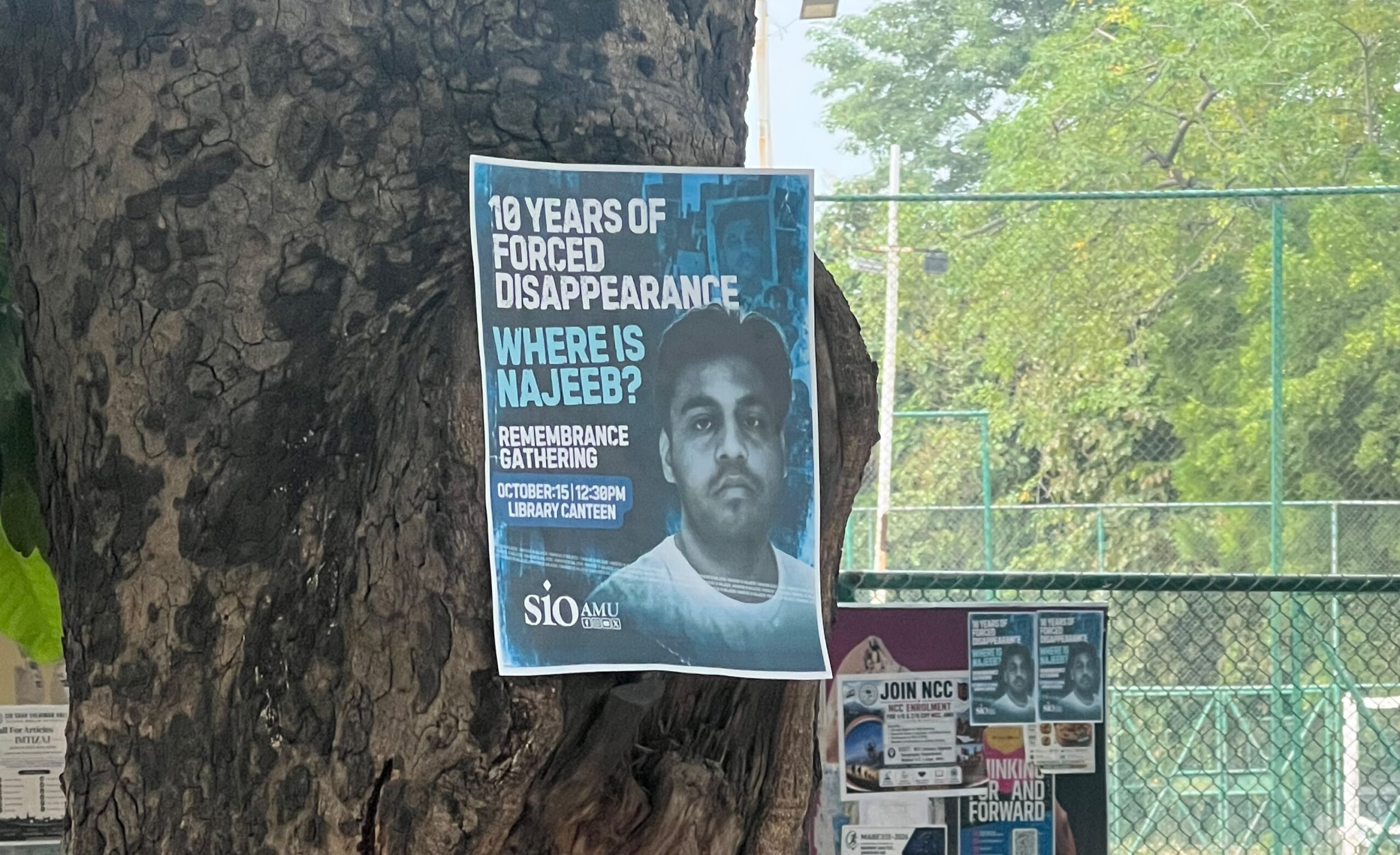
On the night of 14 October 2016, in the Mahi-Mandvi hostel of Jawaharlal Nehru University, a first-year M.Sc. Biotechnology student named Najeeb Ahmad was beaten by ABVP goons. By the morning of the fifteenth, he was forcibly disappeared. He was twenty-seven years old. Ten years later, many of us who write in these pages are approaching that age, and some of us have already crossed it. That arithmetic ought to sit heavily on us. We have been given years he was not given: years of classrooms and hostel corridors, of arguments over chai and drafts of theses, of ordinary student life lived in the shadow of an extraordinary absence. A gift of that kind is never free. It comes with a debt, and the debt is not only remembrance. It is a question about what we will do with the voice he was not allowed to keep.
—
What happened to Najeeb did not begin with his enforced disappearance, and it did not end with it. It began with a conversion: a young man assaulted was turned, within hours, into a young man who was the problem. Letters were written to the warden, including one by a far-left organisation, the All India Students’ Association (AISA), holding the office of president of the JNU Students’ Union, recasting the victim as a troublemaker and as mentally unwell. The philosopher Miranda Fricker calls this testimonial injustice, the moment when prejudice lowers the credibility a person is granted, so that his word, and the word of those who speak for him, arrives already discounted. Najeeb was made unbelievable before he was made absent. Everything that followed flowed from that first act of discrediting: the police and the CBI insinuating links to ISIS that the Delhi High Court itself refused to entertain, the investigation that never seriously confronted the men named in the complaint, the closure report of 2018.
In June last year, a Delhi court accepted that closure report. It acknowledged that witnesses supported the account of the assault and the threats on the night of the fourteenth; it did not accept that these had anything to do with what happened on the fifteenth. It expressed regret that closure still eluded his mother, and left the agency free to reopen the case should credible information ever arrive. A state that can see the blow but cannot see its consequence is not blind. It has decided where to look. Regret, in such a document, is what an institution offers in place of an obligation it has chosen not to bear.
—
Najeeb is not an exception; he is a pattern made visible. Nelson Maldonado-Torres names what lies beneath such patterns the coloniality of being: a condition in which certain people are treated as permanently dispensable, their deaths and disappearances absorbed without disturbance. Indian Muslims have learned this grammar intimately over the last decade: on trains and highways where men were lynched over what they ate or carried, in the library of Jamia Millia Islamia where police entered with batons in December 2019, at Aligarh on the same night, in the long years of imprisonment awaiting trial that followed for students who spoke against a citizenship law.
—
There is a harder truth in Najeeb’s story, and we should not soften it. The failure was not only of the state and the administration. It was also of the progressive campus that could name every injustice except the one standing in front of it. Neither the AISA-led JNUSU nor the teachers’ association organised meaningful solidarity for over a year. Sara Ahmed, writing on how institutions handle difference, observes that the stranger is not simply someone unknown but someone already recognised as being out of place. A Muslim boy from Badaun in a hostel room at India’s most celebrated left campus was (mis)recognised in precisely this way. In such spaces, Muslims are permitted to appear as a problem to be managed or as victims to be defended, but rarely as subjects who speak for themselves and set their own terms. Much of the solidarity Indian Muslims receive is offered on exactly these terms. It borrows our grief and returns very little of our dignity.
This is why the question of student leadership is not a side issue to remembrance. It is the place where remembrance becomes politics.
—
Consider where we stand this October. At Aligarh Muslim University, students had protested again and again for several years, one of them on hunger strike for nineteen days this year, before the administration finally announced that union elections, unheld for eight years, would take place on 5 November. At Jamia Millia Islamia, where the elected union was dissolved in 2006, three students began a hunger strike this week simply to ask for what most central universities take for granted. At Maulana Azad National Urdu University in Hyderabad, where elections were called off in 2024 and a land dispute with the state government showed students what it costs to have no elected body, the union was revived only a month ago. Its students are voting today, on the tenth anniversary of the morning Najeeb went missing.
It is worth pausing over the irony. The campuses where Muslim students are most concentrated are the ones where student democracy has been suspended longest.
The reasons administrations offer are familiar: the academic atmosphere, the pending petition, the fear of outside elements, regulations read as a manual for restriction rather than reform. Beneath them lies something Frantz Fanon understood well: the colonised institution that learns to police itself on behalf of the power that watches it, its administrators more anxious to win the approval of those above them than to answer to those in their care. With their minority character endlessly litigated and their names routinely dragged through television studios, our universities have often concluded that a quiet campus is a safe campus, and that a disciplined, voiceless student body is the surest proof of loyalty they can offer to those in power. Najeeb’s story tells us otherwise. Silence did not protect him. As Audre Lorde warned, your silence will not protect you. It only guarantees that when something happens, there is no one authorised to speak.
—
So why must we be part of student leadership? Not because unions fix the mess menu, though they should, and not because a title looks good on a CV. Leadership, in its truest sense, is the capacity to write the first letter. When Najeeb forcibly disappeared, the first letter signed by the president of his own students’ union described him as a problem. Representation is, finally, a question of who writes that letter: who is in the room when an incident is described, who narrates the story, who decides whether it is called a scuffle or a lynching, who goes to the warden, the proctor, the police station and the press, and who refuses to let a complaint dissolve into a file. Miranda Fricker names a second wrong, hermeneutical injustice, which occurs when a community lacks the shared concepts and forums to make its own experience intelligible, even to itself. A union is such a forum. Without it, every injury becomes a private case.
There is also a vocabulary older than any of these theorists. In our tradition, leadership is an amanah, a trust held on behalf of others. It also teaches that among the greatest forms of striving is a word of truth spoken before an unjust ruler. A students’ union, rightly understood, is an institutional form of that word: a standing structure through which truth can be spoken to power without depending on the courage of a single isolated student who will then be suspended, surveilled, or worse.
—
But representation carries its own temptations, and we should name them. It is possible to win elections and lose the cause: to become the Muslim face on someone else’s panel, the vote bank in another’s arithmetic, the token who confirms an institution’s diversity while leaving its structures untouched. It is possible, too, to mistake representation for spectacle, to chase the microphone and abandon the real work.
The leadership this moment demands is something else. It brings the specific concerns of Muslim students into the centre of campus discourse rather than waiting for permission: the discontinued Maulana Azad National Fellowship, discrimination in housing and hostels, the surveillance of speech, the casual Islamophobia of classrooms and administrations. It meets Dalit, Adivasi, Bahujan, Kashmiri and other marginalised students not as a junior partner and not as a cause, but as subjects, carrying their own memory of being made out of place. It keeps an archive, builds legal and counselling support, and refuses the quiet bargain of individual careers in exchange for collective silence, the advice so many of us have heard at home: keep your head down, clear your exams, go abroad, leave politics to others.
—
Fatima Nafees has not retreated an inch in ten years. She has walked into police stations, courtrooms and protest marches carrying her son’s photograph, and she has been met with delays and regret. Her refusal is, in the deepest sense, an act of witness, placing her hope in Allah’s justice. The question for those of us who are students now is whether we will leave her to carry it alone, or whether we will build the institutions, unions and collectives, publications and friendships, through which her question becomes everyone’s question.
Today, as students at MANUU cast their votes, and on 5 November, when students in Aligarh do the same, they will be doing more than electing office-bearers. In the hunger-strike tent at Jamia, on every campus where a Muslim student decides to stand rather than stay safely invisible, remembrance is taking political form. We who have lived past twenty-seven owe him at least this: that no one on our campuses will again be made a problem in the first letter, and that there will be no next time.
Where is Najeeb? We will keep asking.