

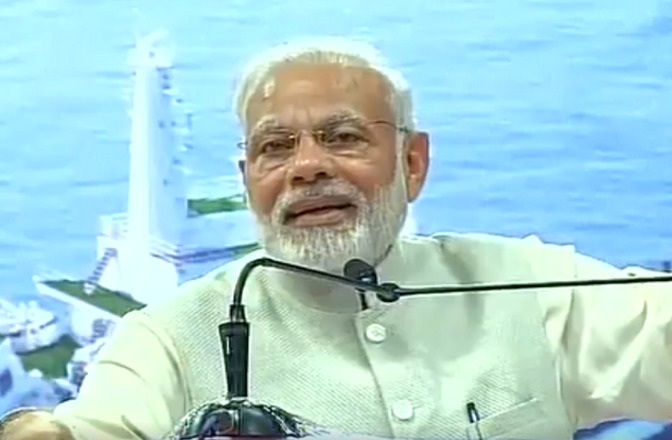
The Prime Minister Narendra Modi has unexpectedly announced that Reserve Bank of India is going to demonetize the Rs.500 and Rs.1000 currency notes from mid night of 8th November for the sake of curbing the black money. The reasons cited by Modi behind scrubbing the said banknotes are, to control fake currency, give shock to terrorism and to paralyze the corruption.
Meanwhile, withdrawals from ATMs have been limited to 2,500 rupees a day for the next few days; returning bills to banks will require some form of government ID; and so on and so forth. The government also urged citizens to be patient with the inconvenience in day to day affairs and asked not to be panic.
This isn’t the first time the RBI has demonitised currency. Rs.1000 and Rs.10,000 banknotes were also demonetized in January 1946. These two denominations were reintroduced in 1954 along with currency notes of Rs.5,000, and all the three were again demonetized in January 1978. The last time demonetization was done in 1978 but through a legal process or I can say by passing an ordinance – High Denomination Banknotes (Demonetization) Act 1978.
But in November 2016 the decision has been taken suddenly without any concern of the common citizen. This decision of government created an uncertainty and chaos among the entire population, as several death has been also reported by media.
There are many questions which ask fro scrutiny. Being a student I can say about the problem which I am facing. ATMs are closed for two days and moreover we the students don’t have enough time to stand in long ques in front of the bank for currency exchange. I believe this decision must be taken with prior information duly disseminated and facilities provisioned so that suffering could be minimized.
India’s real Gross Domestic Product at constant (2011-’12) prices for the year financial year 2015-’16 stood at Rs.113.5 lakh crore, indicating that Rs.500 and Rs.1,000 banknotes accounted for nearly 12% of India’s GDP, which shows how integral these banknotes are to India’s economy. What accounted for this move was rapid rate at which these notes have grown in circulation in the last five years – the Rs.500 notes by 76% and the Rs.1,000 notes by 109% over the 2011 numbers, said Economic Affairs Secretary, Shaktikanta Das on Tuesday.
“Terrorism is a frightening threat. So many have lost their lives because of it. But have you ever thought about how these terrorists get money? Enemies from across the border run their operations using fake currency notes.
The World Bank in July, 2010 estimated the size of the shadow economy for India at 20.7% of the GDP in 1999 and rose to 23.2% in 2007. There are similar estimates made by other Indian and international agencies.
In my opinion I don’t think that large businessmen are affected by demonetization because they can easily convert their money into gold and moreover they deposit their money in Swiss bank and they don’t keep money in cash with them. When you ban notes with bigger denomination it has certainly catastrophic effects on black money held in cash form. But the question here is: how much money are stored in cash form? I don’t think large amount of money would be stored in cash.
Here, I want to give an example of an IAS couple caught few years back for disproportionate asset. That couple had disproportionate asset of 350 crore but they only had 3 crore in cash. That means amount in cash was less than 1% !!! So, effect of this decision surely would be limited. We have just eliminated few notes but still we have the same system and same people, who’ll do corruption in the same way. But next time when they do it, they’ll convert their black money in assets like gold, silver, real estate. They might not accept bribe in currency, they’ll ask for precious metals and diamonds, like they do in drug dealings.
The real black money is held by the politicians and political parties. Under Section 29 (C) of the Representation of the People Act (RoPA), political parties have to furnish an annual statement of all contributions in excess of Rs.20,000 to the ECI (Election commission of India). They have to give the names and addresses of the donors. But we all know how much transparency they show in declaring the donors name.They declare most of their donation as below 20,000 rs donation to hide the detail of their funding which, as common sense dictates, comes from black money.
Chidambaram also pointed out that the economic wisdom of the government will be tested on these three parameters:
1) The present cash ratio to GDP ratio is 12% and it will come down to world average to about 4%.
2) The value of high denomination notes currently in circulation is about 15 lakh crore rupees. Will that value come down significantly?
3) Will gold import surge indicating the unaccounted income, wealth seek refuge?
In the last two years, the Government has taken a number of steps to curb the menace of black money in the economy. It set up a Special Investigation Team (SIT), enacted a law regarding undisclosed foreign income and assets and also amended the Double Taxation Avoidance Agreement between India and Mauritius, India and Cyprus, and Benami Transactions Act. Additionally the government effected a MoU with Switzerland for getting information on bank accounts held by Indians with HSBC and implemented the Income Declaration Scheme 2016.
Apart from interrupting daily lives of common people there are even bigger implications on Indian economy as a whole. Rs.500 and Rs.1000 currency notes play a very important role in Indian economy which is totally based on cash system. Politics and various elections are known to run on cash. Same is the case with sectors such as real estate. The rural areas in particular, which do not have formal sources of banking, also deal largely in cash. Unorganized labour, including in urban households, such as domestic workers and drivers, are paid in cash, and mostly in these denominations. All these activities and economic agents are worse affected by the Modi’s logic of demonetization.
The advantages of this move, if any, will be felt only in the long-term. While formal modes of payments such as debit and credit cards, net-banking and digital wallets should get a boost, this will take a long time to be felt simply because rapid increase of these products is still low among the middle classes and the poor, for whom cash is still the primary mode of transactions.