

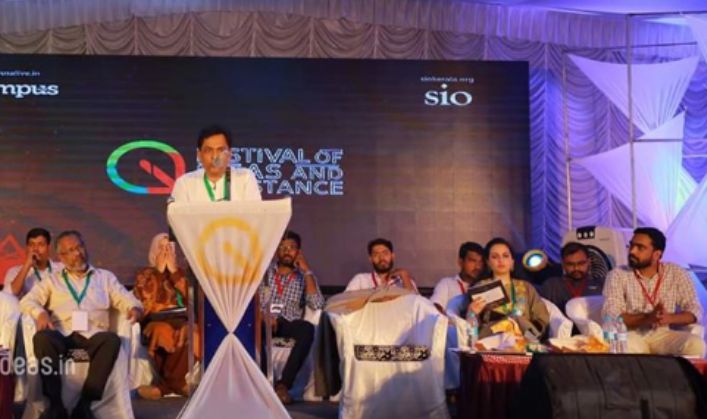
I am much pleased to be part of this conference, “Festival of Ideas & Resistance.” Planned and conceived well before the movements against the Citizenship Amendment Act and NRC, the festival cannot be more timely, relevant and meaningful.
I congratulate the organizers for organizing this conference and bringing such a diverse panel of speakers from various walks of life. It is simply amazing. Of particular importance is the participation of young minds, both as speakers and audience. The youth are obviously the future of India.
I look forward to participating in the conference, and listening to and interacting with so many people.
What I want to do is to briefly identify the main crisis of democracy and also offer an alternative.
Jakob Lindenthal, a German student from IIT Madras, was deported to Germany for attending a protest meeting against the Citizenship Amendment Act and NRC. In contrast, Tarek Fatah, a Canadian citizen of Pakistan origin, is more than welcome in India. Fateh is well known for his Islamophobic views. He is also known for his obedience to the Sangh ideology. Indeed he is lauded for humiliating Muslims and inciting symbolic violence against Muslims. We are also familiar with Fatah’s excellence in ignorance, lies and rumors.
Why Traek Fatah, a joker who is presented as an intellectual in the media, should not be deported from India?
The case of Jakob and Fateh represent two faces of democracy. While Jakob’s participation in protest demonstrates democracy as justice, Fatah’s case shows democracy as hatred and injustice.
However, there is also a deep problem with democracy that Jakob took part in. Democracy is national and territorial. Global or world democracy are no more than empty slogans. Despite India and Germany both being democracy, Jakob was deported because his participation as a German citizen in democratic protest in India went against India’s national-territorial democracy which is the organizing principle of the so-called democratic world.
This territorial-national idea of democracy also works internally. Scholars of geography maintain that almost everything is spatial-territorial. Indian democracy is no exception to this space-centric definition. Award-winning liberals like Ram Chandra Guha thus consider it important to describe Malapuram as Muslim-majority district or Jammu and Kashmir as Muslim-majority state. The neighborhood in Muzaffarpur, Bihar, where my parents live is locally called a Muslim area whereas the city of Muzaffarpur is never called a Hindu-majority city. That Muzaffarpur is a Hindu-majority city is a fact. Likewise, Orrisa is never called a Hindu-majority province in the same way as liberals like Guha never calls Chennai a Hindu-majority city.
Why is this so?
This is so because democracy is wrongly understood as a territorial-majoritarian concept. Remember that in India electoral constituency is also a territorial notion. Demarcation of constituency is done in a way to promote majoritarianism and kill the aspirations and traditions of the minorities.
This majoritarian and ethnic idea of democracy –where people is often coterminous with Hindus –is clearly in full display by the current ruling regime. However, its roots are traceable to the birth of India as an independent republic. Therefore, those who maintain that we need to recover ideals of Gandhi, Nehru and others are wrong. Nehruvian democracy is part of the problem, not a solution. Abul Ala Maududi, a great political theorist who was more democratic than Nehru, had already shown in 1940s how Nehru’s vision of democracy was exclusive, nationalist and, therefore, against pluralism.
You may ask, what is the alternative?
There is an alternative! This alternative requires a fundamental recasting of democracy as follows.
Against the common perception that democracy is the rule by the pre-designed majority, the original meaning of demokratia in Greek is “capacity to do things, not majority rule”. In contrast to monarchia (monos: one) and oligarchia (hoi oligoi: the few), demokratia has no reference to number. It signifies a collective body of people. Since nowhere is any people monolithic, the capacity to do things would be diverse and multiple as would be the cultural goals and political idioms. It is forgotten than critics of democracy were the ones who made a negative equation between democracy and majority rule.
Now if democracy is “capacity to do things, not majority rule,” you may justifiably ask what does “capacity to do things” mean? The answer to this question is what Aysha Renna, Ladeeda Farzana, Shaheen Abdullah and many others did last week. They are shinning symbols of capacity to do things. I feel a sense of pride to say that I am an alumnus of Jamia Millia Islamia, a university where Aysha, Ladeeda and Shaheen currently study.
To realize this capacity to do things, we have to activate consociational model of democracy –a model elaborated by Dutch political theorist Arend Lijphart. This consociational model is more suitable for a linguistically, culturally and religiously plural country that India is. The current ideology of making India as ethnically pure and homogenous is not only undesirable, it is also dangerous, indeed bordering on fascism.
Against the current form of democracy in India, it is high time that we begin to think of adopting the model of democracy practiced in the Netherlands. Unlike in India, in the Dutch democracy, members to Parliament are elected on the basis of percentage of votes they receive in election nationally, not based on territorially fixed electoral constituencies or districts. If we adopt this model and connect it to Lijphart’s notion of consociationalism, we can build a better, inclusive India where pluralism and tolerance will prevail in true sense. In short, we have to use our imagination about how to realize “our capacity to do things” with mutual dialogue and debate.
To those who doubt “our capacity to do things,” we can simply tell them that current movement against the Citizenship Amendment Act and NRC show such a capacity in abundance.
This is the path to genuine democracy. Everything else is pseudo democracy, which promotes domination, exclusivity and cultural purity.
Let this festival of ideas be the springboard for crafting a new idea of democracy. This is democracy to come! However, we can’t simply wait for it. We have to work hard and fearlessly to realize this alternative democracy.
Once again, I congratulate the organizers for organizing this wonderful conference and bringing such a diverse panel of speakers from. I wish the conference a great success.
P. S. The text is unedited and may contain grammatical errors.
(Note: This is the text of the speech delivered by Prof. Irfan Ahmad in the inaugural ceremony of festival of Ideas & Resistance on 27 December, 2019 in Kozhikode, Kerala. This has been republished from here with the author’s permission.)