

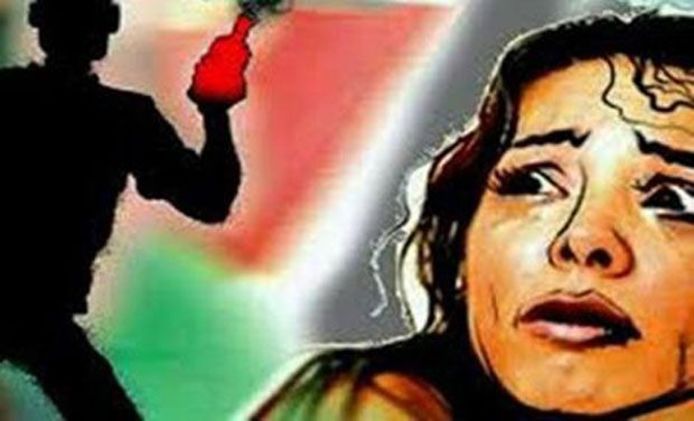
Mass molestation of women on New Year’s Eve in Bengaluru may have broken the cold souls of Indians and brought enough media coverage but providing security to women remains no one’s gossip in India. No one cares to bother how rape victims or survivors of acid attack spend the rest of their lives.
In every second minute, a crime is reported against women in India. If National Crime Record Bureau of the year 2013 is to be believed, on an average 92 women are raped each day, leave alone unreported cases.
“After being married I have often endured beatings from my husband. I know he’s in a relationship with some other women, but what can I do? I have to look after my children and, hence, have accepted this as my destiny”, said Rukhsana (name changed) a middle-aged woman who has never reported her suffering to any police station.
The heinous crime like rape is the fourth most common crime committed against women in India, followed by domestic violence, abduction and molestation. And there is no provision of rehabilitation either.
“The driver of my employer threw acid on my face after I opposed his wrong intentions,” said Basanti Devi, another acid attack survivor. “I feel the blood, be it in winter or summer, rushing from my skin. I am uncomfortable with clothes after the accident and for the poor people, like us, it is hard to survive without support,” she added. She became the victim of an acid attack in April 2011 and since then is fighting for the justice. “I have told everyone that I was caught up in fire. If they come to know the truth, I will be only questioned without any fault”, she said when questioned about society’s attitude towards her.
In February 2013, the acid attack act was classified as a distinct, non-bailable and specific offense under the section 326A and 326B of the IPC, carrying a penalty of imprisonment for a period of minimum 10 years to maximum life term. However, it is to be noted that from available recorded data from ‘Acid Survivor Foundation India’, it is observed that there has been an increase in cases of acid attacks, such cases being almost quadrupled from the year 2013 to the year 2015.
A survivor of the attack is likely to compromise with the culprit as they become economically vulnerable and socially rejected, and see no other hope, such as in the case of Basanti Devi, who was asked to close the case with an offer of 50 lakhs. She accepted the proposal initially, but soon she got to know that the cheque was nothing but a false statement.
Mamta, a young lady turned a victim to an acid attack in the year 2010. One side of her face was burnt. Since then, she is undergoing immense daily trauma. She was attacked by none other than her husband. She was pregnant and lost her child. “He always demanded a four wheeler car and we usually had conflicts. One morning he suddenly came and poured acid over my face up to the shoulder, she said.
“Since my marriage, I have been a victim of domestic violence and have complained several times in the nearby police station. They (police) never helped me, in fact they ignored my complaint and asked me to compromise saying that ‘it’s your family issue’. Even after hurting my brother and murdering my child, he (the culprit) managed to get bail after being arrested. Police have always been mild towards him,” she replied when asked about further progress in her case.
The role of police has forever been questionable and police stations are often found to be the house of corruption. In the case of Mamta as well as of Basanti Devi, the police probe worsened the case. In the former, police never took any action when domestic violence was reported, while in the latter, police supported the culprit.
“I was a beautician, but since my face is distorted and physically damaged, nobody hires me though I am talented. After this incident, my dreams are wounded.” Like Mamta, Basanti Devi too had dreams of better future but after the incident, no one is willing to offer them a job. Tania Singh, the CSO for Make Love Not Scars which extensively works for acid attacked survivors, said, “There is understanding to consider women as sub-human and have no compassion and empathy towards her.”
The chapters of exploiting women begins from home where a child learns from his father’s attitude towards her mother and his domination over his sister. Domestic violence against women is deeply rooted and beating is often justified across the Indian regions and religions. Lack of education, awareness, and extreme poverty may be the reason but above all, there is no fear of legal repercussions in India. “The ratio of policemen is extremely low to control crimes or to implement laws”, Singh further added.
(The author has met these people in his work on acid attack victims.)