

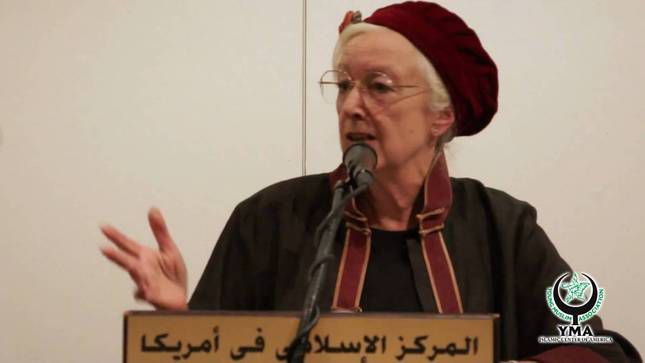
She calls herself an agnostic Jew, and given her age, Lesley Hazleton is more than graceful as one would perhaps least expect. As she walks across the stage of TED – ‘an invitation-only event’ where some of the prominent figures come together to give and find ‘inspiration’- one may be bleakly sure of what she may or may not say. Of course, the subject of her talk, as it appears on the YouTube channel of TED, revolves around Muhammad, a subject chosen rarely for its veracity but mostly for what it does not purport to be might just add to one’s apprehension. And if one were to watch the beginning of her talk on ‘A tourist reads the Quran’ the audience’s laughter at her joke on Thomas Carlyle’s comment after reading the same might just make you change your mind and perhaps even the video itself to escape yet another charade. But Lesley does not walk this predictable path as we assume her to. She is calm and composed, a personification of confidence despite her take on a very controversial issue, her words subtly laced with humour yet unraveling some of the most hidden truths and yes, it is definitely not a hate-talk. Instead, she leads our deceived presumptuous perceptions into an unexpected realm of truth and recognition. But she gives more for me to fall for her head over heels.
She is a British-American author, known for her biography ‘The First Muslim: The Story of Muhammad’, which of course raised eyebrows and questions as well at her valiant attempt but she simply retorts with a blithely confident ‘why not?’ In fact, it is rather dumbfounding to see her ‘adorn an Islamic head scarf’ in the middle of the talk and amidst the deafening silence surrounding the audience. One might drop their jaw in awe or again ‘assume’ she has gone a bit insane, but then she asks, “Is this an act of honour or is it one of disrespect? Is it a gesture of sympathy or is it merely presumptuous or does it make no difference what I say at this moment because all you can focus on is the fact that I am wearing an Islamic headscarf, in which case, why is it so distracting?” She questions our sensibilities as though shaking us out of our numbed minds, satirically hinting at our habitual ‘stereotyping’ of one another and the all pervading plague of Islamophobia. Her conviction does not hinder her from criticizing those like Peter King for branding American Muslims as ‘radicals’ or Ayaan Hirsi Ali for labeling Muslims as ‘perverts’ whom she calls an Islamophobe. And to one’s surprise one will also find her condemning the recent Gaza bombing in her blog ‘The Accidental Theologist’. At one point it makes you stop and wonder if she really is a Jew and not a Muslim, while on the other hand one may warm to her passion and zeal for discovering the truth. Unlike those who passively take in whatever they stumble upon in the media or the web and very ignorantly remark with invectives defaming one another with stark apathy especially via some very un-educating comments and one might also end up questioning their very existence, Lesley doesn’t show the slightest of lack of sensitivity nor will one find any occasional waywardness in her talk on the matter while she executes it with utmost care and dignity. While we may talk of freedom of expression and very intellectually rave about it endlessly without giving any thought to the possibility of offending another, she calls the creators of a video (apparently caricaturing Muhammad and sparking chaos) as ‘small-minded bigots’ with a ‘many agendas’ and none being ‘good’. She recalls how a ‘cropped photograph’ did wonders in a magazine implying millions of Muslims ‘rioting in the streets as opposed to a few hundreds or a dozen’, the same would perhaps be true of the recent peace rally in Paris, if one were to look at the aerial pictures of them on Google where you might just notice a few ‘rows’.
For those who don’t mind chewing onto whatever is thrust in a platter, be it seemingly healthy or un-wholesome, there is a lesson to learn. Despite all the research piled up in front of her, which she says ‘obscures’ the truth rather than revealing it, she urged herself to ‘think’
Biased news and distorted pictures of incidents have so badly crept into our minds that one simply cannot escape the ‘hate-mongering’. Yes, there are certain extremists but as Khaled Hosseini asserts, times of turmoil ‘do not negate decency but demands it even more than in times of peace’. If one were to browse a certain chaotic incident involving perhaps just the tag of a Muslim or Islam one will find a blitzkrieg of abuse and censure and some not-so-intellectual people aiming at each other’s throats ready to spit fire. Some sound so authentic and ambitious that one would want to negotiate, perhaps change a mind or two but the very first words that are spewed in response to one’s attempt would make one never want to do that again. The derision that follows measures more in amount than any other proper debate in the section. Lesley’s Ted talks are no exceptions. Some of the harrowing comments show up, all because she urges us to know more about a man who influences this world and yet ‘how little we know of him’ and about a book that is so easy to ‘misquote’ and if I am not mistaken, I find no foolishness in that.
For those who don’t mind chewing onto whatever is thrust in a platter, be it seemingly healthy or un-wholesome, there is a lesson to learn. Despite all the research piled up in front of her, which she says ‘obscures’ the truth rather than revealing it, she urged herself to ‘think’. She wished to see Muhammad ‘as a whole’ and beyond the distorted image of his that is often posed by both defenders and offenders and that was what inspired her to read the Quran, word to word with transliteration before writing the biography. She was aware that ‘if she were to do justice’ to the ‘remarkable story’ of Muhammad, she ‘would have to write in good faith’.
Her narration of her experience of the holy Quran is quite surprising. She is not only enchanted by the language of it but also that it seeks to be ‘felt and analyzed’ rather than just ‘read’. She also observes, ‘While the bible is addressed exclusively to men using the second and third person masculine, the Quran includes women, talking for instance, of believing men and believing women, honorable men and honorable women.’ Let that not be misread as oppressed. And there are still others who ‘misquote’ verses on ‘killing’ and very proudly advertise in every sense of the word, Lesley clears up some dirt off of that too. The idea of non-violence found in the verses, she says was ‘the biggest surprise’ for her. Not realizing how even more surprising she sounds to her audience, she adds the verse ”the perverse of heart will seek out the ambiguities trying to create discord by pinning down meanings of their own. Only God knows the true meaning,” hinting at the erroneous manner of quoting Quranic verses or phrases out of context which is by far one of the most favorite methods to defame it and yet so scholarly done. She further finds the book ‘flexible’ and ‘more subtle’ than one expects it to be.
Refuse their narrow vision, their comic book distortions, their miserably small minds. We have to reclaim the narrative, the full narrative, beyond stereotypes, beyond snap judgments, beyond head scarves. Just as we need to see Muhammad whole, so we need to start seeing each other whole, in good faith.’
As she acknowledges it herself, it is rather ironical for an ‘agnostic’ person like herself to talk of ‘good faith’, yet her insightful talk into the subject makes me surprisingly want for more. At a time when some of the most blatant lies are being concocted and presented in the most sophisticated manner all aimed to program the fickle-minded, it is heartening to see someone as Lesley Hazleton digging the truth out and portraying the same to the world through TED. It also goes on to prove that no matter how well the perpetrators endeavor to subdue the truth, it claws its way out. No matter how much the detractors exert themselves to spread falsities and indulge in deceit with bravado, the truth will break out into the open through the discerning. She ends with some inspiring words, ‘Whether we live in Tehran or Tel Aviv, in New York or in New Delhi, we do have a choice. We can refuse. Refuse, that is, to allow ourselves to be lead by anger and suspicion. Refuse to allow ourselves to be manipulated by extremists of all stripes. Refuse their narrow vision, their comic book distortions, their miserably small minds. We have to reclaim the narrative, the full narrative, beyond stereotypes, beyond snap judgments, beyond head scarves. Just as we need to see Muhammad whole, so we need to start seeing each other whole, in good faith.’
Beginning from me, that would make a wonderful resolution for all and as I still warm to her words, I am slightly intimidated, for she did justice to a man and a religion and by extension to all its faithful followers, despite her being a ‘tourist’ in this religious sphere. And that gives me hope.