

After 70 years of Independence, India has many achievements to celebrate. Starting form an unnoticeable, poverty ridden, third world nation, it has successfully grown into a leading developing economy. It is now the back-office of the world; the ultimate destination for IT and BPO; superb Indian technical skills are receiving wide-eyed admiration from across the globe. The defining feature of ‘Indianness’ now is the colossal capability of Indians to create and innovate. The vibrant and flourishing democracy provides a fertile ground for the divergent economic activities. The proponents of India Shining campaign claim that the country is passing through one among the best periods of its history. The high rising skyscrapers and thriving malls in the booming Indian cities are signifying that India is changing; and the sparks of hope in the bright eyes of the young urban Indians suggest that this change is leading to a prosperous future.
But this is just one side of reality. Had these spectacles combined with a firm national character, a determined collective vision and a responsible behavior pattern, India would have really stood out. But unfortunately this could not happen. The economic growth arrived on the shoulders of a kind of unprecedented brutal individualism on the part of urban elite. It was this individualism that alienated the educated class from the problems and miseries of masses and created a powerful class that is allergic to any welfare measure.
Now the reality is that in this vibrant democracy, incidence of farmers’ suicide is increasingly on high. As per the records of National Crime Records Bereua from 1995 to 2013, a total of 296,438 Indian farmers committed suicide. During the same period, about 9.5 million people died per year in India from other causes including malnutrition, diseases and suicides that were non-farming related, or about 171 million deaths from 1995 to 2013. In 2015 alone, the number of farmers’ suicides is 12602. The country that created new sparks in the eyes of educated urban youth could not provide assurance to its vast majority that they could even live the next day. In the back-office of the world, employment growth lags one percentage-point behind addition to job market. The ultimate IT and BPO destination is ranked embarrassingly at 127 in the UN human Development Index ranking. In its ‘best phase of history’ the country has nine out of ten pregnant women malnourished. The people known for their creativity and innovation are equally undisciplined and unmanageable on roads. The booming cities with spectacular malls and breath-taking skyscrapers also present very ugly pictures of chaotic traffic, disordered landscape and mismanaged amenities. In the vibrant democracy the killer politicians roam free, the rioters are publicly admired, the corrupt and cruel encounter specialists win awards and judgments and judicial reports are conveniently over-ruled. The greatest paradox is the fourth pillar of democracy that brazenly represents the sectarian interests and handily overlooks the embarrassing realities setting aside all norms of its profession.
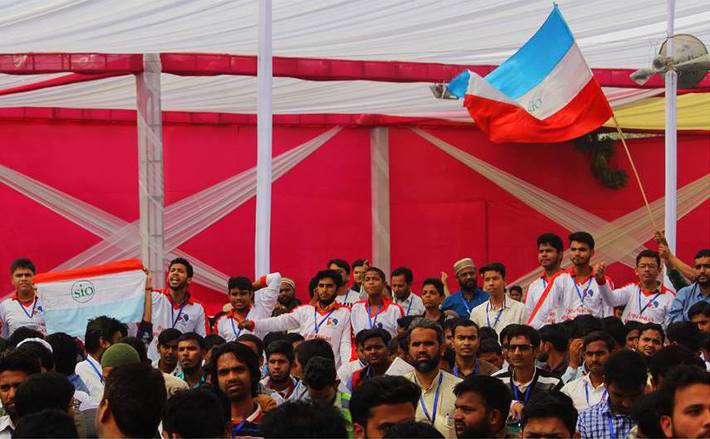
It is in this backdrop that the struggle of SIO seems to be a great source of hope. The greatest contribution of SIO is that in this age of extreme individualism, it is successfully nourishing a generation of bright young men committed to the ideals of social life. SIO’s constituency is the same urban middle class whom the realities of new economic era are teaching not to bother about any thing other than their own individual career and prosperity.
George Bernard Shaw is quoted to have said about middle class, “I have to live for others and not for myself: that’s middle-class morality”. The most inspiring parts of Indian history are reflective of this middle class morality. Notably, it was English-educated, professional elite middle class, that led the freedom struggle. Nehru, Gandhi, Gokhale, Jinnah, etc. were western educated bright professionals with high earning capabilities. They sacrificed their individual interests in compliance with this middle-class morality. In the post independence era the same elite traced a path of sacrifice and devotion to attain the socialist ideals that they dreamt during their freedom struggle.
As Pavan Varma in his widely acclaimed work The Great Indian Middle Class argues, for the middle class, the post-independence era was the era of idealism and of commitment to service to the nation. Pavan Varma then narrates the political changes of 80s and 90s that brought a paradigm shift in the middle class mentality. Ideals of service gave way to ruthless individualism. Stern life styles committed to certain principles were replaced by a hedonistic, consumerist way of life. As Varma argues “The values of the middle class, ironically, came to resemble those reflected in the self-seeking actions of the politicians they so much despised. “
This hypocrisy is evident even in Muslims. They would expect their politicians and even the rulers of the foreign countries to sacrifice their interests, even their governments for collective national causes. They would hate the leaders for their selfish motives. They would demonize anybody who is compromising any thing for his personal interest. Be it the Muslim leaders of mainstream national parties or the puppet rulers of middle-east countries, they would expect them not to bother about their personal careers and governments. But when the matter will be related to themselves or their family, it will be the economic and career related interest that would ultimately govern. They won’t allow their young boy to participate in any social cause. Despite all the drawing room criticism of Congress cronies and Middle East rulers and kings, yardstick of success for their own family members will be the same material prosperity.
SIO’s contribution is that it is successfully fighting this hypocrisy and restoring the age old middle class morality. It is nurturing a generation whose life mission is not confined to its own well being and career growth. Rather it is about the nation and the humanity as a whole. It has among its ranks the bright young people who can be proud assets of any multinational, but they are voluntarily working for a humanitarian cause that won’t return them any thing material. It has proved that the professionals giving up their lucrative careers for national causes, is not just something to be read in history books, it is rather a phenomenon that is very much relevant even today.
SIO’s contribution is related to the most vital and frantic need of India. It is blending talent with character, passion for growth with pain of humanity and urge for prosperity with commitment to values. This is the kind of generation that India needs desperately at this juncture of its national history.
Amid the powerful torrent of acute materialism and individualism, it is nothing less than a miracle that bright young boys with professional degrees are devoting the most productive years of their lives for social causes. This capability to swim against the flow is the result of strongly founded system of character building that SIO has successfully evolved during the course of its twenty five years’journey.
The economic growth that the country is so much proud of becomes meaningless if the drivers of this growth remain selfish and unconcerned with the lives of millions of fellow countrymen. Now that we have successfully embarked on a path of breathe taking growth, our main challenge is to relate this growth to the real problems and concerns of people of India. This challenge can not be met unless we produce a generation that has some real pain of humanity, and that is ever ready to sacrifice personal and sectarian interest for greater humanitarian concern. Exceptional individuals not withstanding; as far as institutionalized mechanism is concerned, SIO seems to stand alone in pursuing the kind of struggle that is needed to attain this objective.
Another major dilemma that the India of new era is facing is the dilemma of religion and spirituality. The multinational capital is also bringing its own values and ethos. The cultural landscape of urban India is undergoing major transition. This transition is creating many questions and dilemmas. On the one side, religion is being thought to be irrelevant in the new globalised society. The brave new world is out to challenge every institution of morality and spirituality. So the globalization and liberalization processes are being considered everywhere a great threat to traditions and even to spirituality.
The new age ‘spiritual gurus’ evolved their own versions of corporate spirituality. It is the kind of spirituality that does not care about morality and life style. It is something to enhance work efficiency, boost the motivation and reduce the stress etc. (perhaps an extension of the corporate HR training!)
In India the religion creates another dilemma. It has been the cause of so many conflicts and violence. Here it arouses wildest passions, making it the most volatile subject in the Indian socio-politics. Religion has always been seen as a tool to create discipline and maintain harmony in the society by promoting the noble values in individuals. But unfortunately in India it has been exploited for narrow political mileages thereby making it a tool to divide and rule. The extreme forms of secularism demonizing religion and rejecting any role for religion is the reaction to this peculiar situation only.
A section of Indian intelligentsia has come out with a strange solution. They preach the philosophy of ‘Sarva Dharma Sambhav’; a self negating ideology that believes in the plurality of truths; a notion that argues that contradictory claims of different religions can all be simultaneously true. Its self contradiction notwithstanding this notion can not be a binding force. This it self is a religious claim that many can never believe. So it can be one among many religious ethos but can not be some thing that has the capacity to bring together different religions and communities.
Here comes SIO. SIO has successfully connected the youth to a kind of religion and spirituality that promotes constructive values and harmonious relations. Instead of reactionary atheism and extreme secularism and unnatural ‘sarva dharma sambhav’ it is promoting true pluralism characterized by healthy inter religious dialogues. It has successfully convinced the young minds that religion also has a role to play; and that the role of religion is not confined to individual and spiritual matters. Religion must guide the people in their social, economic and political affairs also. Yet the religion should not be a destructive force. It can play a significant role in the collective matters of people without being a divisive force. The destruction lies in the misuse of religion, not in religion itself.
As far as religious differences are concerned, SIO’s formula is the most scientific of all the formulas ever presented. SIO promotes healthy dialogues. It invites people of all religions to engage in healthy dialogues based on scientific and rational arguments to honestly search for truth. This is the formula that the people are utilizing in all the realms of life. Science, Philosophy, Sociology, in every area people believe in different and contradictory theories. With the civilizational progress and evolution in human behavior, people have evolved the most scientific formula to live with these differences. They believe in their own theory, yet engage in healthy scientific and rational debate with other theories. If they are convinced with the opponent theory they change their mind, otherwise remain committed to their own theory, still pursuing the debate. SIO has brought this scientific formula in the religious realm. It has made people to engage in healthy inter-religious dialogue. This is a process that apart from helping in independent search of truth, also facilitates better mutual understanding and closeness.
SIO has a special contribution with regard to Muslim community. The long history of prejudices and mistreatment with the community that has been well documented in the recent Sachar committee report has created many complex phenomena. Some times it has created frustration and demoralization. It has resulted in social exclusion and ghettoisation. In some rare cases it has also helped the anti-social elements to promote extremism and exploit the Muslim youth for destructive activities. No country can afford such psychological crisis of a whole community. It is unfortunate that still very few people are ready to pay any heed to this national problem. It is great service of SIO to India that it is successfully combating all these tendencies. It is saving the Muslim youth from demoralization and frustration by showing them the path of peaceful struggle and helping them to empower them selves using the massive opportunities that are available for every body. It is combating social exclusion and ghettoisation by engaging them in the healthy dialogues with other communities and convincing them that being Muslims, they have the responsibility of whole nation. Finally it has austerely combated the extremist elements and has successfully convinced the youth that they should pursue peaceful democratic means to achieve their aspirations.
Mainstream media is not ready to give this great struggle of our time its due space. That is the reason; in many parts of the country people are unaware of this historic movement. Many people do not know that a great reform in the attitudes and mindsets is taking place around them silently. People may keep on revolution, but their lives will not remain unaffected. Whenever the fast pace of growth in India will get combined with true ethics, true humanity and true religiosity, the historian will not be able to ignore SIO’s role in making India an ideal place to live.