

In December 2010, when, the Arab uprising erupted in Tunisia followed by Egypt, the other countries of West Asian and North African region were mired in serious problems. In the entire Arab world, political freedom was at the peak and the younger generation was restive. The civil war in Syria as part of Arab uprising in next month will enter its eighth year that began with normal protests in January 2011, and escalated into a consolidated uprising in March 2011. Initially, the peaceful protests took place in Darra city and demanded the democratic reforms. But when Syrian regime forces cracked down on protesters, subsequently the conflict escalated throughout the country. In the beginning of the conflict President Assad miscalculated the uprising and painted it as a foreign conspiracy. To him there were a handful of armed people who were trying to destabilize Syria with external support and he believed that majority of the Syrians considered him their president. The conflict became more intense when hundreds of non-state actors established themselves as an opposition force which turned into an armed struggle against the Syrian regime. Later on by throwing out the regime forces, they captured some part of Syria. From then onwards the conflict escalated with an increasing violence on both the sides. By the end of 2011, the UN estimated 5000 causalities in Syria and around 8000 Syrian fled Syria and became refugees in immediate neighbouring countries.
External Interventions
Internal conflict of Syria was soon transformed into an internationalized proxy war for several regional and global powers. Internationally, one group led by Russia, is supporting the regime and the other, under the US supervision, is supporting and arming the opposition. Regionally, Iran and Saudi Arabia took different sides and squared off against each other. The former stands with the Assad regime and has made every possible efforts for regime survival, whereas the latter is providing arms and financial support to the opposition. Turkey, Qatar, and Kuwait are following Saudi Arabia and supporting and financing the opposition. In addition a number of foreign non-state actors are involved in the conflict, some fighting from Regime’s side and others fighting against the regime. Many studies revealed that even before the uprising in Syria the US official met some radical groups in Damascus and ensured them for supporting protests against the Alawite Regime.
Current Situation in Eastern Ghouta
Eastern Ghouta is a densely populated agricultural district 10 km east of the central Damascus. In 2010, the total population of Ghouta was 2 million but after the conflict it stood at 400,000. Since late March 2011, Ghouta has become part of the protests against the Syrian regime. After the militarization of the conflict and the advances of the rebels around Damascus, the regular confrontation started between regime and opposition. At the end of 2012, Syrian government failed to control over the area and finally the Free Syrian Army (FSA) set up a strong base in Eastern Ghouta. Since early 2012, opposition armed groups from Eastern Ghouta carried out a number of offensive operations against the regime. They did attack and hit the Syrian regime’s convoy, and seized important roads which served as the regime’s essential supply routes. After the subsequent confrontation between regime and opposition, since 2012, the people of Ghouta have been besieged by the government forces. Consequently, it resulted in mass hunger and malnutrition among the population.
In August 2013, the Syrian regime used chemical weapons against the rebels which led to death of more than 1400 civilians, but Assad denied the use of chemical weapons, and Russia blamed the opposition for the attack. UN Security Council passed a number of resolutions against Assad regime for violating Human Rights but most of them were vetoed by China and Russia. Later on, the fighting within opposition groups increased the suffering of people. It placed new restrictions on internal movement between people and caused death and injury of thousands of civilians. During the last seven years, there was high level of violence carried out by both the regime forces and the opposition militias in eastern Ghouta.
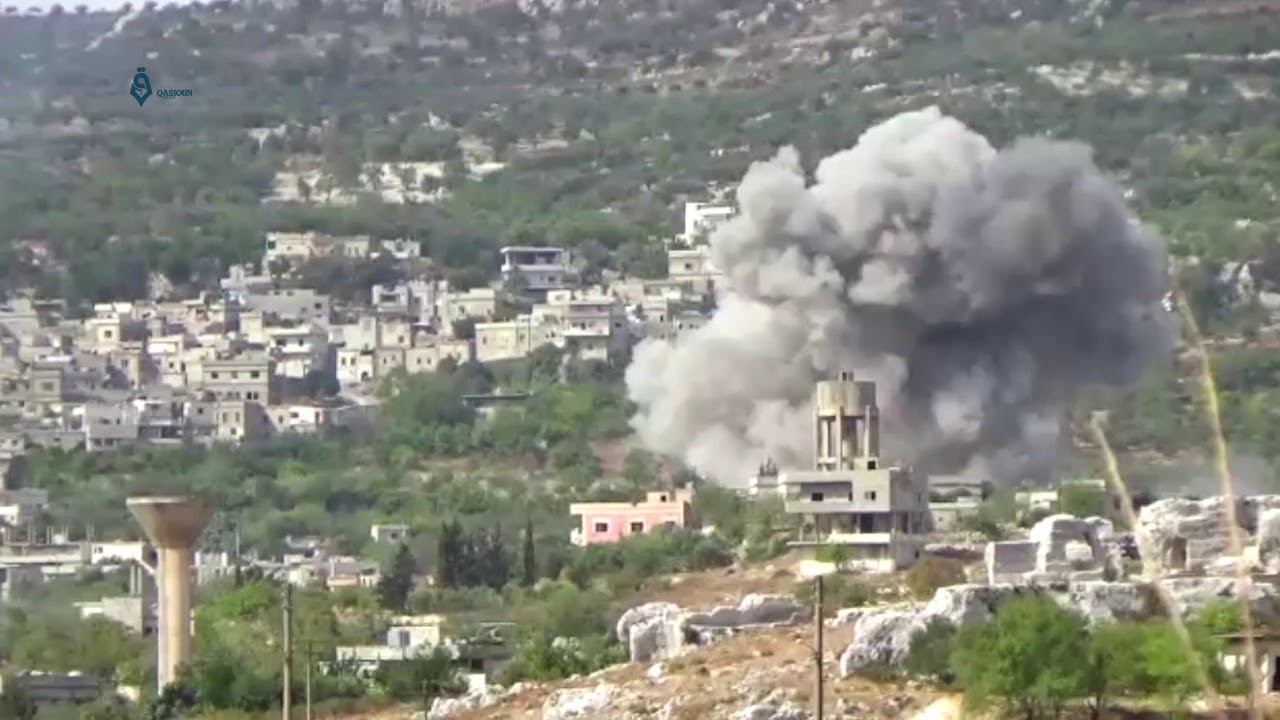
However, Syrian regime wanted to liberate Ghouta from opposition armed groups and carried bombardment since last week. Proximity to Syria’s capital makes Ghouta an important site for the government to reclaim the area from rebels, but it became more expensive. Abdullah Kahala, a Syrian construction worker was quoted by the Jordan Times News saying that he was having breakfast with his wife and children when a huge explosion shattered the wall. He reportedly said “I saw Hala and Sara lying in blood with their mother hysterical…Bombs were falling everywhere near our house. We have been spending the last week digging into the rubble of nearby areas with our bare hands” (Jordan Times News 22 February 2018). United Nations denounced the bombardment by Syrian forces, which has destroyed more than 13 hospitals and other civilian infrastructure, and the UN Secretary General called it as “hell on earth”. But the UN condemnation was undermined by Assad and used barrel bombs against civilians. Some Syrians reportedly testified to the Russian plans of dropping bomb in Ghouta. A commander in the coalition fighting on behalf of Assad’s government told Reuters that the bombing aims to prevent the rebels from targeting the eastern neighbourhoods of Damascus with mortars. On Tuesday the Jordan Times mentioned that rebels also fired mortars against the regime in Damascus near Eastern Ghouta that killed seven people and injured many.
Even after the UN Security Council resolution for a 30-day ceasefire in Syria, regime military is using aircraft and carrying out heavy bombardment. Since last Sunday, the Russia backed Syria’s forces are constantly using rocket fire, shelling, air strikes and helicopter-dropped barrel bombs in Ghouta. As per recent report (Monday 27 February 2018) of the Syrian Observatory for Human Rights estimated 561 civilians have been killed including 185 children and 109 women in Eastern Ghouta. On the other hand, the Syrian government officials said rebels are using civilians as human shields and attacked on the route of the humanitarian corridor. Therefore, conflict resulted into violations and abuses of Human Rights in Syria. On 25 February, the Syrian observatory for Human Rights reported that the Syrian force has used about 3940 artillery raids, 1014 artillery shells, around 2065 missiles, 629 airstrikes carried out by warplanes, more than 232 explosive barrels dropped by helicopters in eastern Ghouta.
Even after the Russia backed truce for 5 hours to allow civilians to evacuate from area Syrian government forces violating it and continue attacks on rebel-held area. People are not providing proper medical facilities either due to shelling and large number of admitted injuries. On 27 February, the World Health Organization said more than 1,000 civilians are critically sick and wounded who urgently needed to be evacuated. The civilians are the core victims of conflict; opposition armed forces are using them as shield and by attacks on rebels’ regime are killing the civilians. A number of questions prop up now: what are the reasons of prolongation of Syrian Civil War? Why the United Nation has failed in bringing peace in Syria? How is the Syrian regime still surviving after? Why is United States supporting opposition and not ready to restore peace in Syria? Thus, before looking at the Syrian crisis in general and on-going Ghouta crisis in particular, these questions are important to take into consideration.
Consequences of Civil War
The Syrian Civil War is near to complete its seventh year. Both the regime and the opposition are fighting for their physical survival and are set on military victory and compromise is therefore out of the question. Therefore, the conflict continues to be characterized by abuses of human rights and international law. Since March 2011, it is estimated that about 6.6 million people have left Syria and 5.6 million Syrians including 1.2 million children have fled to immediate neighbouring countries. Apart from this, about 7.6 million people are internally displaced and as of June 2017, the UN report estimated 600,000 Syrians remain under siege. Death toll from the conflict as of December 2017 reached 5 lakh. Since 2016, the armed-conflict in Syria generated a total economic loss of $ 226 billion and country’s 63 per cent of GDP decreased due to decline in all economic productions. While more than 40 per cent of the population is unable to access basic health services, 50 percent hospitals are either partially functioning or completely out of service. Extensive displacement has increased the sufferings of the population who already face enormous challenges to meet their basic needs. People are also unable to secure basic food and non-food items. They are badly affected by the problem of homelessness, food and medicine shortages, and also the destruction of public services and infrastructure. According to the UN Report (February 2018), around four out of five Syrians live in poverty, 64.7 per cent of the population live in extreme poverty, and 13.1 million Syrians are in need of humanitarian assistance. Therefore, the conflict is going on without any chance of conciliation, both regime and opposition forces are fighting for their political survival. Thus, Syria has triggered the world’s largest humanitarian crisis since the World War Second to which humanity is puzzled.
References
Books and Articles
Lesch, David (2012), Syria: The Fall of the House of Assad, Yale University Press New Haven and London.
Marshall, Jonathan (2015), Hidden Origins of Syria’s Civil War, Consortiumnews.com, 20 July 2015
Richard, Ebere and Adigbuo, Dr (2014), Cold War Resurgence: The Case of Syrian Uprising, Journal Of Humanities And Social Science (IOSR-JHSS) Volume 19, Issue 8, Ver. II, August 2014, 39-47.
Taylor, William (2014), Military Responses to the Arab Uprisings and the Future of Civil-Military Relations in the Middle East Analysis from Egypt, Tunisia, Libya, and Syria, Palgrave Macmillan press.
Wieland, Cartsen et al. (2013), The Syrian Uprising: Dynamics of an Insurgency, University of St Andrews Centre for Syrian Studies, UK.
Online Sources and Reports
Al-Jazeera English
Human Right Watch Reports
BBC News
Full text of President Al-Assad’s interview with Wall Street Journal on 31 January
Syrian Centre for Policy Research
Syrian Network for Human Rights
Syrian Observatory for Human Rights
The Daily Sabah
The Jordan Times
The UNDP Reports
The UNHCR Reports
The United Nations Reports
The World Bank Reports