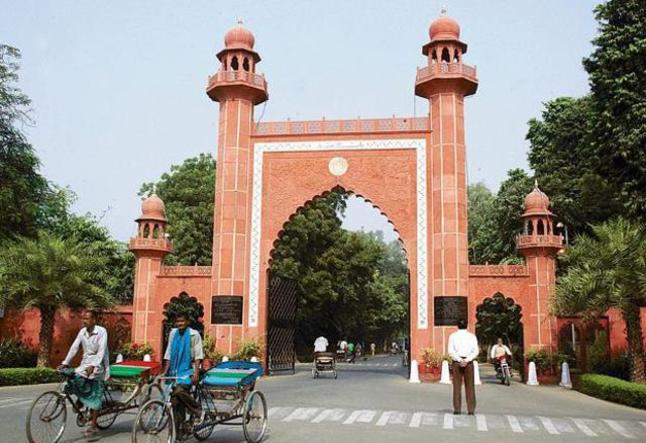
Muslims of India founded the MAO College which transformed into Aligarh Muslim University.
The imperial government replaced Persian with English as the official language of courts and administration in 1842. Muslims of India were severely affected by the decision because the language they were conversant with was of no significance anymore and English they considered to be an evil insignia of the British Raj .Muslims distanced themselves from the language which Britons had introduced. This attitude had a however devastating effect on their status in the society. Moreover the aftermath of the revolt of 1857 in which Muslims became the favorite target of British atrocities resulting from their social, political, educational and economic positions degraded to an alarming level. It was during this turbulent time that Sir Sayed Ahmad Khan sensed the gravity of the situation. He felt that if the Muslims would continue with their attitude of distancing themselves from English language and modern education they would lag far behind time and lose their honor and identity. He founded Mohammedan Anglo Oriental College (MAO College) in 1877 at Aligarh with the vision of educating the Muslin community in English, science and other modern disciplines without prejudicing their religious belief and practices.
The MAO College was initially affiliated to the University of Calcutta and subsequently to the University of Allahabad .When the then Viceroy to India visited the college in 1901, he praised the way the college was being run. He expressed that the college deserved to be independently recognized.
Around the turn of the century, the effort to extend the college into a university gained considerable momentum. The imperial government extended their support to the idea and promised to grant in aid but first asked the community to amass thirty lacks rupees as capital to form the university. The Muslin University Foundation Committee took up the tedious task of collecting the assigned amount. Rich and poor contributed not only from the Muslim community but also from outside the community. However in 1920 by imperial legislation named ALIGARH MUSLIN UNIVERSITY ACT 1920 ‘, teaching and residential muslin university’ at Aligarh came into existence. The then Governor General congratulated the muslin community on the passage of the bill. Hence the erstwhile MAO college founded by Sir Syed Ahmad Khan for the cultural and educational advancement of Muslims of the subcontinent got recognition from the imperial government and transformed into a university by the Act of 1920. The AMU Act 1920 recognized and extended the stature of the educational institution which was established or created by Sir Sayed Ahmad Khan for the betterment of his community. Aligarh Muslin University is nothing but MAO college in its extended and flourished stage. Aligarh Muslin University was envisioned, founded and nurtured by the Muslims of India .Today it stands as a sanctuary of their culture, tradition, and language .
1920 Act recognizes the fact that AMU belongs to the Muslims of India
The intention of the imperial legislature is clear on perusal of the AMU Act 1920 that it wished to give recognition to an educational institution which was founded by Sir Syed Ahmad Khan for his community. The Act while recognizing the efforts which Muslim community had made in building the institution which was subsequently transformed by the act into a university provided that the management of the university should remain in the hands of the Muslin community. Regarding the administration of the AMU the Act says in section 23 that the university court shall be the chief governing body of the university and the clause 1 to section 23 states that only Muslims could be the member of the court. The aim was to allow the muslin community to run and administer the university which they had founded for their own emancipation. The act also accepted the fact that the university which had been incorporated by the AMU Act 1920 has not risen like a phoenix out of anything within a moment of incorporation. It owes its origin to the MAO college which was the result of the unmatchable efforts and farsighted vision of Sir Sayed Ahmad Khan. The preamble to the Act reads ,’Whereas it is expedient to incorporate teaching and residential muslin university at Aligarh….. and to transfer to and vest in the said university all properties and rights of the said societies and of the muslin university foundation committee…’
A sapling which was once planted by Sir Syed grew slowly and finally became a lush tree by 1920, but the fact remains that Sir Syed had planted the sapling, he had founded the MAO college.
Constitution and the Rights of Minority
By virtue of article 372(1) of the constitution of India the Aligarh Muslin University Act, 1920 continued to remain in force. However, the amendment of 1951 brought some changes in the act to bring it in consonance with the constitutional provisions, but the said amendment did not alter the object behind the creation of the educational institution which was earlier called Mohammadan Anglo-Oriental college and subsequently transformed into a university. The object and purpose was the emancipation of the Muslin community through modern education without jeopardizing their religious beliefs and practices. The university which was earlier a legal entity became a matter of constructional and fundamental right under article 30(1) of the constitution. Article 31 gives the minority a fundamental right to establish and administer educational institution of their choice. The constitution of India accorded honor to the varsity by mentioning it among others as an institution of national importance.
Article 21 of the Constitution talks about the right to life and personal liberty. The expression life and liberty are of very wide import. Right to life implies the right to a ‘dignified life (Francis Coralie Mullin v Administrator ,union territory of Delhi. AIR 1981 SC 746). A dignified life is illusory without proper education. Education brings honor and dignity and an institution which imparts education is like a vehicle by which an individual or a community steers toward a dignified and honorable life. Aligarh Muslin University has been the same vehicle for the Muslims of India.
Unfortunately! Honorable Supreme Court of India did not consider AMU a minority educational institution. The judgment in the Aziz Basha case tracked down the historical development through which the university came into existence but went into hyper-technicality while interpreting the word ‘establish.’ According to the decision of the Honorable Court, the university was established through incorporation. That Muslims of India did not create the university through their efforts prior to the incorporation was notable. Since the university was not created by Muslims of India,, they have no right to administer it or claim any reservation therein. Thus the supreme court through a strange reasoning in the haunting decision in Aziz Basha ran roughshod over the entire gamut of fundamental rights which is guaranteed by the constitution to the minority.
The 1981 amendment to the Act ; An Attempt to Bury the Ghost of Aziz Basha
The decision in Aziz Basha case had the effect of altering the character of the university by recognizing it as not a Muslin minority educational institution. The Indian Parliament tried to bury the ghost of Aziz Basha case and undo the consequent damage caused to the character, and the purpose of the university brought the 1981 amendment to the AMU Act. Through this amendment, the union legislature tried to remedy the wrong which the infamous case had done to the character of the university and to restore its original identity. Parliament was all competent to bring such amendment. The amendment made explicit what was earlier implicit by amending the definition of ‘university’ under section 2(l) of the said Act. Section 2(l) reads ; “university” means the educational institution of their choice established by the Muslims of India ,which originated as the Mohammedan Anglo Oriental College, Aligarh, and which was subsequently incorporated as the Aligarh Muslin University. After this amendment the university got the protection of article 31(1), i.e., the Muslims of India got the fundamental right to ‘administer the university which they had ‘established.’ The amendment in effect diluted the ruling of Aziz Basha case and altered its basis. The amendment deleted the word ‘establish’ from the title of the Act. A new subsection 5(2)(c) was added which empowered the university ‘to promote especially the educational and cultural advancement of Muslims of India.’ The amendment further restored the university court with all its former powers. Exercising its right under article 31(1), the university proposed its reservation policy for Muslim students. But the Allahabad high court gave another serious blow to the university’s character by holding that no such reservation policy can be proposed by the university in favor of Muslim minority as the university was not a minority educational institution. The honorable High Court followed the ruling of the Supreme court in Aziz Basha case.(Naresh Agarwal v Union of India) consequently, then the decision of the executive council was quashed, and the ghost of Aziz Basha was reincarnated by Allahabad high court. AMU filed special leave petition before the supreme court same was admitted . The supreme court on the undertaking of the university that it would not implement the 50% reservation policy has stayed the operation of the decisions of the Allahabad high court. The order dated 24-4-2006 passed by Hon’ble Mr. Justice K.G Balakrishnan and Hon`ble Mr. Justice D.K Jain said ‘…..as regards all other matters regarding the appellate institution, status quo will be maintained from the filing of the writ petition before the high court….”
Also read AMU’s Minority Status A Brief History of Needless Confusion
In the light of the above order of the Supreme Court, the 1981 amendment Act continues to be intra vires the Constitution of India. Thus the status quo is that Aligarh Muslin University is an educational institution of their choice established by the Muslims of India, which originated as Mohammedan Anglo-Oriental College and which was subsequently incorporated as the Aligarh Muslim University.
Any Reservation for SCs/ STs/ OBCs in AMU is Constitutionally Invalid
The present position is that the AMU is a minority educational institution as defined by section 2(l) of the Aligarh Muslim University Act 1920 as amended in 1981. A minority educational institution is explicitly exempt from any reservation which may be made in favor of scheduled castes, scheduled tribe, etc as Article 15(5) says that a minority educational institution is not covered under any special provision which the state would make for the advancement of SEBCs , SC or STs. Thus any attempt to impose reservations for SCs, STs, OBCs on AMU would be against the letter and spirit of the constitution.
The Central Educational Institution (Reservation in Admission ) Act 2006 deals with the matter of reservation in admission of the students belonging to scheduled castes, scheduled tribes and other backward classes of citizens to certain educational institution established and maintained or aided by the central government. Section 4 of this Act makes a special exception in favor of minority educational institutions which means that any reservation policy made in favor of the above-stated classes is not applicable to a minority educational institution. Aligarh Muslin University being a minority educational institution as declared by 1921 Act is entitled to the exemption under section 4 of 2006 Act. The manufactured controversy regarding such reservation is nothing but another political grandstanding of the incumbent government which has utterly failed to deliver the promises it had made to the people of India in its election manifesto. Such reservation in AMU is neither constitutionally valid nor legally tenable.