

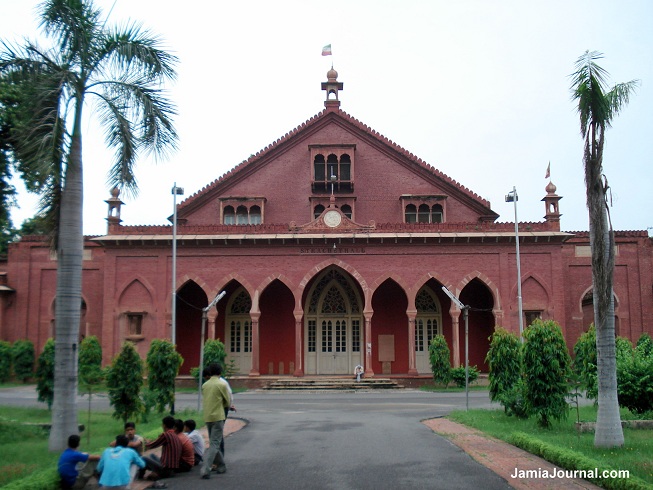
The Central Government on 12th January submitted before the Supreme Court that Aligarh Muslim University is not a minority institution. This submission of the Government not only threatens to spoil AMU’s case but also indicates attempts to politicize the entire issue of ‘minority institution’, as is evident with the government’s subsequent statements concerning Jamia Milia.
We must remember that the fight to preserve AMU’s Minority Character is not a fight for any special favors or concessions; it is a struggle for rights guaranteed under the Indian Constitution, specifically Article30 in the present case.
An institution coming under article 30 would have the right to manage its affairs according to its own laws, customs and traditions and to promote the welfare of the community it represents as it deems fit, such as through reservation of seats or other means. In other words, it would have the status of a ‘Minority Institution’.
In the case S.P. Mittal vs. Union of India (AIR 1983 SC 1), the Supreme Court has said that in order to claim the benefit of Article 30(1), the community in question must show; (a) that it is a religious/linguistic minority; (b) that the institution was established by it. Further, the NCMEI in its judgement on the minority status of Jamia Milia Islamia noted that, based on various authoritative judgements of the Supreme Court, the following facts are to be proved for grant of minority status certificate to a minority educational institution on religious basis:
- that the educational institution was established by a member/members of the religious minority community;
- that the educational institution was established for the benefit of the minority community; and
- that the educational institution is being administered by the minority community.
Anyone who has even a faint understanding of the Aligarh Movement would know that AMU was established after years of struggle and efforts to set up a university primarily aimed at bringing Muslims into the mainstream of education. AMU has never closed its doors to non-Muslim students, but the fact remains that its establishment and evolution are the direct result of efforts to address educational backwardness among Muslims.
The university officially came into existence through an Act of Parliament in 1920. But the funds for its establishment came entirely from private individuals all over the world, including some prominent Hindu zamindaars, who had all contributed money for the stated aim of setting up a Muslim University at Aligarh. Even the Act itself merely declared the existing Mohammedan Anglo Oriental College (which had been set up by Sir Syed) as the newly constituted Aligarh Muslim University.
Anyone who has even a faint understanding of the Aligarh Movement would know that AMU was established after years of struggle and efforts to set up a university primarily aimed at bringing Muslims into the mainstream of education. AMU has never closed its doors to non-Muslim students, but the fact remains that its establishment and evolution are the direct result of efforts to address educational backwardness among Muslims.
However, in 1967 in the Azeez Bahsha case the Supreme Court chose to ignore all these facts and moved to pronounce that merely because the university came into existence through an Act of parliament, it was hence ‘established’ by the government and not the Muslim community.
The Supreme Court’s interpretation of the ‘establishment’ of AMU was – and continues to be – very perplexing for those who were familiar with the history of its formation. To any Alig, and to many others to be sure, the passing of the AMU Act 1920 was direct result of the efforts of Sir Syed Ahmad Khan in particular and the Muslim community at large. Tara Chand, a prominent historian and member of the Rajya Sabha at the time, said that:
“It will be a falsification of the history of
India if it is asserted from any quarter that
the Aligarh Muslim University was not
established by the Muslims, and primarily for
the educational advancement of the Muslims
of India..”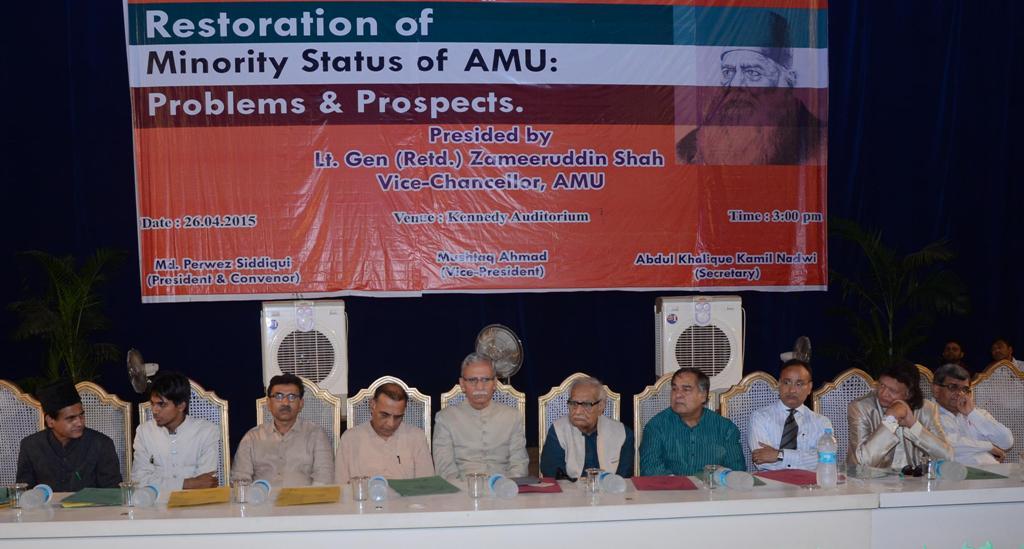
This decision has become a precedent in determining the rights of the minorities under Article 30 of the constitution, but nevertheless it was also widely criticised. The minorities commission ten years later clearly stated that if the Supreme Court’s view in this case is correct then it would mean that a linguistic or religious minority is debarred from establishing a university as in a university can only be established by an act of the central or state legislature. The prominent constitutional lawyer and author H.M. Seervai perhaps put it best when he wrote that:
“It is the first case in which the Supreme Court
has departed from the broad spirit in which
it had decided cases on cultural and educational
rights of minorities… It is submitted
that the decision Is clearly wrong and productive
of grave public mischief and it should
be overruled.”
The issue of AMU Minority Status became a political hot cake, and successive elections saw parties across the ideological spectrum promising to restore the minority status by passing an amendment to the AMU Act. This was finally done by Indira Gandhi government in 1981, which seemed to put the matter to rest.
However, the controversy erupted once again in 2005, when the University tried to make use of the privileges guaranteed under Article 30 and reserve 50% seats for Muslims in Post Graduate Medical courses. This decision was taken by the Admission Committee of the university on 10th January 2005. After being approved by the Executive Council, the decision was forwarded to the Central Government for approval. Subsequently the Union of India gave its approval in a letter dated 25th February 2005 and the admission policy was moved forward.
This decision was challenged in the Allahabad High Court by 34 different petitioners who claimed their right to participate in the admission process for selection against 50% of the total seats had been violated. They challenged it on the ground that Article 30 did not apply to AMU and the decision violated their Fundamental Rights under article 14 and article 29(2) of the Constitution.
The Allahabad High Court ruled in favor of the petitioners, stating that AMU had no right to reserve seats for Muslims. As far as the 1981 (amending) Act was concerned, the HC categorically stated that the Act sought to fabricate history and by merely stating that the University was established by Muslims could not subvert the fact that it was actually established by an act of Parliament. Hence, in legal terms, it ‘read down’(that is, interpreted it in a way that is different from the original meaning intended by the legislators, but otherwise consistent with the Act) the relevant provision of the Act which was intended to guarantee that AMU would come under the purview of Article 30 of the Constitution. Hence, AMU could not be said to be a minority institution within the meaning of Article 30. Subsequently, the decision of the AMU Academic Council and the Executive Council concerning the reservation of seats for Muslims, as well as the letter of approval of the Union of India, was quashed by the Court.
The decision of the HC was challenged in the Supreme Court, but for nearly 10 years now the case is dragging along with no end in sight. The Government of India had earlier supported the contention of the University that it is a minority institution, but on Tuesday the Attorney General submitted before the Court that the government no longer believes so.
The Constitution clearly lays down a vision of society where minorities are not only allowed to exist, but to evolve and prosper along the lines of their own faith and beliefs. What is at stake before the Supreme Court is not only the status of AMU, but our constitutional set up itself that sought to allay fears of majoritarianism by providing adequate guarantees that minority communities will be allowed to develop along the lines of their own culture and beliefs.
It is that vision which has been imperiled by the government’s historic betrayal of the AMU cause, and it is now for the Supreme Court to decide on what has become an unnecessarily contentious and politicked issue.

Thanks.