In these days of heightened xenophobia, racial issues and identity conflicts, Medina Charter (henceforth the Charter) continues to show us the way to secure honorable and dignified life for all human beings. Constituted by the Prophet Mohammed [PBUH] in 622 A.D, it remains a lively document from which many lessons can be drawn to enhance peaceful inter-religious relations. As conflicts driven by politics, economics and differing ideologies become widespread, the Charter serves as an example for resolving these disputes through respect, tolerance and peaceful means. The Charter was constituted such that it was in line with following Quranic verse.
“O people, We created you from the same male and female and rendered you into distinct peoples and tribes that you may recognize one another. The best of you in the sight of God is the most righteous.”
Practically Medina state was the first democratic nation in the world history with unified citizenry (Ummath un Wahida), multicultural expression & sound concern for justice and non-discrimination. Based on pragmatism of Islamic ideology, this Charter succeeded in building multi-religious plural society with freedom to practice religion for all, state guaranteed security for life, wealth, identity and dignity for all its citizens. These are the democratic dogmas and principles that remain unrealized in several nations today across the world.
Onus on Government
In these COVID times, glaring apathy to the woes of migrant workers was strikingly evident. Even the short comings of the health infrastructure and an unprecedented human health crisis was blamed on the someone or the other. In the process the responsibility of the government was shirked off and accountability was diminished. Contrastingly Medina charter makes government accountable and responsible for the welfare of the citizens in an uncompromising manner. Thus the idea of governance evolving from charter is in contrast to an idea increasingly promoted today. It was humanitarian in approach, reformist in nature and growth oriented, with interests of every individual citizen being the core.
State Affairs – Engagement the key
Medina society consisted of multiple tribes with most of them having certain unique traditions and customs; everyone of them rigidly attached to their practices. These tribes added to the diversity of the society and often these tribes would become hostile towards each other. Medina charter approached this with rendezvous spirit. Charter required that state affairs be managed through consultation. Presence of envoys from all tribes was mandated when meeting with foreign envoys, in discussions preceding key decisions. Conflicts were resolved through dialogue in open and mutually respected atmosphere by hearing each side. Thus it evolved an participative model, where every individual included in the pact was assured of dignity and respect.
Rights of Non Muslims enshrined in medina charter
- Security of God is equal for all groups.
- Non-Muslim members have the same cultural rights as Muslims . They have autonomy and freedom of religion.
- Non-Muslims take up arms against the enemy of the nation along with Muslims and share the cost of war. There is to be no treachery between the two.
Salient features of Medina Charter
The Medina state consisted of twenty districts with chief and his deputy. At that time it had a population of about ten thousand. Of these, the Muslims made up only a few hundred; half of it were monotheist Jews, the rest being polytheists. The Charter that governed this state consisted of 47 clauses. Clauses 1,2 and 39 state the formation of a sovereign nation-state with common citizenship – consisting of various communities. Following are few of the salient features of Medina Charter.
- The Charter provided a federal structure with a centralized authority, with the various tribes in various districts constituting a unit and enjoying autonomy in certain matters of a social, cultural and religious character except state security and national defense. (Clauses 3 through to 11 and 26 through to 35 detail these autonomy. Clauses 13, 15, 17 and 44 list the provisions of centralized subjects.). Only in cases of disputes the units could not resolve, recourse for their decisions had to be made to the Prophet, whose decision was final. (Clauses 23 and 41)
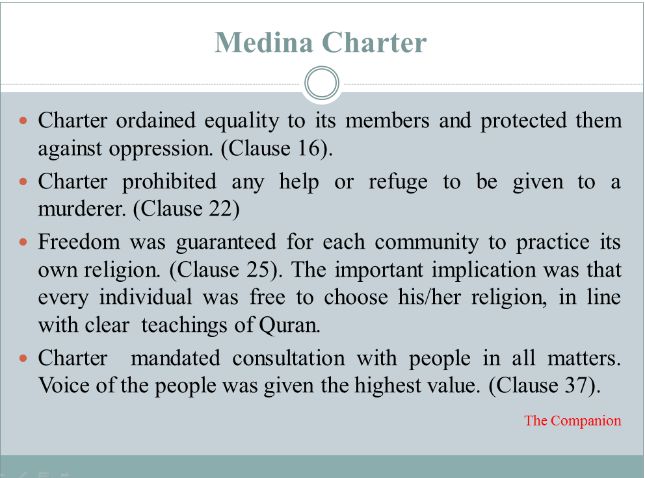
- Charter ordained equality to its members and protected them against oppression. (Clause 16).
- Charter prohibited any help or refuge to be given to a murderer. (Clause 22)
- Freedom was guaranteed for each community to practice its own religion. (Clause 25). The important implication was that every individual was free to choose his/her religion, in line with clear teachings of Quran.
- Charter mandated consultation with people in all matters. Voice of the people was given the highest value. (Clause 37).
Prof. Hamidullah, speaking on Medina Charter, points out the following aspects. “… this new constitution brought with it very important, and to Arabia at least very revolutionary change and improvement, by providing the people with central public institution for seeking justice, in place of everyone seeking it with the power of his own hand or, at best that of his family. This epoch –making innovation .. brought an end for all times to the chaos of tribalism and which laid the basis for a wider institution, viz a state.”
In the light of atrocities on religious minorities across the world, it is time that this charter is revived. This charter is a testimony to the fact that Islam stands for well being of all and also that it is far more pragmatic and capable with regards to other ideologies/systems to establish a just and welfare state.