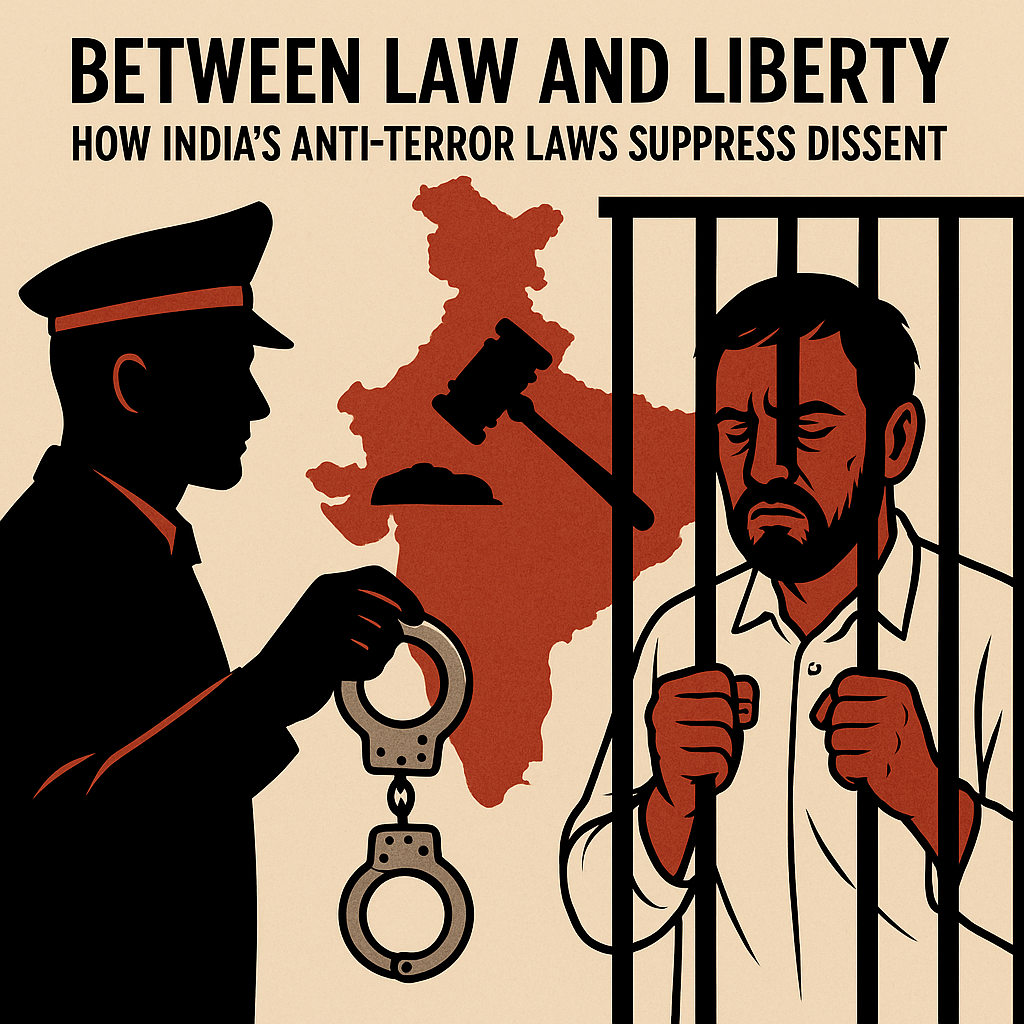
The tension between national security and civil liberties is a perennial challenge in democratic societies. In recent years, the application of India’s Unlawful Activities (Prevention) Act (UAPA) has expanded beyond its intended purpose of combating terrorism to encompass a broader strategy of suppressing dissent. Human rights organisations have consistently raised concerns that the law is being employed to incarcerate peaceful critics of government policy under charges that often lack substantive evidence. As various rights monitors observed, UAPA is frequently “misused… to keep activists behind bars and fabricate cases against them,” resulting in prolonged pre-trial detention without meaningful judicial scrutiny. The impact of this legal strategy is profound: individuals accused under UAPA face extraordinary barriers to bail, only about 23% are granted it, while final judicial outcomes often reveal the fragility of the prosecution’s case, with approximately two-thirds of completed trials ending in acquittal or discharge.
This disjuncture between accusation and conviction underscores a troubling trend: the law’s exceptional powers are being used less as tools of justice and more as instruments of intimidation. Courts themselves have begun to acknowledge this pattern, warning that such detentions appear “designed to send a chilling message… that criticism of government policies will not be tolerated.” The implications are particularly acute for Muslim communities and other politically marginalised groups, who have borne the brunt of these sweeping prosecutions. Civil society actors warn that this sustained use of counter-terror legislation against dissenters not only corrodes public trust in democratic institutions but also signals a broader erosion of constitutional protections. In this light, the UAPA emerges not merely as a legal framework but as a mechanism that reconfigures dissent as danger, thereby narrowing the space for civic engagement and amplifying existing patterns of exclusion.
The Legal Framework: Evolution and Challenges
Historical Context and Legislative Origins
Anti‐terror legislation in India has its roots in colonial-era laws such as the Prevention of Seditious Meetings Act (1911) and the Rowlatt Act. These laws were used to suppress dissent against British colonial rule and laid the foundation for a tradition of preventive detention. Post-independence, the Indian state continued to rely on similar legislative frameworks, adapting them to address the new challenges of national security. The Preventive Detention Act of 1950, followed by the Maintenance of Internal Security Act (MISA) in 1971 and later the NSA of 1980, exemplify this continuity. Today, the UAPA remains the cornerstone of India’s anti‐terror framework, but its broad and ambiguous language has raised serious concerns regarding its potential for misuse (Gopalan v. State of Madras, 1950; Maneka Gandhi v. Union of India, 1978).
Constitutional Safeguards and Their Limitations
The Constitution of India enshrines fundamental rights, including the right to life and personal liberty under Article 21 and protection against arbitrary detention under Article 22. Article 22 requires that an individual who is arrested must be informed of the grounds of arrest and produced before a magistrate within 24 hours. Yet, the exception provided for preventive detention means that these safeguards do not always apply. As a result, individuals detained under laws like the UAPA can be held for extended periods without trial, a provision that stands in stark contrast to the constitutional promise of due process (Indian Kanoon, Article 22).
The judicial journey from A.K. Gopalan to Maneka Gandhi reflects an evolving understanding of liberty and due process in India. While early interpretations accepted the “procedure established by law” as sufficient, later judgments demanded that such procedures also be “just, fair, and reasonable.” Despite these advancements, the legal system still permits extended detentions based on vague notions of “public order” and “national security,” thereby compromising the rights of the accused.
The Rigidity of Bail Provisions and Legal Loopholes
A critical aspect of the current anti‐terror framework is the strict approach to bail. Section 43d (5) of the UAPA effectively limits judicial discretion, often resulting in prolonged pre-trial detention. Courts have routinely upheld detention orders based on “prima facie evidence” of involvement in a larger conspiracy, even when such evidence is circumstantial. This rigidity not only impedes the timely delivery of justice but also creates an environment in which political dissent is de facto criminalised (SCO Observer, 2022). The consequence is a chilling effect on free speech and public protest, particularly among marginalised communities.
Case Studies: Humanising the Impact
Sharjeel Imam: The Penalisation of Ideological Dissent and Intellectual Speech
Sharjeel Imam, a PhD candidate in Modern History at Jawaharlal Nehru University, was charged under sedition and UAPA provisions for speeches made during the anti-CAA protests. His calls for democratic self-determination and nonviolent civil disobedience were construed as incitement to secession and communal disharmony. The charges against Imam underscore the criminalisation of intellectual dissent, especially when articulated by Muslim scholars, and demonstrate how state mechanisms increasingly target ideologically oppositional discourse through national security statutes.
Sharjeel Imam, once an emerging student activist at Jamia Millia Islamia, became a symbol of the state’s repressive response to dissent. His impassioned speeches during protests against the Citizenship Amendment Act (CAA) and the National Register of Citizens (NRC) led to his arrest under multiple sections of the Indian Penal Code and the UAPA. The authorities charged him with inciting communal violence and participating in a conspiracy, even as the evidence against him remained largely circumstantial. Despite instances where bail was granted on certain charges, Imam’s detention on other counts persists, symbolising the state’s unwillingness to tolerate dissent (The Observer Post, 2025).
From a human perspective, Imam’s case is emblematic of the risks faced by activists. His extended detention has not only disrupted his personal and academic life but has also served as a warning to other voices seeking to challenge prevailing government policies. The narrative of his struggle underscores the tension between the right to protest and the risk of being branded a terrorist, a label that carries profound social and legal consequences.
Safoora Zargar: The Gendered Dimensions of Pretrial Incarceration under UAPA
Safoora Zargar, an MPhil student at Jamia Millia Islamia and a vocal participant in the anti-CAA protests, was arrested in April 2020 under UAPA charges while she was pregnant. Her prolonged detention without trial highlighted the gendered implications of preventive detention and the state’s disproportionate response to Muslim women activists. Zargar’s case drew national and international attention to the erosion of constitutional protections and the humanitarian consequences of extended pretrial incarceration under draconian laws.
Safoora Zargar’s case is particularly poignant. A media coordinator for the Jamia Coordination Committee, Zargar was actively involved in organising peaceful protests against the CAA. Her arrest in April 2020, while she was in the second trimester of pregnancy, sparked widespread outrage both domestically and internationally. Charged under the UAPA on vague allegations of being a “key conspirator” in orchestrating riots, Zargar’s treatment has been criticised as disproportionate and inhumane.
The human cost of her detention is significant. Beyond the physical toll of incarceration, especially under conditions that are ill-suited for a pregnant woman, there is also the psychological burden borne by her and her family. Zargar’s struggle highlights how anti‐terror laws can be weaponised against individuals who dare to challenge unjust policies, reinforcing the notion that dissent, regardless of its peaceful nature, is met with punitive measures.
Umar Khalid: Repression of Academic Dissent Through Anti-Terror Legislation
Umar Khalid, a former doctoral candidate at Jawaharlal Nehru University (JNU), became a prominent figure in the Indian student movement. His arrest under the Unlawful Activities (Prevention) Act (UAPA) in connection with the 2020 Delhi riots exemplifies the increasing use of counter-terrorism laws to silence dissent. Despite the absence of direct evidence linking him to violence, Khalid’s speeches and activism were construed as part of a larger “conspiracy,” raising serious questions about due process and the limits of free expression in a democratic society.
Khalid’s case has broader implications for the treatment of activists. His continued detention has not only curtailed his ability to participate in public discourse but also sent a stark message to others: that the state will use its expansive legal apparatus to neutralise dissent. This atmosphere of legal uncertainty and prolonged incarceration has a paralysing effect on minority communities and civil society at large.
Gulfishan Fatima: Localised Activism and the Expansion of National Security Frameworks
Gulfishan Fatima, an MBA graduate, played a key role in organising peaceful anti-CAA protests at the local level, primarily by educating and mobilising women participants. Despite her nonviolent engagement, she was arrested and detained under the National Security Act (NSA), a law permitting incarceration without formal charges. Her case illustrates how grassroots activism, especially when led by Muslim women, is increasingly subjected to securitisation, reflecting a broader pattern of conflating civil protest with threats to national order.
Beyond abstract statistics, the human cost is stark. Gulfishan Fatima exemplifies how UAPA ensnares even modest student activists. Gulfishan came from a humble family; her parents ran a small general store in Delhi and had no political backing. Yet she became active in the anti-CAA protests of 2019–20, even teaching English to local women at protest sites. On 9 April 2020, she was arrested in a first case (FIR 48) on relatively minor charges, released on bail, and then, within ten days, rearrested under UAPA in a related conspiracy case.
Gulfishan has since been jailed without trial on terrorism-related UAPA counts, despite widespread acknowledgement (even by the UN) that her peaceful activism posed no genuine threat. Her supporters note that she was “falsely charged under the draconian UAPA law” merely for defending the Constitution, and that this ambush by anti-terror laws especially betrays her modest background. Her family, including her younger siblings, anxiously awaiting her return, bear the daily grief of her indefinite detention.
Khalid Saifi: Grassroots Mobilisation, Familial Fragmentation, and the Human Cost of Pretrial Incarceration
Khalid Saifi, a 41-year-old Muslim businessman, social activist, and father of three, was a co-founder of United Against Hate, a citizen-led platform formed in response to rising communal violence and majoritarianism in India. Actively involved in coordinating peaceful demonstrations against the Citizenship Amendment Act (CAA), Saifi was arrested on 26 February 2020 amid the Delhi riots and later charged under multiple First Information Reports (FIRS), including the Unlawful Activities (Prevention) Act (UAPA). Despite the absence of conclusive evidence directly linking him to any violent acts, he has remained incarcerated for over four years, emblematic of a broader shift wherein the UAPA is wielded to suppress dissent through protracted pretrial detention.
The implications of Saifi’s detention extend far beyond his liberty. As the primary breadwinner for his family, his absence has imposed acute economic and emotional hardship on his wife, Nargis, a 34-year-old homemaker, and their three children, then aged 13, 11, and 8. Nargis recounts the traumatic morning of his arrest: he fainted in front of their home, and she stood helplessly for hours, watching the street, hoping he would return. Now, years later, she describes UAPA as a law that “does not just affect the individual – it tears apart families.” Her account speaks to a persistent grief: Khalid “misses taking walks with the kids, having pillow fights with them… and most of all, holding them in his arms.” In her words, “I have seen my children grow up before their time,” shadowed by uncertainty and loss.
Khalid Saifi’s case illustrates how anti-terror legislation, when applied expansively and without a timely trial, destabilises entire family systems. It underscores a structural vulnerability experienced by dissenters who lack political patronage or institutional affiliation. Alongside Saifi, several others, including students and grassroots organisers, have faced similar detentions under the UAPA following the 2020 protests. As noted by United Nations human rights experts, “these defenders, many of them students, appear to have been arrested simply because they exercised their right to denounce and protest against [the CAA]”.
The cases of Gulfishan, Safoora Zargar, Natasha Narwal, Devangana Kalita, Umar Khalid, and Sharjeel Imam converge on a shared reality: the UAPA, while framed as a national security tool, often exacts its most devastating toll on ordinary citizens, whose personal and familial lives are profoundly disrupted by its reach where parents report the agony of not knowing if their child will ever see freedom again, siblings speak of deferred marriages, and spouses tell of lives upended by enforced silence.
Broader Implications for Minority Activism
These individual cases reflect a broader pattern that imperils India’s democratic fabric. Notably, the UAPA’s recent enforcement appears aimed heavily at student and intellectual dissent. Commentators have observed that “the large majority” of those charged as conspirators in the Delhi riots case were “young students and scholars”. Indeed, at least five women under 31 – Natasha Narwal, Devangana Kalita, Safoora Zargar, Ishrat Jahan, and Gulfishan Fatima – were swept up as co-accused, alongside several young PhD-holders like Umar Khalid. Rights groups held a press conference in 2024, noting that “student leaders and activists such as Umar Khalid, Gulfisha Fatima, Khalid Saifi…” have now spent over four years in jail under UAPA without trial. This is no coincidence: a researcher from Citizens for Justice and Peace warned that selective policing in the riots probes is “targeted only towards one end,” i.e., the anti-CAA student movement.
Criminalising campus activism sends a chilling message across universities. One editorialist lamented that the idealistic anti-CAA protests – where students “animated… corners of India” are now being crushed by a “massive hunt-down of young protesters,” many of them entirely peaceful. UN experts and human-rights organisations echo this alarm, noting that applying UAPA to students and academics undermines the fundamental right to free expression. In practical terms, student activists report a climate of fear on campus. A CIVICUS freedom-of-association monitor quoted student leaders warning that a new government agenda could mean a “drastic increase in crackdowns on academic institutions,” with already-jailed student leaders left to languish. Faculty and alumni share this anxiety, as one activist puts it, when the state starts detaining scholars under anti-terror laws, “the wells of debate and dissent” that universities rely on are poisoned.
The broader cost is clear: when young Muslims and other minorities see their peers branded “terrorists” for protesting or even speaking out, their faith in India’s pluralistic promise erodes. Student activism has historically been a wellspring of social reform and critical thought in India; today’s arrests risk hollowing out those traditions. In effect, the UAPA’s campus usage turns lecture halls and protest grounds into zones of suspicion, chilling intellectual inquiry. As one observer warned, the continued targeting of student dissent under UAPA jeopardises the “intellectual and democratic future” of the nation. If tomorrow’s engineers, teachers, and doctors learn that asking tough questions can land them in jail, the space for reasoned debate shrinks, and the foundation of India’s democracy is weakened.
Preventive Detention: Constitutional Paradox and Human Rights Concerns
Preventive detention, by definition, involves detaining individuals based on the apprehension that they may commit an offence in the future. In India, this concept is enshrined in several statutes and justified as necessary for maintaining public order and national security. However, the preventive detention exception in Article 22 of the Constitution creates a fundamental contradiction. On one hand, the Constitution seeks to protect individual liberty; on the other, it permits detention without trial in cases where the threat is only speculative.
The early judgments in A.K. Gopalan v. State of Madras (1950) upheld the legality of preventive detention based on “procedure established by law.” However, the later landmark decision in Maneka Gandhi v. Union of India (1978) significantly broadened the interpretation of personal liberty and due process. Despite this evolution, the preventive detention framework has remained largely intact, allowing the state considerable discretion, a discretion that, as numerous cases have shown, can be easily abused.
A critical weakness in the current system is the lack of effective judicial oversight over preventive detention orders. Although the Constitution mandates that detainees be informed of the grounds for their detention and be allowed to contest it, the reality is often starkly different. In many cases, including those discussed herein, judicial reviews of detention orders are perfunctory or delayed. Detainees may remain in custody for extended periods without meaningful recourse, their cases languishing in legal limbo.
This failure of oversight not only violates the spirit of Article 22 but also undermines public confidence in the judicial process. The extended detentions of Imam, Zargar, and Khalid underscore how, in practice, preventive detention can become a tool for silencing dissent rather than a safeguard for national security. Such judicial inertia fosters an environment where the state’s narrative of “prima facie evidence” goes unchallenged, leaving little room for the nuanced debate that is essential in a pluralistic democracy.
Comparative studies of preventive detention practices reveal that while many democracies struggle with the balance between security and liberty, there is often a stronger institutional framework in place to prevent abuse. International human rights organisations have repeatedly criticised India’s approach to preventive detention, noting that its provisions frequently fail to meet international standards of due process and fairness (Human Rights Watch, 2021). The lack of robust safeguards not only contravenes the norms of democratic governance but also creates a chilling effect on political expression, a phenomenon that is especially pronounced among marginalised communities.
The Human and Social Costs of Repressive Legal Frameworks
The personal toll of prolonged detention cannot be overstated. Activists like Imam, Gulfishan, and Khalid endure not only the physical hardships of incarceration but also significant psychological distress. The uncertainty of indefinite detention, coupled with the stigma associated with being labelled a terrorist or conspirator, can lead to severe mental health challenges. Many detainees suffer from anxiety, depression, and a profound sense of isolation, which in turn affects their ability to reintegrate into society once released.
Moreover, the impact of such detention extends to the families of the accused. Loved ones are forced to navigate the dual burdens of legal battles and emotional anguish, often facing social ostracism and economic hardship. In cases like Zargar’s, where the detainee is pregnant, the human cost is compounded by the added stress on both the individual and her family, creating long-term repercussions that can span generations.
The use of anti‐terror laws as a means of suppressing dissent creates an atmosphere of fear that permeates society. When public figures and activists are detained for expressing critical views, it sends a powerful message to others that challenging the status quo carries an exorbitant risk. This chilling effect stifles public discourse and discourages citizens from engaging in the political process, particularly on issues related to government policy and minority rights.
The marginalisation of minority voices is especially damaging in a country as diverse as India. When dissent is equated with terrorism, the state effectively silences those who are most likely to offer alternative perspectives on social and political issues. This not only undermines the democratic process but also perpetuates systemic inequalities, as minority communities find themselves increasingly excluded from meaningful participation in public life.
The repercussions of these legal practices are not confined to the realm of human rights; they also have significant economic implications. Activists, intellectuals, and community leaders contribute substantially to the social and economic development of a nation. When these individuals are detained or marginalised, it stifles innovation, hinders social reform, and impedes progress. Moreover, the reputation of a country that suppresses dissent can affect foreign investment and diplomatic relations, ultimately impacting overall development.
Toward a Reformed Paradigm: Judicial and Legislative Reforms
A fundamental step toward reform is the enhancement of judicial oversight over detention orders. Courts must adopt a more proactive role in scrutinising the evidence presented by the state and in ensuring that detention orders are not used as a pretext to silence political dissent. This requires the establishment of independent advisory boards with genuine authority to review and, if necessary, overturn detention orders. Such boards should be composed of seasoned judges and legal experts who can critically assess the state’s evidence and ensure that the fundamental rights of detainees are upheld.
Legislative reform is urgently needed to narrow the scope of laws like the UAPA. The current broad definitions of “terrorist act” and “public order” allow for significant discretion, which often results in the criminalisation of peaceful dissent. Revising these definitions to focus on demonstrable threats, rather than speculative or politically motivated actions, would help ensure that anti‐terror laws are applied only in cases of genuine risk. Additionally, amending bail provisions to allow for more judicial discretion could reduce the instances of prolonged pre-trial detention, ensuring that individuals are not deprived of their liberty without adequate cause.
Accountability is essential for preventing the abuse of anti‐terror laws. Law enforcement agencies must be subject to independent oversight, and mechanisms should be established to regularly audit their actions. Transparency in the use of preventive detention, such as public disclosure of detention orders and periodic reports on the status of detainees, can foster public trust and ensure that state power is exercised responsibly. International human rights bodies and domestic watchdog organisations should be granted unhindered access to detention facilities, enabling them to monitor conditions and advocate for detainees’ rights.
A vibrant civil society is the cornerstone of any democracy. It is imperative that the state create an environment in which dissent is not only tolerated but encouraged. Legal aid for activists facing charges under anti‐terror laws should be expanded, and civil society organisations must be supported in their efforts to defend human rights. Public awareness campaigns that humanise the stories of activists can also help shift public opinion and create pressure for reform. When citizens understand the personal and collective cost of silencing dissent, there is greater impetus for change.
Finally, international advocacy plays a crucial role in shaping domestic policy. Reports by organisations such as Human Rights Watch, Amnesty International, and the U.S. Commission on International Religious Freedom have already begun to draw attention to the misuse of anti‐terror laws in India. While binding international sanctions may not be immediately forthcoming, sustained pressure from the global community can encourage domestic reform. Aligning India’s legal framework with international human rights standards is not only a moral imperative but also essential for maintaining its standing in the global arena.
Broader Social and Political Implications
The disproportionate impact of anti‐terror laws on minority communities exacerbates existing societal inequalities. In a country as diverse as India, the targeting of activists from marginalised groups further deepens social divides. The use of such laws to detain minority leaders sends a message of exclusion and reinforces negative stereotypes. This dynamic not only stifles dissent but also undermines the democratic principle of equal participation for all citizens.
The conflation of dissent with terrorism has led to a climate of political polarisation, where even constructive criticism of government policies is viewed as subversive. This erosion of democratic norms weakens public debate and limits the accountability of elected officials. When dissent is suppressed, the democratic process itself is compromised, leading to a system where only a narrow range of viewpoints is represented in public discourse.
Personal Reflections: The Human Cost of Silence
Throughout this inquiry, I have been struck by the personal dimensions of what might otherwise be treated as abstract legal debates. The experiences of Sharjeel Imam, Safoora Zargar, and Umar Khalid remind us that behind every detention order and court ruling lies a human life profoundly affected by state action. Their struggles illustrate the precariousness of dissent in a system where legal power is concentrated in the hands of the state, often at the expense of individual freedom.
I recall a conversation with a colleague who recounted the deep-seated fear among activists, a fear that each public statement or protest could lead to indefinite detention. This chilling effect is not merely a theoretical concern; it has real consequences for the vibrancy of public discourse and the health of a democratic society. When voices of dissent are silenced, the social contract is weakened, and the collective ability to hold power to account is diminished.
The stories of these activists are, in many ways, emblematic of a broader human tragedy. They compel us to ask: What is the cost of security when it is achieved by sacrificing the very freedoms that define a democratic society? The answer, I believe, lies in a reimagining of our legal and political institutions, one that places human dignity and the right to dissent at its core.
Conclusion
In reflecting on the legal and human dimensions of anti‐terror laws in India, it becomes clear that the current framework, while ostensibly designed to protect national security, has often been used to suppress dissent and marginalise minority voices. The cases of Sharjeel Imam, Safoora Zargar, Gulfishan Fatima, Khalid Saifi, and Umar Khalid serve as potent reminders of the high human cost of such policies, costs that are measured not only in years of detention and legal uncertainty but in the erosion of democratic values and the stifling of social progress.
This article has aimed to humanise what might otherwise be seen as abstract legal debates by focusing on the lived experiences of those who have borne the brunt of state repression. It is a call for a new paradigm, one in which the principles of justice, transparency, and accountability are not sacrificed at the altar of security. The future of Indian democracy depends on our ability to reconcile these imperatives, ensuring that the rights of dissenting voices are protected, not punished.
As citizens, scholars, and human rights advocates, we must continue to scrutinise and challenge the legal mechanisms that enable repression. The journey toward a more just society is arduous, but it is one that is necessary if we are to preserve the core values of freedom and democracy. Only by embracing reform, accountability, and compassion can we hope to transform the current landscape, one in which security measures do not become tools of terror against those who dare to speak truth to power.
In the final analysis, the question remains: Are we truly protecting our nation from terror, or are we terrorising those who dissent? The answer, as illuminated by the cases and reflections discussed herein, will determine not only the fate of individual activists but the future trajectory of Indian democracy itself.
References
- Gopalan v. State of Madras, AIR 1950 SC 27.
- Maneka Gandhi v. Union of India, AIR 1978 SC 597.
- Indian Kanoon, Article 22 of the Constitution of India.
- SCO Observer. (2022). “Umar Khalid’s Bail Application Tracker.”
- Reuters. (2025). “US Religious Freedom Panel Urges Sanctions Against India’s External Spy Agency.”
- Human Rights Watch. (2021). [Various Reports on Preventive Detention].
- The Observer Post. (2025). [Articles on Sharjeel Imam].
- Al Jazeera. (2020). “India: Charged with Anti-Terror Law, Pregnant Woman Sent to Jail.”