

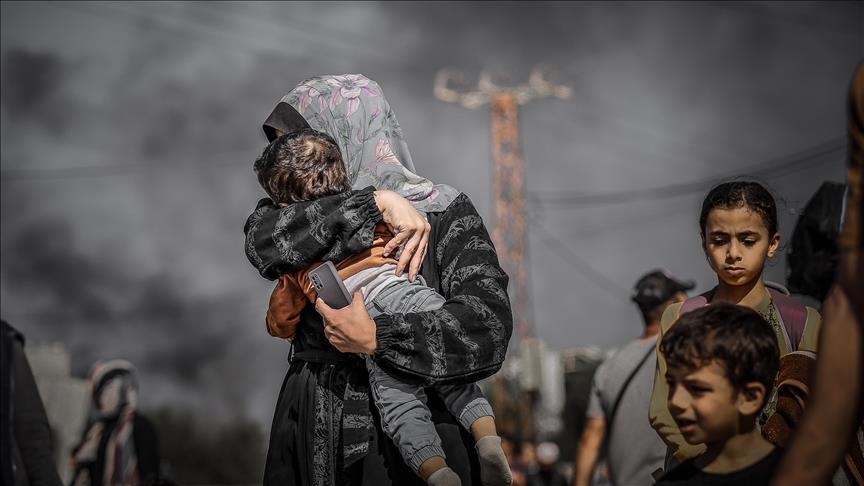
We are humans. But how is this humane?
How do we stand by while children sleep to the sound of airstrikes and mothers carry coffins too small for their sons? How do we speak of justice in a world where a child’s name must be written on their body, not for school books, but so they can be identified under the rubble?
By all accounts, 2024 marked one of the darkest years in recent memory for the children of war. According to UNICEF, it was among the worst for children in armed conflict zones, echoed by the sounds of bombs falling, lullabies interrupted, and childhoods lost. But these aren’t merely statistics. They are the bleeding truths of women and children in Palestine and Kashmir, two of the most militarized and oppressed regions in the world, whose lives unfold like torn pages in a history book no one wants to read.
In Gaza, homes are no longer shelters; they are graves in waiting. The UN reports that nearly 70% of the over 33,000 killed since the war on Gaza began were women and children. Hospitals have turned into mourning halls; makeshift shelters have become schools, maternity wards, and morgues all in one. Pregnant women undergo cesarean sections without anesthesia. Girls deliver their babies in bombed-out ruins with no midwife but trauma. Breastfeeding mothers starve, their milk dried by hunger and fear. Over 1 million children in Gaza now suffer from acute malnutrition, many reduced to skin and bone, their eyes too sunken to dream.
Across the mountains, in Kashmir, silence isn’t peace, it’s suppression. Conflict simmers here like an unquenchable ember. Women, mothers, widows, daughters, live with the permanent absence of the men in their lives: the ‘half-widows’ whose husbands have disappeared, neither alive nor dead. Children here don’t count the days with school bells, but with curfews, military crackdowns, and pellet gun wounds. While Palestine bleeds in the spotlight, Kashmir fades in a curated quiet, muffled under a long history of denial and militarized governance.
The trauma runs parallel. Both lands are stitched with stories of survival that should never have needed to exist.
Women and girls in conflict situations are forced to endure brutal incidents of sexual violence, have fewer resources for protection and survival, lose their loved ones, and have to take responsibility for their families, are forced to join the combatants, or to flee, leaving everything behind. Being women, they also face difficulties during times of menstruation and pregnancy. It gets impossible to maintain and nurture a new life when your own is at stake. They are compounded by the fact that the very nature of wars invades ever more private spaces, becoming a threat to their identity and their security. Added to this, many outbreaks of violence today are of religious or ethnic origin, linked to issues of identity, which play against women and women’s rights. Many of these conflicts are marked by extreme violence and gender-based abuse.
Women’s bodies are seen as “instruments of war” in such zones, and violence is directed towards women in various forms. Women’s physical, mental as well and emotional well-being is at stake; they are often displaced from their land, defrauded, widowed, and left to live as refugees. Modern warfare has had a devastating effect on the lives and dignity of women and girls, as well as on the health and educational services that are essential to family and community survival. Along with reproductive health complications, the adverse effects of conflict hit women and girls harder than it does their male counterparts.
Palestinian women carry the weight of a nation with nothing but willpower and empty hands. They lead protests, raise children, tend to the wounded, and cradle the dead. In Kashmir, women are archivists of resistance. They remember everything, every raid, every disappearance, every bullet fired into silence. They are storytellers and fighters, grieving mothers and fierce defenders of memory.
On May 23, 2025, a powerful Israeli airstrike flattened the home of Dr. Alaa al‑Najjar, a pediatrician, killing nine of her ten children, aged from six months to 12 years, and critically injuring her husband, Dr. Hamdi. Only their youngest child, Adam, survived with serious injuries. Dr. Alaa, who had left for work just before the strike, returned to the unimaginable loss of nearly her entire family. Dr. Hamdi later died on June 1 from his injuries. This devastating event, known as the Al‑Najjar family massacre, starkly illustrates the human toll of the Gaza conflict.
A wedding celebration in Poonch, Jammu & Kashmir, ended in tragedy when an old, unexploded shell detonated during the event. The explosion claimed multiple lives, including the bride, and left several injured, turning what should have been a moment of joy into a scene of grief. The incident underscores how the shadow of conflict permeates daily life in Kashmir, where even weddings can become sites of death rather than celebration.
Stories like these depict that the air is heavy with the scent of tear gas and martyrdom in both areas. There is no innocence left, only resilience hollowed by fatigue.
And still, the women persist.
Their shared pain is not merely a consequence of war, it is a method of control, a system of erasure.
Women and girls should not only be seen as victims of conflict and instability. They have historically had and continue to have a role as combatants, as part of organised civil society, as human rights defenders, as members of resistance movements, and as active agents in both formal and informal peace-building and recovery processes. Wherever women are, peace is. Women and peace are synonyms. Women from 11 conflict and post-conflict countries share stories of fights to rebuild their countries and find peace. The Rise of Islam saw a number of prominent women in combat, such as Nusaybah bint Ka’ab, Khawlah bint al-Azwar, and Ghazala Alaa Salah. Alaa Salah, the woman in white, who became a symbol of the Sudanese fight for freedom, Bissan Oudah, a community organiser from Gaza, Masuma Jami, a peace activist from Herat, Afghanistan, and many more are the epitome of influential women at war. True empowerment is giving space to women to take control of their own lives, building the key supportive frameworks and interventions in a sensitised manner, that allows restoration of peace in these zones.
What should be done?
What is the future of a child who has never known safety? What is justice to a mother who cannot even name her grief? The international community often turns its gaze away or chooses politically palatable narratives, but these women and children are not footnotes. They are the very heart of a struggle for humanity.
This is not a call for pity.It is a demand for acknowledgement. For rage. For reckoning.
Because no child should learn to spell ‘genocide’ before they learn to read. No woman should be forced to mother a generation she knows will not live long enough to become mothers themselves.
From the ashes of Gaza to the shadows of Kashmir, the world owes these women and children more than silence.
It owes them justice. It owes them peace. It owes them the right to live with dignity, not just survive.
Reference:
https://pmc.ncbi.nlm.nih.gov/articles/PMC7612212/
https://iap-kpj.org/the-impact-of-war-on-children/
https://www.un.org/unispal/event/war-on-gaza-impact-on-palestinian-women-and-children/
https://www.nature.com/articles/s41599-024-02742-x
https://vc.bridgew.edu/cgi/viewcontent.cgi?article=2846&context=jiws



Excellent