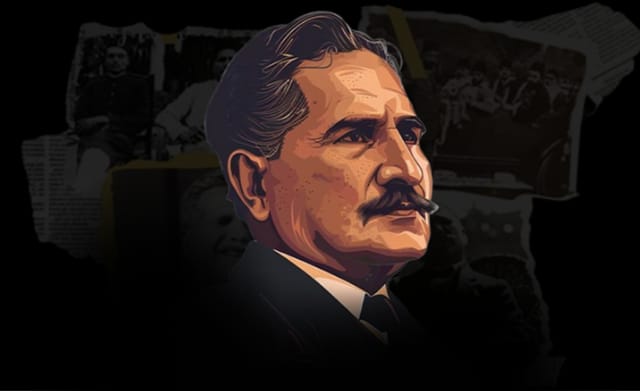
Dr. Muhammad Iqbal (November 9, 1877- April 21, 1938), commonly referred to as Allama Iqbal, is one of the most influential figures of the twentieth-century Indian subcontinent who, through his poetry, inspired the audience for universal values such as freedom, human dignity, and self-resilience. It demands no mention of the fact that his influence extends beyond this subcontinental geography and has proved himself on the global stage, and thus becomes the poet not only of the East but of the West too.
Poets like Iqbal continue to command the audience beyond time and space; his ideas and thoughts woven in his writings hold enduring relevance. In a time when chaos appears as order, trouble as trend, Iqbal has the potential to offer some solid solutions even today, after his departure from this temporal world nearly a century ago.
We are living in a post-modern time where the Ummatic consciousness seems to be resurging, and that longing is apparent among the lovers and followers of the Prophet Muhammad (pbuh). In such a time, Iqbal appears with his soul-stirring words, which contain a powerful emotional longing. His lifelong endeavor was to awaken the Ummah from its slumber and to call for an Ummatic solidarity—a call that stood in direct resistance to the forces of colonial and imperial modernity.
Modernity and the Loss of Ummatic Spirit
The deep penetration of modernity into the Muslim world pushed them to face some unprecedented challenges. The official political disintegration of the long-standing Ottoman Caliphate in 1924 brought the Muslims to the edge of hopelessness. The awe-inspiring technological advancement of the West made the Muslims believe that there is no way to get out of its clutch, let alone to reimagine the Ummatic unity. One of the things that the colonial modernity has done to the Muslim conscience is to criminalize the very idea of the Ummatic spirit (otherwise known as Caliphate), as aptly argued by Ilham Ibrahim in her essay titled Criminalizing the Caliphate.1
Iqbal was among those who not only had first-hand experience of colonialism but also had the experience of being in the land of the colonizers. He is someone among others who is qualified to tell the Muslims the way out of this malaise and envision a prosperous future, bringing the spirit from the enviable and glorious past. He used the medium of poetry to revive the Muslim Ummah. Iqbal had understood well the soul of modernity, and accordingly, he tried to give a very comprehensive response to it in his magnum opus, The Reconstruction of Religious Thought in Islam. He can be summed up as somebody whose methodology was not to bring modernity in line with Islam but of “recapturing the universe with the ‘spirit of abiding revolution’ implicit in the Quran and the idea of the finality of the Prophethood.”
On History: Iqbal’s Reflection
Iqbal emphasizes that the complete severance from one’s history amounts to a form of civilizational suicide. For Iqbal, a people can only build something truly enduring if it remains organically connected to its historical continuity, especially in the case of Muslims, for whom the closure of Prophethood signifies the end of direct divine representation. Hence, a creative allegiance to the past becomes essential, not as nostalgia but as spiritual and intellectual grounding.
Reflecting on Muslim history, Iqbal marvels at its dynamism:
From the day of its foundation up to the beginning of the sixteenth century – about a thousand years – this energetic race (I say race since Islam has functioned as a race-making force) was continually busy in the all-absorbing occupation of political expansion. Yet in this storm of continuous activity, these wonderful people found sufficient time to unearth and preserve the treasures of ancient sciences, to make material additions to them, to build a literature of a unique character, and above all to develop a complete system of law – the most valuable legacy that Muslim lawyers have left us.2
For Iqbal, history is not a static record but a living repository of collective experience. In his words,
History is a sort of huge gramophone in which the voices of nations are preserved.3
Through this metaphor, Iqbal implies that nations live, speak, and resonate through their history. Forgetting or erasing that record would silence their collective voice in the symphony of civilization.
In order to (re)create the future, Muslims must come out from idealizing the past and start contributing to the civilizational progress/remaking rooted in the Islamic ethos of justice, truth, and beauty. They must analyze their past in a critical manner and learn from it, and never to repeat the mistakes made before. The Muslims also need to believe in their immense potential and sow a deep-rooted tree of hope about the future.
On Unity and Hope: Understanding Ummah’s Strength and Soul
Iqbal greatly influenced the Muslim thought through his thought-provoking writings. The Islamic Revolution of Iran owes much of its success to Iqbal. In 1986, Iran’s supreme leader, Sayyid Ali Khamenei, said that the Islamic Republic of Iran was ‘the embodiment of Iqbal’s dream’.4 Ali Shariati also took a keen interest and inspiration from Iqbal. Like Iqbal, he also emphasized the youth generation for the revival of the Ummah.
There is no denial of the fact that the strength of any group of people lies in their being united. Unity is what gives power to a community or a nation. Today, under the direct influence of West-orchestrated nationalism, the Muslim Ummah is divided not only geographically but also spiritually (the scenario at the mass level is changing, though). The repercussions of this division are felt every time we look around the globe. The situation of the Uyghur Muslims in China, the Rohingya Muslims of Myanmar, and the Muslims of Palestine are a few instances to spell out.
It is felt throughout the Muslim world that Muslims must be united to protect not only the Muslim community but also those people who are suffering from injustices, irrespective of their religious background, from the persecution of others happening in this world. For this purpose, in the post-Ottoman world, many revivalist movements emerged to reinstall the power structure for the safeguarding of the Ummah, as was the case during the Ottomans.
It would not be exaggerated to say that many of these revivalist movements are influenced—directly and/or indirectly—by the ideas of Iqbal. In a way, he is much celebrated in this field for the powerful contribution that he made during his lifetime through his powerful and lucid writing and eloquent speeches. These hold immense and undying potential for a new dawn, as his ideas were shaped by the depth of the Divine Message, the Qur’an.
Iqbal indeed emphasizes the universal human values accepted by all religions and schools of thought, but he never forgets that these values can only be achieved through the religion of Islam, as it is the Last Divine Guidance for the entire humanity. Hence, he chose to call to the Muslim Ummah his immediate audience for the reformation/embellishment of humanity.
Iqbal was well aware of the fact that the strength of the Ummah lies in its unity. He frequently reminded Muslims of this most important point. He, in his acclaimed Jawab-e-Shikwa (Answer to the Complaints), profoundly pointed out:
haram-e-pāk bhī allāh bhī qur.ān bhī ek
kuchh baḌī baat thī hote jo musalmān bhī ek
(The Sacred Sanctuary is one, Allah is one, the Qur’an is one,
It would have been something great if Muslims, too, were one.)
Amidst this gloomy and wretched situation of the Muslims, Iqbal and his thoughts serve as a beacon of light as he intended to ignite the hearts of Muslims to recreate the lost glory of the Ummah, considering the changes that have taken place over the passage of time. Out of his humility, he says that he is not a poet; he just chose it as a medium to convey what he wanted to convey before the world in general and the Muslims in particular. He is not merely a poet to be celebrated, but an original Islamic thinker and philosopher whose ideas have the potential to solve many of our problems we are struggling with, and envision the Ummatic vision in a changing and fractured world. Going beyond simply celebrating him as a “great poet”, we need to read and think of Iqbal and his ideas as a tool of solution from within. One interesting point that makes him quite unique—and perhaps he alone holds this distinct position—is that he is a person who is revered by every school of Islamic thought found in the Indian subcontinent in particular. Taking Iqbal as a point of departure can serve us well in this venture for the quest for (spiritual) unification of the Muslims.
We are living in a world that is categorized by mistrust, deceit, hopelessness, and so many other negative characteristics. It seems fairy tale when we talk about Ummatic unity in this gloomy time. But Iqbal motivates us when he says:
Millat Ke Sath Rabta Ustawar Rakh
Pewasta Reh Shajar Se, Umeed-e-Bahar Rakh!
(Keep very strong communication with the nation.
Remain attached to the tree and have spring’s expectations!)
(Bang-e-Dra-153)
Holding onto hope is what gives us the power to move toward the goal we wish to achieve. Losing hope equates to killing oneself in one’s own hands. A person who has iman in Allah, the Everlasting, cannot entertain losing it. In the following couplet, Iqbal lovingly reminds us of the secret of resilience in his poem Aik Naujawan Ke Naam (To A Young Man):
Na Ho Naumeed, Naumeedi Zawal-e-Ilm-o-Irfan Hai
Umeed-e-Mard-e-Momin Hai Khuda Ke Raazdanon Mein
(Despair not, for despair is the decline of knowledge and gnosis:
The Hope of a Believer is among the confidants of God.)
(Bal-e-Jibril: 139)
Islam Beyond Borders: Iqbal as a Ummatic Thinker
It would be an injustice to Iqbal if we were to confine him merely within the category of a poet. Though he was indeed a poet par excellence, his own words testify that poetry, for him, held only a secondary place. As Shamsur Rahman Faruqi notes, Iqbal wrote in 1919: “Poetryness in my poems had but a secondary place. I don’t at all have aspirations to be counted among the poets of this age.” In another letter, he confides: “It’s a wonder that people regard me as a poet and press me to recite my poems to them, although I have nothing to do with poetry.”5
More than a poet, Iqbal was a visionary, philosopher, and thinker. Professor Yahya Michot, Fellow of Islamic Studies at the Oxford Centre for Islamic Studies and member of the Faculty of Theology, Oxford University, regards Iqbal as the last great Muslim thinker in the lineage of al-Ghazali, al-Razi, and Shah Waliullah.6 For Iqbal, poetry was not an end in itself but a medium—an instrument to convey his vision and philosophy. His words were meant to be translated into action. Through his poetry and prose, he sought to awaken a sense of purpose within a despairing Ummah, urging it to rediscover its mission and moral strength.
It is estimated that more than five thousand books have been written on Iqbal—most of them in his praise, with very few offering critical engagement. The paradox is striking: the same Iqbal who so powerfully denounced nationalism as a form of idolatry ended up being celebrated as the “spiritual father” of a nation-state. He writes:
Islam appeared as a protest against idolatry. And what is patriotism but a subtle form of idolatry—a deification of a material object? The patriotic songs of various nations will bear me out in my calling. Islam could not tolerate idolatry in any form. It is our eternal mission to protest against idolatry in all its forms. What was to be demolished by Islam could not be made the very principle of its structure as a political community. The fact that the Prophet prospered and died in a place not his birthplace is perhaps a mystic hint to the same effect.7
Iqbal’s critique of nationalism was not merely political; it was spiritual and civilizational. He believed that Islam’s essence lies in transcending all artificial boundaries—geographical, racial, and linguistic—and that its ultimate aim is the unification of humanity under the sovereignty of the Divine. Hence, his vision was not “Islam in a country” but “Islam beyond borders.”
In his Presidential Address to the Twenty-Fifth Session of the All-India Muslim League, delivered at Allahabad on 29 December 1930, Iqbal declared:
One lesson I have learnt from the history of Muslims. At critical moments in their history, it is Islam that has saved Muslims and not vice versa. If today you focus your vision on Islam and seek inspiration from the ever-vitalising idea embodied in it, you will be only reassembling your scattered forces, regaining your lost integrity, and thereby saving yourself from total destruction. One of the profoundest verses in the Holy Qur’an teaches us that the birth and rebirth of the whole of humanity is like the birth and rebirth of a single individual.8
For Iqbal, the individual held a central role in the transformation of society. His private notebook reveals this striking definition when he defines Islam:
Islam is not a religion in the ancient sense of the word. It is an attitude—an attitude, that is to say, of freedom and even of defiance to the Universe. It is really a protest against the entire outlook of the ancient world. Briefly, it is the discovery of Man.9
Iqbal’s vision is therefore not merely an abstract ideal but a call for the reassertion of human dignity and spiritual freedom. He saw in the rejuvenated Muslim individual the seed of Ummatic revival—an individual rooted in faith, conscious of history, and oriented toward divine mission. His thought thus invites us to imagine Islam beyond the confines of the nation-state and to restore the lost consciousness of the Ummah as a living moral and spiritual organism.
References
- Ilham Ibrahim, “Criminalizing the Caliphate: Transforming Remembrance into Resistance,” Ummatics, Sep 2, 2024, https://ummatics.org/papers/criminalizing-the-caliphate.
- Iqbal, Javid (ed.), Stray Reflections: The Private Notebook of Muhammad Iqbal, Iqbal Academy Pakistan, Fourth Edition, 2008, p.91
- Ibid, 97
- Anjum, Zafar, Iqbal: The Life of a Poet, Philosopher and Politician, Introduction, p. 17.
- Faruqi, Shamsur Rahman, “How to Read Iqbal,” The Annual of Urdu Studies, 20 (2005), p. 7 (f.n.).
- Anjum, Zafar, op. cit., p. 13.
- Iqbal, Javid, op. cit., p. 35.
- Sherwani, Latif Ahmad (ed.), Speeches, Writings and Statements of Iqbal, New Delhi: Adam Publishers and Distributors, 2008, p. 29.
- Iqbal, Javid, op. cit., p. 153.