

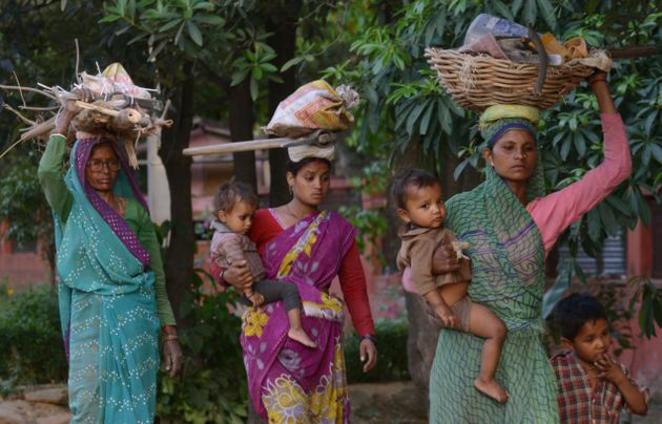
After more than a decade of Gender Budgeting at the national level, 48 percent of India’s population—its women, are still discriminated against, not solely because of their gender but also due to its intersection with caste, class and religion-based discrimination. It is therefore imperative to evaluate and understand the latest union budget on the basis of its differential impact on men and women, and to really dissect the budget to see whether it is actually doing enough to mainstream gender into our budgetary decisions.
Amidst some chest-thumping, a new scheme to provide LPG connections to women belonging to close to 1.5 crore BPL households was announced and Rs 2000 crore has been set aside for the same. This is a welcome move, considering the fact that women suffer adversely from the ill-effects of Chulha-cooking. Rs 500 crore has also been allocated for SC, ST and women entrepreneurs under the ‘Stand Up India’ scheme to promote entrepreneurship among the marginalized sections. The allocation for the National Mission for Empowerment of Women has also been almost doubled to Rs 50 crore. The Nirbhaya schemes too received a significant boost of Rs 500 crore, up from Rs 30.50 crore in the Budget 2015-16 RE.
While such moves are commendable, it must also be noted that schemes related to skill-development initiatives for women and adolescent girls have received little attention. Schemes aimed at providing credit to women in the informal sector have received little to no attention. The Rashtriya Mahila Kosh (RMK) received a paltry sum of Rs 1 crore after having been completely ignored in the previous budget, while the Priyadarshini Scheme received no allocation at all this time around. Further, no allocation was made for the implementation of the Domestic Violence Act, as pointed out by Yamini Mishra (Gender Budgeting Specialist, UN-Women). While some steps have been taken to end the violence against women outside the household under the Nirbhaya scheme (Women Helpline etc) and to combat trafficking, violence within the household has largely been ignored.
With the latest Economic Survey pointing out that there is a significant difference in the labour force participation rates among men and women in both rural and urban India, a greater push to reduce this gap should have been given in the current budget.
The Gender Budgeting Statement (Statement 20 of the Exp. Budget, Vol. I), first introduced in 2005-06, includes budget provisions and schemes meant for the benefit of women. Part A of the Gender Budgeting Statement (GBS) includes schemes which allocate 100% of the total provision towards women and Part B of the GBS details schemes where the allocation amounts to at least 30% of the total provision.
The total magnitude of the GBS remains at 4.5% of the total budget, seeing no change from the previous budget. The increase in the BE 2016-17 over the RE 2015-16 was recorded at Rs 9375.64 crore or 11.5%. What is worrisome however, is that the total allocation under Part A remains hardly unchanged at Rs 17412.01 crore, marginally up from the previous budget’s total of Rs 16,657.11 (which was reduced to Rs 11388.41 crore in the revised estimate). The budgetary allocation to the Ministry of Women and Child Development (MWCD) has also decreased in real terms. ‘Gender Budgeting’ in itself, as a scheme under the MWCD received Rs 2 crore, unchanged from the previous budget. Another important aspect pointed out by Mishra was the inadequate allocation of Rs 400 crore towards the Indira Gandhi Matritva Sahyog Yojana (IGMSY), which aims at providing conditional cash transfers to pregnant and lactating mothers to promote better health and nutrition. One of the nine pillars of Monday’s budget was to “cover all under welfare and health services”. In this context, an amount of Rs 400 crore seems to be too little to achieve this universalization of mother and child nutrition.
The actual benefits to women from the schemes under the Part-B of the GBS of course remain hidden, and the differential impact on men and women, of schemes under the Part-B is extremely difficult to analyze.
With the latest Economic Survey pointing out that there is a significant difference in the labour force participation rates among men and women in both rural and urban India, a greater push to reduce this gap should have been given in the current budget. Further, given the hidden nature of women’s unpaid labour in household work and child-care, steps need to be taken to institutionalize such unpaid labour especially in the form of building of crèches, health care facilities to the aged etc. Moreover, under the budget’s theme of ‘Transform India’, infrastructure to meet women’s needs, including restrooms, feeding rooms etc in offices needs to be addressed. The level of financial inclusion of women in the country’s formal banking sector still remains poor. While some progressive steps have been taken in this budget, we still have a long way to go to realize the gender-just society that we hope to live in.