
In his fifty odd minute’s farewell speech—outgoing US President Barack Obama hailed the ‘institution of Democracy’ and its values for most of the time. Obama passionately pleaded the case that the US wouldn’t abstain from ‘installing democracies abroad’. She can’t afford to “withdraw from big global fights to expand democracy.” No matter it may cost millions of innocent lives, humongous refugee crises and mass abuse! Democracy has to be installed. That’s the part of “protecting America”.
This time around, the same ‘Democracy’ ditched America back home. And, it gave birth to the most “racist, bigoted, xenophobic, Islamophobic and anti-minority” president in the US history. Donald J. Trump didn’t rise out of phoenix. He represents the systematic malaise, inherent flaws of this institution and deep resentment of American people piled over years of disguised rule.
On 20th January Donald J. Trump was inaugurated as the 45th president of the United States of America. From a billionaire business tycoon to the promotion to most powerful position on earth with nearly ending the political career of veteran Democrat Hillary Clinton altogether—the rise of Trump is the bigger story than hoax popularity of Obamas and Clintons!
Now, Trump is going to take over a country that has lost almost all its confidence in the democratic process and even its elected leaders. He is taking over an America that is more divided than it has ever been united. Be it wealth, race or ethnicity–he takes over the US that has for the first time faced the challenge of being global hegemony after the post-cold war period.
It’s an obvious truth, neither has Trump ever held a political office nor does he have the experience to run it. He has to gather the people around him who are familiar with policy making. So, one can expect a volley of controversial statements from Trump in coming days while the real work will be left for the people he has managed to gather around him.
A Look at Trumps Cabinet:
Mike Pence: He has been picked as the 48th Vice president of US. An arch Neo-Con who actually believes the US should have never left Iraq. It should have kept its troops there.
Rex Tillerson: Picked up as the Secretary of the State. He is the former Chairman of Exxon Mobile Corporation and a trustee of Centre for Strategic and International studies— a neo-con Think Tank which also has its trustees as Henry Kissinger, Richard Armitage, and Rezenski.
Former Lt. General Michael Flynn: Picked up as the National Security Adviser. He sees the Muslims as the key reason for terrorism around the world. He completely supports Trump’s comments on vetting Muslims when they come to the US.
Gen. James Mattes (Retd.): He will be the Secretary of Defense. He is a former military man who believes Iran is the root cause of all evil.
The other appointment is his son-in-law Jared Kushner who historically has financed illegal settlements in Israel. Essentially, he will reward those who came out early to support him. For example, the finance director of the Trump campaign and former Goldman Sachs director Stephen Mnuchin has already been appointed as Secretary of Treasure, billionaire Wilbur Rose has been appointed as Secretary of Commerce. Appointing key associates and pro-business people to his office is the trend Trump is likely to continue in 2017.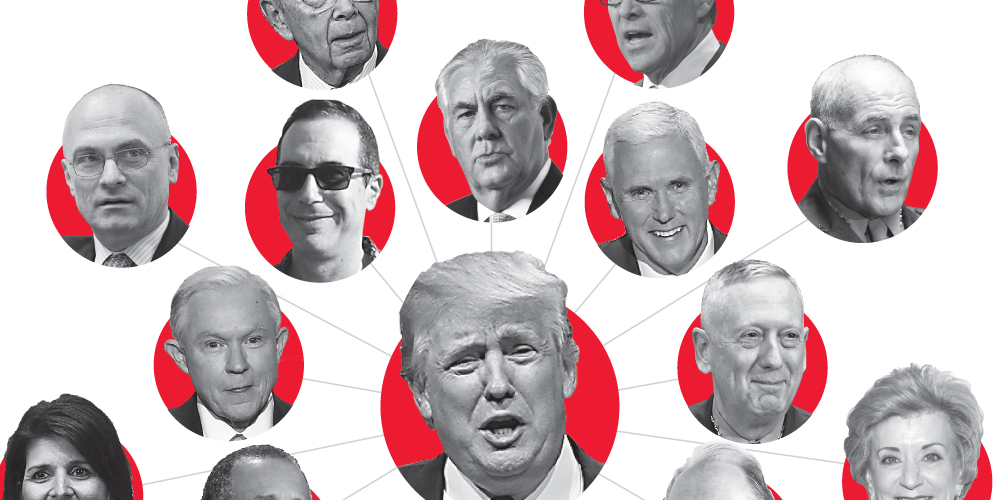
US foreign policy under Trump: A General Overview
Up until now, the foreign policy of US has swung back and forth from overreaching global adventures and then to withering self-criticism and retreat. Trump’s approach could avoid both. It’s possible that Trump’s approach may lead to a much more stable foreign policy.
The US under Trump will squarely focus on America’s vital national interests–narrowly defined especially its economic interest. This doesn’t mean the US will be unwilling to work with friends and allies on shared interests. It will. But, only when such friends and allies are prepared to bring real assets to the table
With over 800 military bases in over 70 countries—the vast US Empire— took a heavy toll on US economy. Recognizing the strain on the economy by the extended empire, Trump administration can give up the image of a global supercop or big brother attitude. The rationale will be: reshape the economy in the bad patch, homogenize the country along specific cultural lines/ values and come out all guns blazing with another spell of absolute hegemony. So, Trump can be expected to pursue a more transanctional approach that could be entirely realistic and potentially much more predictable. But we should be under no illusion—this is going to take us into the world we have not known in eight decades. The world that can be devoid of one or two dominating powers!
Trump’s approach vis-à-vis Islamic Civilization:
Trump has called Islam as his number one enemy followed by China, Iran and Russia. Trump-ian era marks the beginning of the end of healthy engagement between the civilizations.
Unlike his cunning predecessor who judiciously dichotomized Muslims into ‘culturally assimilated’ and otherwise binaries and devised his policies both within and outside the country accordingly; Trump administration views all Muslims as the potential soft power within the country who can’t be assimilated but in turn, can shape ‘US values’ within. Trump, however, will face immense legal hurdles in launching an all-out war against Muslims in the US that can also sharply polarize the country. Many Muslim analysts believe that Trump can burst the bubble of ‘idea-of-America’ and can help forge much needed Muslim unity but all this has to come at a price. All in all, Trump’s guiding principle vis-à-vis Muslims within the country is going to be strategy less. He is going to play tactical rather than at long term strategic level.
Other than that, the US adventures in Muslim lands will not stop despite the regime change. Even if we look at the people he has picked up to work, they all believe in the continuity of the existing US policy.
The Rise of China! Can it be peaceful?
Defensive Realists like Kenneth Waltz and Offensive Realists like John Mearsheimer have debated at length on the rise of China—whether can it be peaceful or otherwise? Mearsheimer’s vision seems to be the driving force for Trump vis-à-vis China.
Under Donald Trump, the US will cease to view the rise of China as essentially benign. That has been the approach of American policy to China. It has been a consensus on foreign policy and many corporate interests. Trump’s administration to China extends way beyond the mere trade imbalance (4:1).It has to do with the series of issues extending from financing the rise of potential geopolitical adversaries and obviously pointing the issues like the cyber warfare to South China Sea dispute. Donald Trump’s take on China reflects the public opinion which has viewed it much more as a threat than an opportunity.
Trump on India and Russia:
As the Trump administration moves away from Europe, as it moves towards Asia and confronts China, as it continues to focus on so-called ‘war on terror’, it will be looking for friends, potential partners who share these concerns. India under the hyper-nationalistic regime of Modi— Trump administration will see a potential ally.
The Trump administration is attempting to wean Russia away from China through engaging over places like Iran especially Syria. The aim is to weaken both Russia and China by creating a divide between them. Trump defended Russia against the allegations of hacking. To the unsuspecting eye, he seems to support Russia by appointing Russia-friendly Secretary-of-State Rex Tillerson. Under-Secretary to him is Neo-Con John Kelly who is mostly likely seen behind the wheel driving the policy for Russia. Trump statements for Putin are really as a leader or as a person. We haven’t seen Trump support Russia as a nation. It takes people’s attention away from the Russia which they believe is authoritarian, has severe media gag and doesn’t ‘respect rule of law’.
From Globalization to De-globalization:
When the US was thriving economically, they rigorously advocated the doctrines of globalization. Today, with the economic rise of new players like China on the level playing field and west’s economic slowdown, the former out rightly alarms to snub the concept altogether. And, China suddenly finds itself as the new advocate of globalization thesis.
One of the Trump’s most questionable stand concerns the recent trade treaties. Trump has a protectionist stand on Trade. He believes the current deals are hurting American workers and companies. More specifically he doesn’t approve of Trans-Pacific Partnership (TPP), the Transatlantic Trade and Investment partnership (TTIP) and the North American Free Trade Agreement (NAFTA).
The TTP included 12 countries with almost Eight hundred million consumers. The members have the combined GDP of about 28 trillion USD. The TTP seeks to link American economy eleven others around the pacific. It’s ambitious but ultimately it’s far too complicated to work. The TTP is only in its infancy and has not been ratified; meaning in 2017 Trump will have no trouble overturning the concept. And without American participation, the concept will be rendered meaningless. In the long term, the failure to implement the TTP will diminish the American influence in the pacific.
TTIP seeks to bring about lower trade tariffs, reduce regulatory barriers and spread forth cheaper goods and services in the US and EU. The TTIP is one of the biggest agreement of its kind, however, the deal is still years away from the real structure. Like TTP, Trump can also scrap TTIP but it will little change the state of affairs. In fact, the EU may prefer to ditch the draft either way since the TTIP seeks to get rid of non-tariff barriers. The TTIP would boost the EU’S economy at 120 billion USD. However, in Europe, the treaty has been criticized for reducing the regulatory barriers. This would result in lower quality of commodity and services.
NAFTA is a trilateral trade bloc in North America. While some Canadian may be skeptical that Trump may change the agreement. However, he will be powerless to do so. The trade bloc is an existing treaty. In other words, it’s the American law that a president can’t change laws. Only US Congress can. And regarding NAFTA Congress isn’t expected to adjust its position. In fact, Trump would be isolated in his attempt to undermine the NAFTA since it would disturb the trade. For instance, the goods and services trade between US and Canada amounted to 662 billion dollars. The Ottawa is the second-largest goods trading partner and without NAFTA the flow of goods will diminish due to Tariff and non-tariff barriers.
Stand on Immigration:
Trump has stated that he will deport illegal immigrants from Mexico and other countries. And he will construct a wall on Mexican-American border. Yet in 2017, mass deportation legislation will fail to pass. First, there are an estimated 11 million undocumented immigrants in the US. However illegal immigration exists in the US because of US citizens who are willing to hire workers without documentation. Trump could focus on fining and arresting citizens rather immigrants themselves. It would upset the construction and Agriculture lobbies in Washington. For these reasons, it’s unlikely Trump will unlikely do against illegal immigrants. Trump could do it only after the long legal battle to overturn executive orders of erstwhile US president.
Trump could also block Syrian refugees or refugees from war zones from entering the US. With the Right media coverage, the deportation of hundreds of thousands of people and denying Syrian refugee from asylum would be just as dramatic as the 11 million illegal immigrants. Trump may view this as a low-risk objective however in pursuit of such goals; he would find enormous opposition in the senate by the Democrats as well as the Republicans. As far as the wall on the Mexican border is concerned, Trump could technically build it but it would be completely meaningless. A wall can’t stop the smuggling of contraband for the same reasons it can’t stop illegal immigrants. The flow of contraband is not a matter of physical security. As long as there is a demand for contraband, Americans will smuggle guns into Mexico and later will smuggle narcotics into the former via checkpoints through ‘systematic smuggling’ and bu exploiting loopholes in security.
Tailpiece:
Trump–whether one likes it or not—is, without a doubt, the biggest game changer of 2017. As president, he would face tremendous bureaucratic challenges. Some would say these bureaucrats prevent America from being great yet others will say that the constitution limits the harm one president can do. If Trump fails he will be replaced in four years, however the populist, nationalist, Islamophobic and xenophobic sentiments that have spread throughout the US are inherently more alarming than any president. In the past, disillusioned societies have often facilitated strong leaders who have harnessed the populist anger to break the rule of the system yet the populist phenomenon is not unique to the US. As America opens the Pandora box for new era— the UK, the Netherlands, France, India, China and Japan and many more will soon follow as we gradually enter into the nationalist-populist era. And, many Muslims will see Trump as the triumph card, yet knowing that the cost to pay for this stake is high.