
The air in universities these days has hit ‘intimidation is the new black’ tagline. Routes of democracy seem to have taken a sideline, (a fault line perhaps) –as students keep getting vandalized in this ‘hyper-nationalistic’ atmosphere, sometimes for the acts ideally they should be rewarded –voice, articulation of political partaking and activism. By contrast, the very ethos of our democracy includes ‘democratic dissent’.
Plausible –if it is, universities stand for a ‘universe’ in themselves. They are social laboratories, where not one but numerous ideologies meet, only to open a broader range of ideas and debates and to create a fertile ground for social and political experiments and discoveries. All –but students packed with dissent have increased in wavelength so much so that they are centre to intimidation these days.
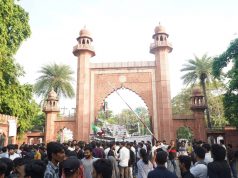
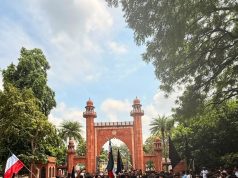
In the row of ‘fighting authoritarianism’, students of Jamia Millia Islamia, New Delhi on 21st of this month organised a massive protest, rejecting ‘Students Council’ that the authorities have decided to create instead of a Students Union. Few important features of the council include –VC as its president (hence sovereign character deleted), no PhD student to be its member and participation to rather be limited to the CRs.
In 2006, Jamia had banned student’s union election on campus, though students have kept protesting for that silently, it had a little impact. But the current decision by the authorities has drawn a lot of attention lately and the protests seem to take even more of the mass with it.
“All the students in the University strongly condemn this unconstitutional and incompetent Student’s Council whose electoral college will be limited to CRs only. This authoritarian Student’s Council (to be headed by the VC) is being imposed on us 17000 students of JMI. We demand a democratically elected Students Union in Jamia Millia Islamia for the larger welfare of the students’ community of JMI…” –posted NSUI (National Students’ Union of India) JMI unit on 18th of March on its social media timeline.
Looking at the pattern of increasing attempts to shun student voices and of trying to depoliticise the student mass, disregarding their political participation, one thing is for sure –there is some immense power, power of solidarity and power of ‘student interaction’ which creates fear in them. Yes, it’s the power of student camaraderie.
The clear intimidation practices targeted on students these days have undeniably created an atmosphere of fear (that the despotic system wants to instill in students), but somewhere, through an invisible but credible thread of cohesion –students across universities are coming under a common identity –student identity, and are together fighting for student rights.
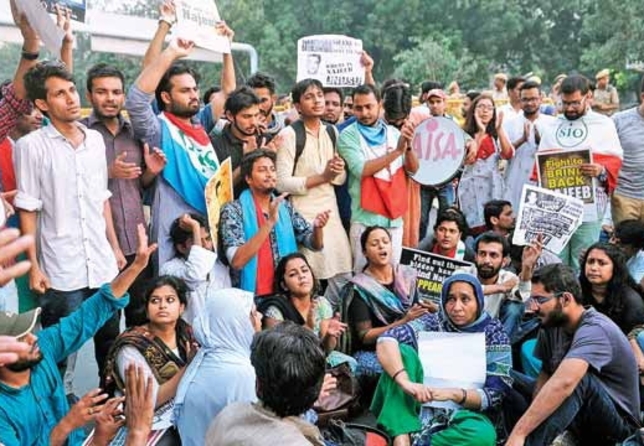
A discernible example proving the above argument sound is the protests launched by various institutions demanding justice for Najeeb Ahmed –the missing student of Jawaharlal Nehru University (JNU). From #JusticeForNajeeb to #WhereIsNajeeb, from facebook to twitter these trends (online protests) have seen all the more ‘coming together’ of students across university borders. Though, Najeeb’s existence is still a big question, though Fatima Nafees (Najeeb’s mother) hasn’t got her son back, though ‘justice’ seems afar – a silent and invisible but strong movement has already begun and there is no looking back.
Coming back to the argument of vandalizing students –authoritative bodies or the bodies that have ‘taken’ authorities in hands, what hurled this process, (although less popular than that of 9th February 2016 incident of JNU –the wave of ‘official’ meaning of ‘nationalism’ that it created) was the Ramjas College incident. Umar Khalid –an activist and Doctoral fellow at JNU had been invited as a speaker for a seminar on ‘Cultures of Protest’ at Delhi University’s Ramjas College. According to the students, Akhil Bharatiya Vidyarthi Parishad (ABVP) backed by Rashtriya Swayamsevak Sangh (RSS) and Bharatiya Janata Party (BJP), disrupted the seminar and on 22nd February (the next day) when students tried protesting against the disruption of the seminar, ABVP goons attacked students, teachers and journalist, according to students who fell victim to the incident.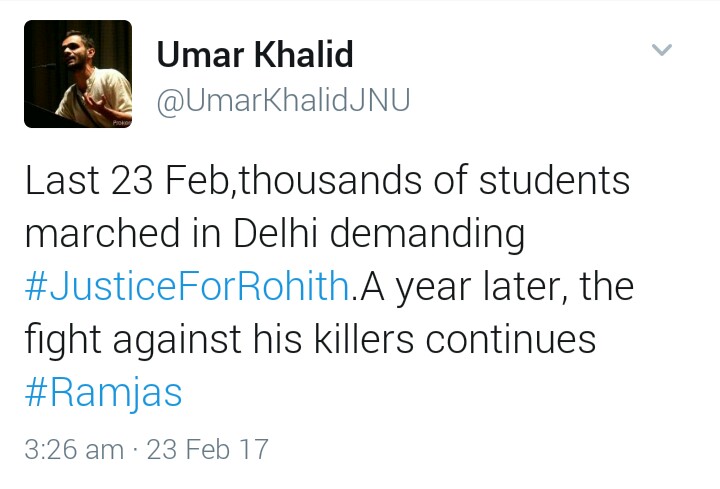
It is important to look closely at the incidents of past while keeping track of the ongoing issues, because there is a palpable pattern to reject the student voices. Instilling ‘fear’ in students is their prime tool –as they use it quite often, putting students behind bars over ‘facebook posts’ over ‘sedition charges’ over ‘anti-nationalism’ over ‘opposing the government’ and also over things like speaking up against fascism and bigotry.
“The incident at Ramjas College is not an isolated one, rather there has been a concerted campaign by the ABVP students and youth activists to dominate campus life in India in the name of Nationalism” –The Quint
The pattern discussed above, follows steps to decelerate the student’s activism, creating fear –as the prime tool, the other steps include (through breaching down Student Unions) minimizing student interface and dividing the mass over the identity they easily get divided –religious identity.
Today, the students in India are not just fighting for student’s rights against the system but the state additionally. The fight ahead is not limited to the University boundaries but the country’s, against extortion rather. The ever shrinking space for this task makes it unbelievable and quite fictional, but the fight has to grow stronger, the students have to come together and take up the issues in ‘solidarity’. Because one thing that we students have (despite of the many, many differences) is our unity, other than our ideas and dissent power. Instances might slightly prove otherwise, but those instances would be few and our stories of unity would overpower them, so let’s write more such stories together.