

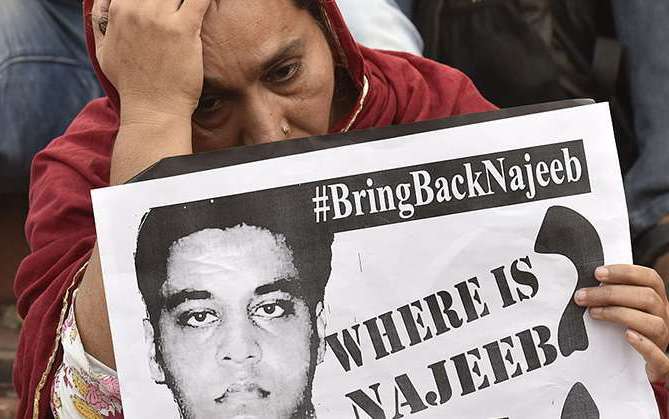
While I was travelling from New Delhi to Calicut in Mangala-Lakshadweep Express last week, I met a research scholar from Jawaharlal Nehru University. In the initial talk itself, JNU campus issues came up in our conversation. Meanwhile she criticized BAPSA (Birsa Ambedkar Phule Students Association), a well-known Ambedkarite student movement in JNU. She told that they are dividing JNUSU (Jawaharlal Nehru University Students Association) by raising their own concerns separately. She further criticized that they are also against non-Dalit movements who raise Dalit issues. I was shocked as I always do while witnessing such criticism
As for me, her criticism was a good metaphor to understand how secular liberal minds distort oppressed voices of the country. At the same time they agree, as an undisputed notion, that the most deserved voice is women security and most necessary freedom is that of a woman. But it gets distorted when it comes to the question of other oppressed sections. Eventually by fishing in this troubled water, liberalism suppresses the oppressed voices just like the Brahmanism in a brahmanically structured society. It is more evident regarding Muslim issues.
The stark reality of this manifestation can recently be traced back to a JNU Muslim student Najeeb Ahmed’s mysterious case of disappearance. He is/was a research student at School of Biotechnology JNU, hailing from Badaun, Uttar Pradesh. He was assaulted by a gang of Akhil Bharatiya Vidhyarthi Parishad (ABVP), the student wing of Rashtriya Swayamsevak Sangh (RSS), at his room No.106 at Mahi-Mandavi Hostel on 14th October 2016, who verbally abused him on communal lines and physically attacked even in front of Hostel Warden. He was badly beaten by iron rods and as a result suffered serious injuries including a number of fractures. Slogans like “All Muslims are terrorists” and “Pakistani Mullahs Go Back” could be seen in common rooms and on walls of bathrooms in the hostel. On the next day, Najeeb went mysteriously missing at 11 AM from his hostel room. It seems like a kidnap as he got disappeared after being subjected to the brutal attack by ABVP gang.
But public reaction on this incident both from media and student community in and outside of the campus was nominal. Soon after students realised that Najeeb was missing, they started protest gatherings in the campus with the concerned students. But no media came to cover it. There were no live reporters, no breaking cards in TV screens; media hesitation was obvious. Just months back, this same JNU was full of OB vehicles to report Kanahya Kumar’s return from police custody. Considering Najeeb’s mysterious missing case, it had same or more News value in a sense. But it has been neglected. And was even reported as a scuffle between Najeeb and ABVP gang last night, instead of one-sided lynching of Najeeb, against the eye witness statements that report otherwise.
In the wake of this incident, Najeeb’s mother Fathima Nafees Ahmed has given petition to Vasant Kunj Police Station wherein the police have registered a case under section 365 (Kidnapping or abducting with intent secretly and wrongfully to confine person) of Indian Penal Code on 15th October 2016. It’s been almost three months since Najeeb Ahmad went missing from campus, but the JNU administration and the Delhi Police have been inactive and biased in finding and ensuring justice to Najeeb and punishing ABVP culprits. The JNU administration constituted a proctorial committee for probing the alleged ‘scuffle’ and identified four ABVP workers namely Vikrant Kumar, Ankit Roy, Vijender Thakur and Aishwarya Pratap Singh, who got ‘punished’ through transfer of hostel. The proctorial committee recommended to take action against Najeeb also, after he is found. The Delhi police continue the investigation at a very low pace by raising reward amount for anyone providing information about Najeeb. In response to a habeas corpus plea filed by Najeeb’s mother Fatima Nafees on 29th November 2016, the Delhi High Court asked Delhi Police and the university to “cut across all political barriers” and look for him. But the police probe has been highly trivial. They are asking court for more time to find him as the accused are not ready to cooperate in the enquiry. To this, Fathima Nafees’s Lawyer had accused police of giving ‘VIP’ treatment to ABVP students, instead of interrogating them. Najeeb’s family is desperately waiting for his return.
This is obvious that there was a deliberate negligence from a well-organized state machinery (police) in handling a Muslim research scholar’s kidnapping case. But in later days, we have witnessed even more severe issues. The Delhi police conducted a raid on Najeeb’s home on 28th January, 2017, as part of the probe of Najeeb’s kidnap case, with huge number of police in early hours of the day. This indicates that police were functioning as a tool of right wing government. Remember that this same police had given the report asking for the incorporation of the accused to Delhi High Court. Such a raid on accused ABVP members would be more than enough to catch them, but the police is not interested to do that yet.
Najeeb’s issue cannot be understood by singling it out. It rather has to be understood as a part of the series of growing incidents of atrocities against Muslims from Akhlaq’s murder to Bhopal fake encounter. But when we come across this particular case of Najeeb, it says something more to Muslims of the nation. Protests have been going on across the nation demanding justice for Najeeb since he disappeared. But when this question is raised by SIO of India and concerned social groups, some alleged that it is not a Muslim issue; they call it merely a student issue. Although it is very clear that Najeeb was targeted because of his religious identity, the ‘secular’ logic still continues to argue that once we talk about religious identity, it is always communal. This basic drawback in the mainstream secular understanding of religious identity, especially a minority identity can be very much seen in the movement #JusticeForNajeeb.
Anti-Muslim sentiment can be seen working at the core of this nation’s making, and the violence against Muslims can be seen as a common denominator of Indian social existence. The communal violence in India is organized with a larger aim to justify the caste system by keeping Muslims as an external other. In such a serious juncture, it is not only disheartening but disappointing that the so called ‘progressive’ organizations are still afraid to raise the Muslim issue openly. Also, one has to look at the histories of ‘communal violence’ in India and see that they are nothing but Sangh’s one-sided Fascist onslaught on a particular community. Instead of looking at the global propaganda of ‘war on terror’, and the continuing spectra of partition haunting the Indian Muslims, the progressive movements are still caught up in the mere secular-communal binary which is prompting them to step back from the movement.
The major issue here is the lack of understanding of the incident from its core, and that itself is the main reason why the movement is getting weaker day by day. Najeeb’s question is largely and clearly a Muslim question, and one has to take it like that only. One can’t see and analyse the issue within the limited binary of secularism vs communalism. At the same time, there is need to look and accept the weakness of this binary. When Brahminic fascism is targeting the Muslim community, it is essential to categorically state that first, and then only go for the appropriate protesting measures.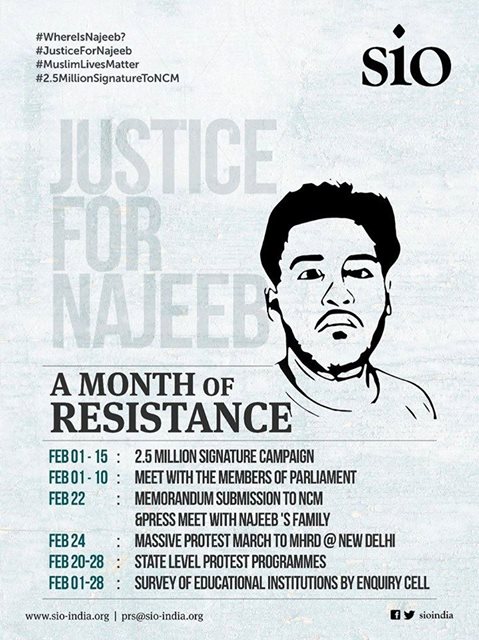
As I explained initially in this article how distortion takes place with oppressed voices, it has once again been proved by this argument. This is a targeted game plan to silence the Muslims’ voice regarding their own issues. This is actually a form of Islamophobia. By the demonising projection and negligence of state machineries, media, and the community at large, Muslims in the nation are suppressed even from resisting an atrocity. It is nothing else, but a discursive violence on Muslim social fabric.
Muslim students feel intimidated and threatened in universities by their mere presence. Meanwhile they are traumatised and are in a state of fear in the context of rising anti-Muslim atrocities across country and even universities are not much safe and secure for them to ensure their right to life and right to education.The attack on Najeeb Ahmad is clearly a hate crime and assault motivated by hostility towards minorities, especially Muslim students pursuing their studies in higher educational institutions. The atmosphere created by leaders of the ruling party at the Centre at different levels is the context in which such crimes are occurring. So, Sio of India demands appropriate action to ensure safe and secure atmosphere for minority students in educational institutions. Almost three months after Najeeb Ahmad went missing from campus, the Jawaharlal Nehru University administration and the Delhi Police have been inactive and biased on finding and ensuring justice to Najeeb and punishing ABVP culprits. Najeeb’smother as well as the student community have been protesting to bring back him and to seek justice for him. We also demand justice for Najeeb Ahmad through immediate and effective investigation. Sio of India is conducting a signature campaign demanding justice for Najeeb and has decided to submit a memorandum to National Commission for Minorities. We hope active participation and cooperation of the public to ensure social justice in our country.

[…] to mark their celebration. But in Kerala, girls are using Mehndi to mark their protest this Eid. ‘Where is Najeeb, A mother is still crying’ asks the majority of these hands, remembering the JNU student Najeeb […]