
It is generally held that for any society or community to succeed and to have a substantial voice in the political sphere, they have to be a part of the system. System, here, means the bureaucratic structure or the ruling apparatus of any state. There are limits to exert voice from outside, for instance, by lobbying, a common ground of such pressure group activities. This is done by giving the responsibility of the self to some other players who are affluent enough to carry them out in the state apparatus. It is been observed, particularly in Indian scenario, that such lobbying turns out to be opportunistic at times. Generally, those smaller factions or identity-based segments are at the bitter sides of the receiving end. Another manifestation of this ‘vicious’ cycle is the idea of tokenism. When elections are due, to mobilize and garner vote base, again these sections are utilized and are reduced to mere tools to succeed. To make them on their side, major players provide them seats to assemblies so as to appease the entire vulnerable, depressed, minority communities and so forth. What happens or not, at the end of the day, state apparatus runs the state, nation and ultimately the country. It is as clear as daylight that basic premises of what constitutes a nation or not are at times sponsored by the state. In the Indian context, the largest democracy on the planet, this is too obvious and one can easily understand that it is on the boil in these times and is supposed to pick up the pace in the subsequent episodes. There are many such players in India, as mentioned earlier, who try to raise their voice but goes unheard with due attention as they don’t have adequate representation in both political sphere and state apparatus.
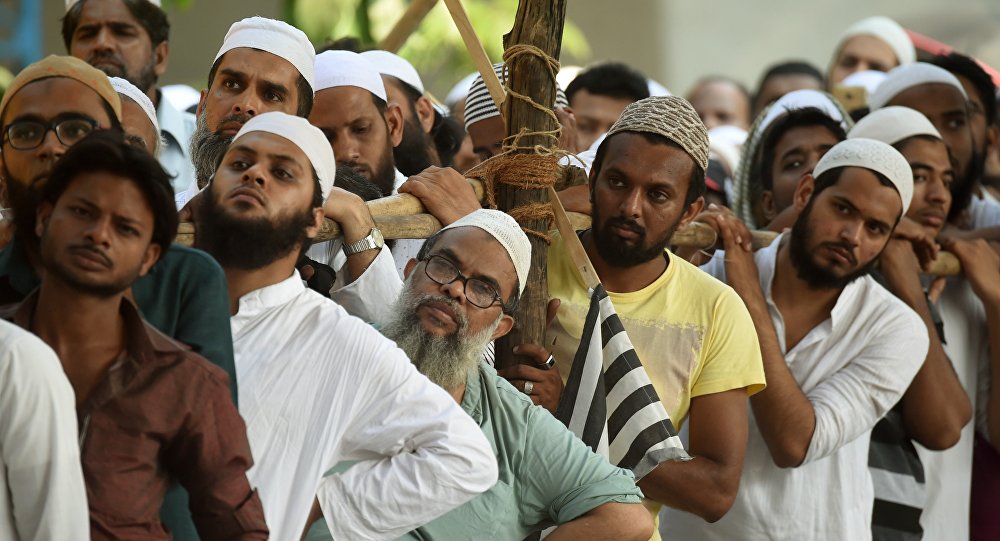
This piece of writing intends to focus on Muslims of the country and then to derive binaries from Central Asia, the core of Heartland, as portrayed by Sir Mackinder. Muslims, in general, lack presence in all three estates of democracy barring some area-specific exceptions. Any kind of activity occurring outside the system has a limit to be successful and then to reap dividends. In India, various instances of selective targeting of Muslims have taken place extensively, adding to the list the latest Rohingya refugee crisis. We have also seen law and justice turning backside against Muslims in many cases. When one gets into the latent facets of this, it is easy to
understand that those who run the system sponsor something and defends the same for their partisan benefits. Law, police, media, public opinion etc. are angled into this corner that others become unable or are too late to convince the general society about the realities and the technicalities that are involved. Serial bomb blasting episodes the country had witnessed in the previous decade is one such instance and this had led to visible cleavages in society.
Earlier, same was the plight of Muslims in Central Asia until they recognized the need of working through the system as drivers and not just as passengers. The Muslim community was very downtrodden to the extent that even religion was highly contaminated. All those evil practices and superstitions had lowered the level of community and were nothing more than just a collection of individuals. Russian authorities, who had colonized this area, were also trying to maintain the status quo, as they had not much to worry about the potential friction that may arise. It was in the second half of the 19th century, progressive movements and cultural reform ideals started sprouting here. Efforts made by Behbudi (1874-1919), Munawwar Qari (1878-1931) etc had started to make inroads into the society. They were nationalists, but not on theological lines as to what Russian administration was suspicious of. They demanded Turkestanis to have a say in the administration of their homeland. Their primary aim was to educate people and to turn them into assets of their society. Even though they had to face extreme resistance from within the community, as the general public was into the fold of ulama, slowly they turned to be in support of these reformers. They convinced their people the need of using other social platforms to elevate their status in society and to lead them.
If someone were in a position to advise or guide others, then how were they able to get into that position? Many of the pioneers of this reform movement too came from the ulama circle- the religious elite. But some of them had vast travel experiences that made them witness realities around the globe. In ‘Muslim’ countries of the west, they witnessed such kinds of modernity manifestation that were beyond their comprehension. This made them realize that their society was not just regressive but was actually decaying. On returning, they tried to instil such ideals in Central Asia too. Not too far away, in Crimea and Tatar, Muslims were playing an active and instrumental role in their social set up. This also added to the introspection of these reformers.
They found the necessity of education to lift themselves rather than being instruments of oppression.
Every instance of political turmoil creates opportunities for new players to emerge provided they tap the potential. In Russia too, Revolution of 1905 provided such opportunities but these reformers and their followers were not able to utilize the opportunity as they couldn’t display a collective action. They were not trying to topple the authority, but to increase their presence in the political sphere and to have a say in the administration of their land. Next decade became a milestone in the pages of history as it witnessed the First World War and the famous Russian Revolution. But by then, these reformers, known as Jadids, were able to inculcate more political consciousness among people. It made ripples in society; as more and more people started to align with them. The first generation of Jadids was from the old school, trying to steady the ship from their bitter past experiences, and was liberal but the second generation, who supported Jadids realizing the need of change, was highly critical of the old order. They had become stakeholders in polity and even Bolsheviks had come to terms with them. Rest is history that how brutally Stalin finished of these reformers for questioning the rule of Central Asian offices completely by Russians. They raised the issue of indigenization of state apparatus that is totally justifiable to which Russian authorities turned back.
But as generally said, an idea cannot be killed. Even though strict repressive measures were taken, the perception of working through the system had caught the attention of people. Jadids enabled the community to climb ladders in the pyramid from darkness to the top echelons of power. The relevance and strategic importance of Central Asian countries in International polity today are visible to the entire globe. From an era of darkness, they rose to one of the most sought-after economic destinations on the planet. Earlier, they were just subjects and had no voice or otherwise, they did not try to exert themselves. Well-off sections, who were present here during 18th and 19th centuries, used their wealth to celebrate themselves and did not use it for the upliftment of the society. But champions of reform led the society out of the impasse and took them to another level. Jadids channelized the community’s money, manpower etc. to educate people and to create awareness. They held extensive campaigns ranging from literacy to sanitation to gender justice and so forth.
This case has been taken to illustrate the need of having cadres inside the power structure. For Muslims in India too, if they need to climb ladders as said earlier, they have to be a part of the system. As they are already late in the race, it may take quite a time to enjoy the fruits, but not too long. Yes, there are many valid reasons for them being late, but remember past is past. Muslims in many parts of the country are still against entering the Government sector. To those who are adamant to enter the system, it’s high time to change your mindset as there is a limit to play as an outsider. Mere economic progression, beyond a limit, does not help to cater to the needs of the community. Not only for Muslims but for all out there, keep trying and motivating people to be a part of the administrative process. Remember, the first best time was a couple of years back, but the second best time is now.
REFERENCES:
Baldauf, I. (2001). Jadidism in Central Asia within Reformism and Modernism in the Muslim World. Die Welt Des Islams, 41(1), 72–88. Retrieved from http://www.jstor.org/stable/1571377
Jawaid, M. A., Jehangir, K. N., Bose, S., & Research, I. C. of S. S. (2007). Minorities of India: problems & prospects. Indian Council of Social Science Research in association with Manak Publications. Retrieved from https://books.google.co.in/books?id=NyUwAQAAIAAJ
Khalid, A. (1999). The Politics of Muslim Cultural Reform: Jadidism in Central Asia. University of California Press. Retrieved from https://books.google.co.in/books?id=HjNfWREAdMoC
Mushrif, S. M. (n.d.). Who Killed Karkare? Pharos Media & Publishing. Retrieved from https://books.google.co.in/books?id=GxqjSQAACAAJ
Sartori, P. (2010). Towards a History of the Muslims’ Soviet Union: A View from Central Asia. Die Welt Des Islams, 50(3/4), 315–334. Retrieved from http://www.jstor.org/stable/41105358
Shorish, M. M. (1994). Back To Jadidism: the Future of Education in Central Asia. Islamic Studies, 33(2/3), 161–182. Retrieved from http://www.jstor.org/stable/20840165%5Cnhttp://www.jstor.org/stable/pdfplus/20840165.pdf?acceptTC=true