SIO Telangana has embarked upon a 10-day campaign “Aasha-e-Zindagi”, targeting the issue of addiction. The campaign aims at bringing into public discussions awareness on the potential threat of addiction covering various topics like drug abuse, addiction psychology, rehabilitation processes, drug gangs and mafia, preventive measures and possible solutions, and role of government and family and others.
This campaign is being run at a time when the youth of this country are getting trapped in the nefarious web of addictions, on an unprecedented scale. It is also an established phenomenon that the ‘educated youth’ are particularly at the centre of this menace, which is enough to set the alarm bells tolling. Apart from drug addictions, today’s generation appears to be waist deep in various other addictions like pornography, alcoholism and vulgarity.
To tackle this problem, before the situation goes unattended, SIO Telangana has decided to take it upon itself to challenge the situation and pull out the country’s future from traps of addiction. Apart from bailing out the trapped youth, creating a barrage to restrict the youth getting attracted towards such addictions, SIO aims to address the conditions which give rise to such addictions. To explore and envisage such grass root level problems a ‘Round Table Conference’ was organized which was attended by intellectuals from various fields. The participants include Dr. Minhaj, Vice President Psychiatrist Association, Telangana, Yaseen Wahab, Advocate Hyderabad High Court, Abu Aimal Azad, Journalist, Khalida Parveen, Hyderabad based social activist, Khalid Khan, Secretary AIM, Asma Rubab, social activist, Sana Wahab, Lawyer and many more.
Speaking on the occasion, renowned social activist Ms. Khalida Parveen outlined the organized manner in which the drug mafia is working in the city. She quoted a few examples from her own field experience to expose the shocking secrets of drug abuse.
Coming down heavily on the government and legislations in this regard, Advocate Yaseen Wahab rued the lack of ‘preventive legislation’ to prevent the phenomenon of addiction. He suggested that instead of making remedial legislations and awarding punishments, the governments should focus more on measures to prevent the occurrence of the crimes. Since no matter how much strict rules the government make, but the anti-social elements would find out a loop hole or an escape route.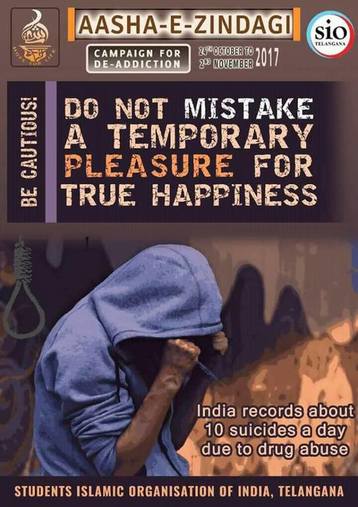
During the course of the discussion, the participants agreed on fighting the menace of addiction on three fronts, all at the same moment.
1. Strengthening individual personality: As the saying goes ‘you are the creator of your own destiny’, to fight the addiction menace one should primarily focus on strengthening their personality. If one’s conscience is pure, no matter how strong the attraction is, it wouldn’t allow getting into the nefarious web. It’s ultimately the person himself who is going to decide as to get trapped into the web of addiction or not. So, a person must be made mentally so strong that he should always be able to take firm decision to not get into the web of addictions.
2. Creating strong family relations: Psychologists and activists among the delegates underscored one common aspect recurring in the cases of addictions-disturbed family life. Children from closely knit family are less likely to get into the menace. Whereas children whose family life is less pacific, they are prone to the problem. In most cases youth from less bonded families are the first to go on the track of addictions. As they fail to find relief and comfort in their families, they get an urge to discover new avenues of happiness and solace. Thus, maintaining healthy family relations works wonders, and prevents the youth from straying towards negative thoughts. Even if such problem arises, counseling and discussing within the family would easily wipe away the problem.
3. Positive attitude of society towards the addicts: The society must accept that addiction is also a form of diseases like other occurring diseases. It should not allow the affected person to feel isolated or alien. Instead maintaining a positive attitude with the addicts would surely have a remarkable impact on their rehabilitation.
Participants with their academia and experience held discussions on various aspects of addictions. Preventive and remedial measures were suggested. The conference was chaired by Br. Layeeq Ahmed Khan Aqil, Zonal President, SIO Telangana. He welcomed and briefed the delegates on the ongoing campaign and the efforts being invested by SIO to tackle the problem. He stressed the need for strong family relations and moral education to prevent the occurrence of such evils. He called upon the government and the civil society to systematically tackle the problem. He advised to treat the addicted youth through professionalism and with empathy. He called upon the delegates to go down the history lane and revisit the case of banning liquor in the Islamic state of Medina. The people who would virtually drench themselves with liquor at every possible occasion, had given up completely on drinking. It may sound strange but it is a historical reality. Those wishing to tackle the menace of addiction, must take cue from it.
Started on 24th October, the campaign will end on 2nd November.