

In Delhi, February 2017 has started to look a lot like the February of 2016. At this time last year, the Rashtriya Swayamsevak Sangh’s student wing, the Akhil Bhartiya Vidyarthi Parishad, accused some students at Jawaharlal Nehru University of shouting slogans they claimed were anti-national after pushing a Dalit Phd scholar Rohith Vemula at HCU to commit suicide.
The intensifying cultures of menacing, spreading of lies and roughing up ideological adversary, whet in Hyderabad Central University (HCU) and Jawaharlal Nehru University (JNU) last year, are now burgeon pan-India. The day may not be that too far when classrooms will start to resemble like army barracks. The alarming rate at which the university campuses, the space for academic debate and political engagement is shrinking as mere ground where right wing ideologues want to curb freedom of speech is something perturbing. The new normal on campus is an atmosphere of fear coupled by the threat of violence from foot soldiers of those in power.
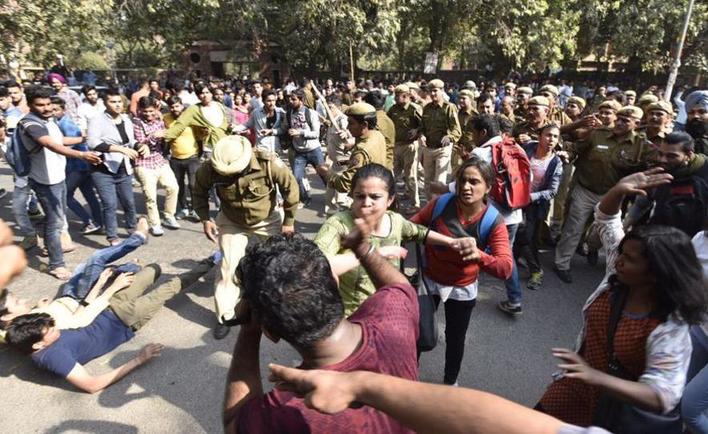
The latest victim to ABVP’s hunting ground became Ramjas College, which had invited Umar Khalid, a PhD student at JNU currently facing charges of sedition for anti-national slogans, to speak in a seminar on life in Adivasi areas. Faced with the threat of violence from the ABVP, the college decided to call off the seminar. That, however, did not deter the ABVP from going violence and soon activists attacked Left-wing students and professors, hurling stones and thrashing them and dragging women by their hair. The blatant acts of thuggery were an attack on the idea of the university, on wisdom and reasoning, on the rights manifested in the Constitution, and on the very idea of India.
The Ramjas College violence is the clearest sign yet of what is in store for the country if such politically-sanctioned hooliganism remains unchecked. First, the ABVP violently disrupted the literary event and forced not just the cancellation of Umar Khalid’s talk but the entire programme. Next, it attacked students in and around the college who had gathered peacefully to protest this assault on their democratic rights.
Apart from Ramjas College, the impact of the ABVP’s wrath has extended to the Ambedkar University Delhi (AUD) where authorities ‘postponed’ an event marking the anniversary of the Kunan Poshpora mass rape in Kashmir of 1991. While, SGTB Khalsa College (University of Delhi), which was forced to cancel its annual street play competition, the Times of India reported. Amit Tanwar, president of the ABVP-led Delhi University Students’ Union (DUSU), claims he told the principal that if there were “objectionable and anti-national” elements in the event, security for it could not be guaranteed.
Universities have the mandate to promote open discussion and that is why, historically, parties and politicians who dislike democracy tend to turn campuses into battlefields. The BJP and sanghparivar are no different. After coming to power in 2014, they have not taken kindly to the liberal spaces that have evolved in various universities over the years. The list of the ABVP’s acts of vandalism and violent attacks has been lengthening by the day. From disrupting seminars, subverting curricula, to muzzling all forms of dissent – academic and non-academic alike – the ABVP has become adept at using university campuses as sites for pushing a divisive, communal agenda.
The tragic suicide of Rohith Vemula, the attack on JNU, and the spate of incidents involving the ABVP at universities in Allahabad, Ranchi, Lucknow, and Jodhpur speak volumes of shrinking democratic spaces. It is also an open secret that the ABVP enjoys the blessings of the very top – both at the party and government level – to act as moral police, even to the extent of taking the law into their own hands.
Traditionally, institutions of higher education have served as fertile ground for critical discourses. Yet, more and more institutions in the country are coming under fire for fostering an ethos of free expression. As the consequences of being deemed “anti-national” loom large, university administrations across the country appear to be seeking comfort in the path of least resistance.
[…] pelting stones, hurling abuses, and even resorting to violence at times. This week at DU’s Ramjas College, ABVP displayed what it has been doing all along. In past it has manhandled the Proctors, Vice […]