“Strike in unison, for also upon us is the executive worry of making sure that the judgment would be more conductive for an irretrievably fractured society.” If this was the motive behind the unanimous verdict, full marks then to the maturity depicted by the apex court, akin to the score of Allahabad High Court for its verdict of 2009, in its effort to put rest to, the most sensitive and polarizing, if not the most complex case before Indian judiciary.
Unlike its unanimous bench, the findings of the Apex Court lack uniformity. If deductions and derivations are of more worth than speculations, what seems to suggest is that the Court has ditched sense in order to be seemed as wise. To quote a few contradictions, the SC says that title cannot be established on faith and belief. However on the other hand it provides little support to its decision as to why there should be a temple built instead of the erstwhile mosque. The Archeological Survey of India fell short of making any such finding that there was any temple beneath the Mosque. In the absence of proof, has not the Court let the faith and beliefs of a particular community prevail over its legal reasoning? Even if the report of the ASI that the mosque so constructed was not an empty land and which may or may not have been a temple is to be believed; the SC is silent as to why then should the benefit of such ambiguity be given for the construction of a temple? However, had even an iota of this benefit been tendered to the Sunni Waqf Board which proved the existence of the mosque since 1528, the Court would not have demanded proof or denied the probability of prayers been offered in the subject Mosque for 325 years until 1857.
A complete study of the thousand paged judgment may bring to light many more details of justices and injustices. Glaring defects, has unfortunately gone on to become the most noted precedent and facet of judgments that tend to have high stakes involved. Whilst admitting submissions pertaining independently to the inner space and outer courtyard by respective parties, the SC has surprisingly contemplated that the entire site be considered as a composite whole; and ended up taking away even the symbolic one third that was granted to the Sunni Waqf board by the Allahabad High Court. What the court has been successful in doing is to apply balm to the losing side which for some felt like salt onto their wounds. Invoking its powers under Article 142 of Indian Constitution, the Court has provided some justification as to why a ‘suitable land’ of 5 acres be granted to the Sunni Waqf Board. To its credit, the court did intend to strike a note of its secular credentials. However, the court, by its unanimous verdict that a temple should be built at the disputed site has implicitly concluded that there existed a temple prior to mosque which in turn implies that the mosque was built illegally after demolition of the temple.
Chief of the questions that may arise will not be whether the court acted contrary to the report of ASI or undisputed facts but whether the Indian Judiciary is now toeing the line of Indian politicians of assuaging all sections, by means of an appeasing judgment? Grant the powerful its wish and to the weak – some sops in exchange for their due?
Some have begun to opine that it may have been wise to not fan the raw emotions of the fringe faction. One that does not differentiate the bringing down of structures having domes on them, either living or not. However, to be wise is the prerogative of the Legislature and Executive. The task of a court in matters like these is to provide justice, irrespective of possible outbreak of chaos upon its implementation. The court at best can provide constructive interpretation of laws that are ambiguous or empowering in nature, of which the grant of a five acre land as a balm is not an example.
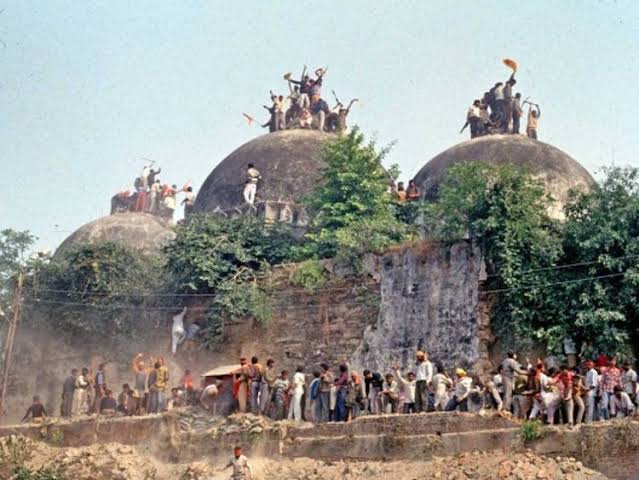
Whether the Court was just in letting down merits of the few, upholding the belief of many, winning the faith of the strong, losing that of the weak and to be more of wisdom than justice, remains to be answered. And like the decrying in today’s verdict – the desecration and demolition of the Babri Mosque in 1949 and 1992 as “egregious violations of rule of law”, it may be hoped that some four or five decades into the future, posterity will have one phrased answers to questions being posed today.