
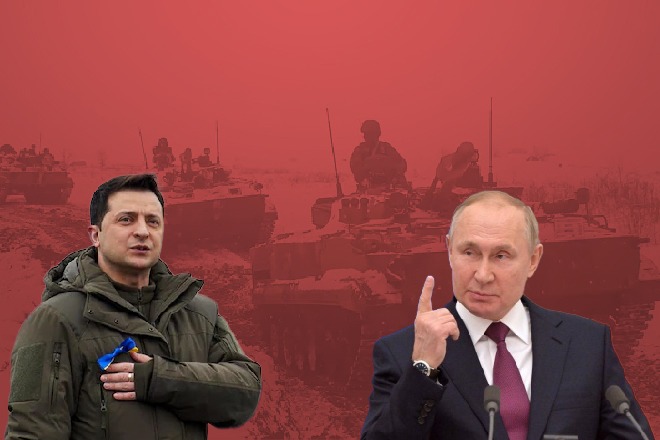
On the early morning of 24th February 2022, Russian president Vladimir Putin ordered a major military operation in Ukraine. Russia has launched an all-out attack on Ukraine by land, sea and Air. Russian ground forces are gradually entering into Ukraine from various sides. According to experts, the capital of Ukraine (Kyiv) may fall anytime soon into Russian hands. Ukraine president Vladimir Zelensky declared martial law in Ukraine and called for Ukrainians with battle experience to take up arms and fight against Russia.
In response, the US, UK and other European countries announced various sanctions against Russia but refused to interfere militarily in Ukraine. On 25th February, the UN Security Council voted on a resolution against Russian attack on Ukraine but Russia vetoed it and India along with China and the UAE abstained from voting.
Recent Developments
Russia has been accumulating troops and military hardware around Ukraine since the month of November, 2021. In December, the United States warned about a Russian attack on Ukraine at that time and demanded Russia to cease its military build-up and withdraw its forces along the Ukraine borders.
The Russian foreign ministry issued a set of demands calling the US and North Atlantic Treaty Organization (NATO) to cease military activity in Eastern Europe, stop their eastward expansion, and to prevent Ukraine from joining NATO. But the US and NATO rejected Russian demands and warned Russia that they will impose severe economic sanctions if Russia attacks Ukraine. During the same time, they provided Ukraine with military aid and ammunition.
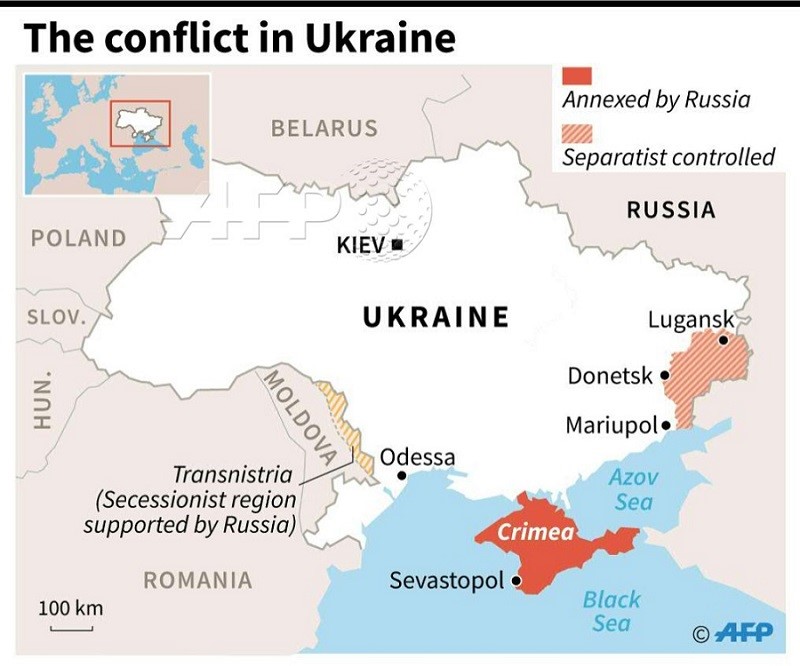
On 21st February 2022, Russia recognized the independence of two provinces of Ukraine i.e. Luhansk and Donetsk into separate republics and signed bilateral treaties of friendship and military cooperation with both of them. Ukraine rejected the Russian recognition of Luhansk and Donetsk and called the Russian action a violation of its territorial sovereignty. On the next day, Russia deployed its troops into both the regions claiming to be “peace keepers” against Ukrainian forces.
Background of the Russia-Ukraine conflict
Ukraine was once a part of the United Soviet Socialist Republic (USSR). After the collapse of the USSR in 1991, Ukraine emerged as an independent country along with 14 other countries. But Russia has always influenced the foreign policies of these countries and believes that integration of these countries with Europe and the North Atlantic Treaty Organization (NATO) is a threat to its security. It alleges that the US and Europe are actively engaging in the eastward expansion of NATO by which they want to bring their weapons to Russian borders. Three former soviet republics, namely Latvia, Lithuania and Estonia joined the EU and NATO in 2004.
| NATO: Its Full form stands for North Atlantic Treaty Organization, formed as a collective defense initiative of western countries. It has 30 member states, and Russia treats NATO’s eastward expansion as a threat to its national security. |
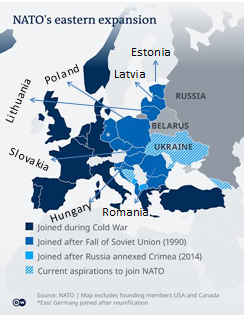
Ukraine applied to begin a NATO membership action plan. During the 2008 NATO summit, it also started to contribute to NATO-led operations and missions. In 2017, the Ukrainian parliament adopted legislation to join NATO and made it its foreign and security policy objective. In 2020, Ukraine’s national security strategy directs the country to fast-track the country’s accession to NATO.
Russian response to Ukraine engagement with NATO
In 2010, then Ukraine president Victor Yonkovich shelved the country’s plan to join NATO and claimed to remain non-aligned. But in 2013, when Yonkovich rejected a deal for greater integration with the European Union, it sparked violent protests across the country. So, the president resigned and fled the country. Snap elections were conducted in 2014 and a new government was elected which is friendly towards Europe.
In response to new developments, Russian troops attacked Ukraine in February 2014 and took control of the strategic Crimean Peninsula of Ukraine and conducted a referendum in which the local population voted in favor of joining the Russian federation. Eastern Ukraine, the part known as Donbas (Luhansk & Donetsk) declared independence from Ukraine.
Ukraine rejected their independence and announced a military operation against the Donbas region. But Russia intervened and a ceasefire was announced by signing the Minsk accord-I between Ukraine and Donbas separatist leaders. But after violence broke out again between Ukraine and the Donbas region, the Minsk-II accords with a set of 13 agreements was signed on 12 February 2015 by representatives of Russia, Ukraine, the Donbas region and the Organization of security and cooperation in Europe (OSCE) and a ceasefire was announced.
The Minsk-II Accords were negotiated and drafted with a lot of hastiness that led to confusion and disagreements between Russia and Ukraine. They allege each other for not obliging with the terms of Minsk accords. Russia also alleges that Ukraine tortured the population of Donbas and tried to erase Russian history and identity in Ukraine. OSCE, France and Germany tried to mediate between Russia and Ukraine but failed.
Conclusion:
Ukraine is a sovereign country and has the right to take its security and policy decisions independently. But Russian security concerns against NATO must be addressed with negotiation and talks. Russian president Vladimir Putin’s justification for invading Ukraine is that it was once a part of the Russian empire, so correcting the historical mistake is nothing but a pretext to occupying Ukraine by force.
Today’s world has changed in almost every sense and each country can take its own decisions regarding its future. Eastward expansion of NATO is a big concern for Russian security and it must be addressed. Russia must withdraw its military forces from Ukraine and negotiate on matters of disagreement. It is important for Ukraine to realize its unique position in the European landscape and maintain a neutral position in relations with Europe and Russia.