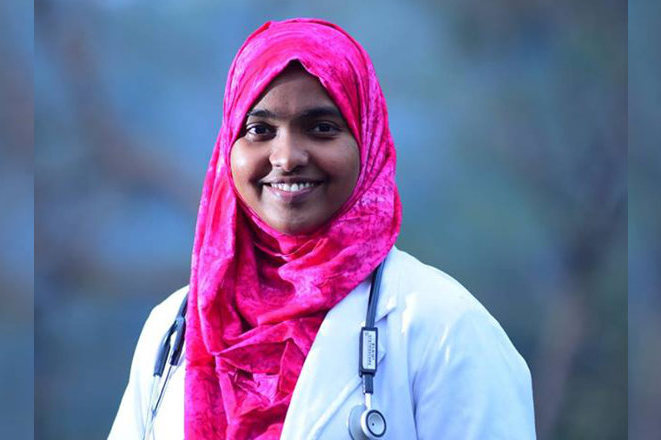
Dr. Hadiya Ashokan was an earnestly-awaited byline for Keralites, especially for Kerala Muslim women, in the recent past. The curiosity has been largely ignited out of a desire to hear her story in her own words, rather than through a second person or a news reporter. Her six-month-long house arrest, in which she was denied her fundamental rights by the state as well as the society, came to the limelight across India with much ambiguity. Since the media could expose little about the truth behind these dramatic events, this book reveals the most crucial moments in her life.
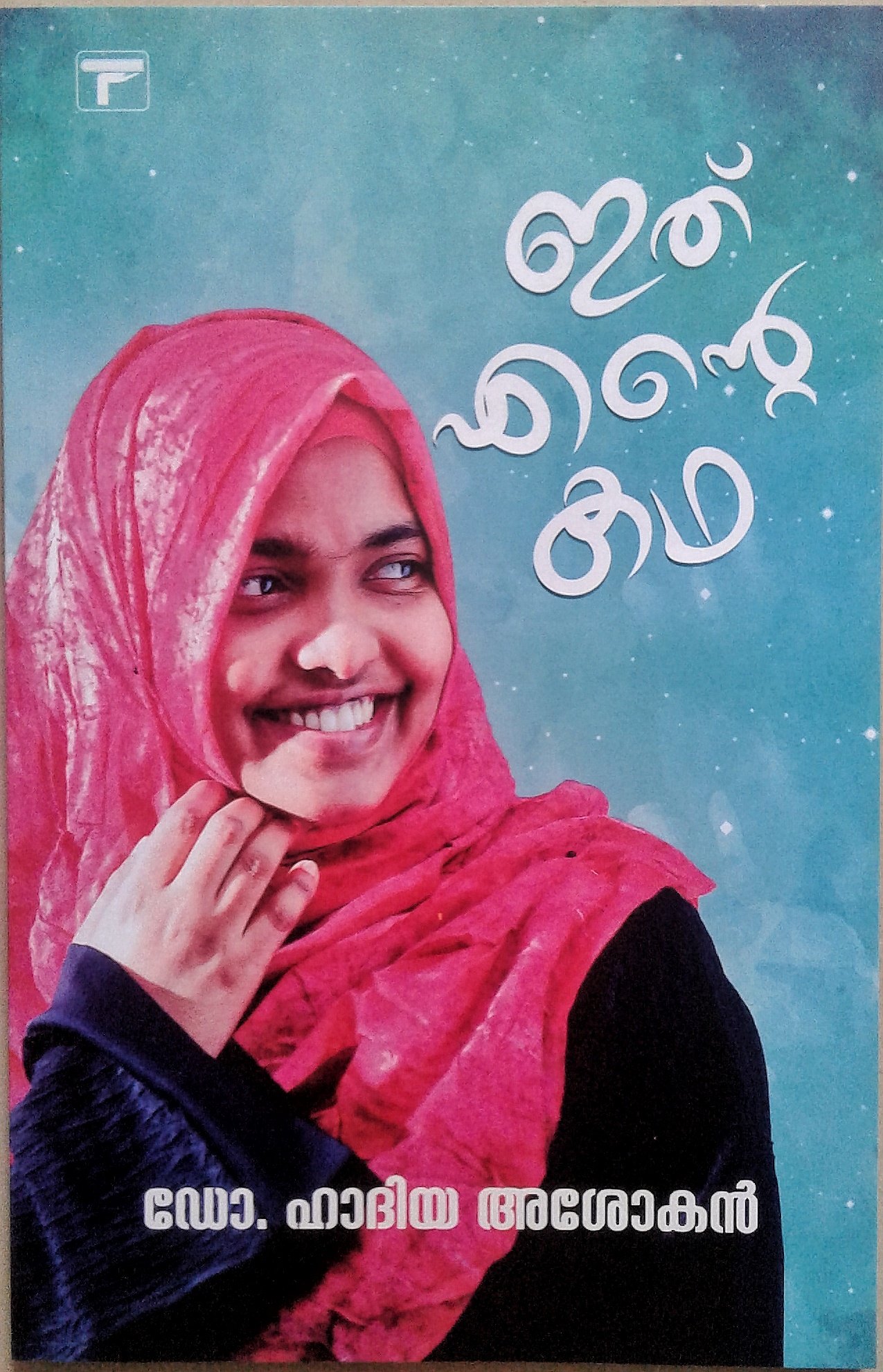
Ithu Ente Kadha (This is My Story) published by Thejas books in April is an autobiographical note talking about the truth-seeking story of a girl named Hadiya, 25-year-old medical student. It speaks aloud about the selective injustice she faced because of her choice, even though she is a citizen of a democratic country. When she faced questions about her hastiness to write an autobiography at this young age of 25, she replied in the words of Kamala Surayya.
The book is divided into 23 chapters; starting with the title of Ashokan Makal Hadiya (Ashokan’s daughter Hadiya). This chapter talks about her parents and childhood memories, which dragged her to doubt upon the existing theological concepts of those surroundings. The first part of this book deals with her childhood and doubts. We can read it as her launching pad towards the path of truth-seeking. Through this, Hadiya is debunking the arguments of the people who accuses that she has been forcefully converted. Through this book, she bravely reveals the doubts which she had from her childhood.
The statement of Hadiya -as she had basic knowledge about Christianity as well as Hinduism before completing her secondary level- are proof of her wide and in-depth reading of religions. The book also talks about her hostel life, which stands as her turning point. But it doesn’t have any mention of forceful influences or intentional conversions. A reader can easily recognize her hostel life as the period where she has a moment of understanding and finds answers for many of her doubts, through the companionship of her Muslim friends.
“I used to know Islam without doing Namaz (prayer) and without covering my head as well as by using the bindi on my forehead”, Hadiya says. The talking point of her book is her quest, rather than the influence of her hostel mates. It is obvious that her decision was made of her own volition. She also points out that the factions that exist in the Muslim society disturb her.
We can read the divergence of her understandings about Islam during primary stage and the people who were active on that path. That is, she doesn’t hesitate to recall some of her wrong understandings as well in her book.
“By the end of 2013, I understood Islam to be the best way in the world,” Hadiya says. What followed was a resolute decision to stick to the path she had chosen. We see a brave and strong woman determined to follow the decision to discover the truth on her own and to overcome all hurdles.
Perhaps, the readers may feel this as a documentation of events rather than a review. But the author has employed a narrative style where she recounts the events of her life and leaves it to the reader to form an opinion about the events and characters. Her unequivocal love towards her father is obvious, although she also speaks about the chaos created by his actions.
The role played by the state government, and the clear Islamophobia displayed by the state and the police, is another subject that the book deals with. These two agencies, rather than the public, was the source of Islamophobia in this particular context. Hadiya recalls the contents of a letter she sent to Pinarayi Vijayan, the Chief Minister of Kerala, where she explained all her ordeals. But she neither received a reply nor any kind of action from the CM, who is also in charge of the Home Affairs department.
The book throws light on the way a citizen was denied all her fundamentals rights with the facilitation of the state itself, which assigned police security in her personal room itself. Along with that, the book points out the selective discrimination that had taken place even in courtrooms. In the courts, Hadiya had to suffer the injustice of having to prove her own identity, existence and her personal relationship with a person in front of a state system. Despite acknowledging her needs, the court repeatedly sent her back to household arrest. This is a revealing episode on the Islamophobia that has gripped even the judiciary system of Kerala.
It is clear from the book that Hadiya was satisfied with the religious ideology that she had learned. According to the words of Mridula Bhavani from the book ‘Hadiya: Mukhyadhara Feminisavum Muslim Bheethiyum (Hadiya: Mainstream Feminism and Islamophobia), “the public conscience of the Kerala was not shocked by the information that Hadiya might be killed from the home prison, but shocked to see her unaltered Iman (faith)”. “I am a Muslim” this was her most repeated submission than anything else during that time. We can find this from the book as well in all its spirit.
We can understand the unbearable protest and grief displayed by Hadiya against the unwanted state-sponsored restriction even after the process of defining and understanding her choice in this matter. The court judgments regarding Hadiya’s marriage was highly-followed news at that time. But it was deemed as “unconventional and bizarre” concepts, which was unheard of, in front of so-called secular society. No one seems to care that it had happened according to her decision. The court annulled a person’s marriage within a day. The book strongly condemns the state-sponsored separation imposed on her in the courtroom. Hadiya was victimized by these repeated interventions from the government into her personal life.
Another aspect that the book discusses is the questioning she faced from National Investigative Agency (NIA) and the approaches of police towards her. NIA was quite persistent and the police was very rigid in her case, and so was the magistrate. It is pertinent to note that the final report of NIA attested that there was no love jihad in Kerala, despite a detailed investigation.
The court hearing continuously tried to frame her as a criminal or anti-national. The book is also sure of the fact that the state government authorities and a good part of the public of Kerala played a vital role in helping her father in his attempts to curb her rights. We could find the support of media and even the court in this particular issue, which ostensibly proves the social repressiveness of our society. It also clarifies how responsible the civic society actually is towards the values and beliefs of the existing democracy.
In an attempt to get justice, Hadiya went on a hunger strike while inside her house and maintained her fight to reveal the truth of her circumstances to the outside world. She used every moment she received outside her house to reaffirm her Muslim identity. We also read how she uses her hijab as a strong indication of the Muslim woman identity.
Through this book, Hadiya is trying to give clear-cut information about the incidents which was being discussed by the public of Kerala in a very strong manner. NP Chekkutty, editor of Thejas Books, writes in the Foreword, “when we think about the acceptance of Hadiya and her life story by the public of Kerala, we can say that it is not just a matter of an individual, but also of the society”.
May be this book will help the public to go back to the issue of Hadiya. She winds up with the Shahadath (affirmation of faith) and by reiterating her Muslim identity along with prayers for those who stood up for her.