CONTEMPORARY WEST ASIA: PERSPECTIVES ON CONTINUITY AND CHANGE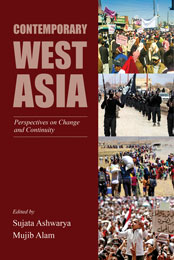
Publisher: KW Publishers
Published Date: November 2016
ISBN: 978-93-86288-04-2
Book Author(s): Sujata Ashwarya, Mujib Alam
This book basically tries to establish a relation between the facts and the narratives, that emerged from Arab Spring and ensued into ideas which are mistakenly taken as canonical for change. The book begins with the “SWOT” analysis of the West Asia or Middle East of the last century ‘supposedly’ claimed to be the main theme of the first 3 chapters, which is ‘wittingly’ a fallacious claim and the fallacy being that “it’s perhaps the only book which has tried to map the trajectory of change in the region by isolating Israel”. History is a testimony to the fact that Israeli policies had and continue to have a significant impact on the changes taking place in almost every state of the region. Wisely, the book is divided into 16 chapters, last 13 chapters deal with impact of Arab Spring in individual states and try to connect with and give credence to the central theme of the book but less Israel.
In the book this region is explicitly viewed through the frames of, “philosophical prism of modernity, post modernity and tradition, clash of identities whether at individual or group level, dichotomization of pan Arabism and secularization and economic underdevelopment”, albeit, social and political subaltern discourses also manage to make a place in the text.
The first frame discusses the advent of Islam and its place in regions, society and politics and how it has propagated a distinct worldview and is still considered as an epitome of influence. The Islamic tradition and principles are discussed, which outlines and castigates that every governance structure which is built on modern secular and liberal principles will only escalate religious tensions and development which is devoid of devotion to Islamic tenets brooks no long-term profit. However, ijtihad (critical reasoning) has been given too much importance, so that some give-and-take can take place between modernity and tradition.
The book fails to recognize the disproportions of separate and close, awe-inspiring and vicious, ordinary and crucial demographic binaries which are the major impediments in understanding the region and will deter the readers in critically analyzing the text and understanding the objective behind cause and effect of every event mentioned in the book.
The second frame draws a parallel between the notion of identity or how societies and individuals have become discernible with the passage of time. The West Asia, as book tells us, is defined by groups “persons are deeply embedded in communities, in family, in ethnic, racial or social groupings”, implying that it’s not an “I” driven cultural region but a “WE’ driven, whereas western one is based on excessive individualism. It further asserts that “indeed domain of kinship cannot be separated from the domain of politics either at the behavioral or symbolic- cognitive level”. This perspective also discusses nationalism and its impact but concludes that “people never completely identify themselves with the idea of nationalism propagated by the states that where artificial creations of colonial powers”. Further adding that nation-state at its core is an individualist concept, stemming from the logic of social contract, where everyone is invested in the emergence and perpetuation of the state and the insignificance of the same was witnessed in numerous post Arab-spring cases.
The third perspective of “pan Arabism and secularization” speaks of how western scholars undermined the traditional values and overrated the secularization of nationalism and how it was transported from European version of nationalism. Quoting intellectual Avi Shlaim, it says “there were obstacles along its path. In the first place were conflicting identities and competing loyalties to tribe, sect, region and religion. Second there was always tension between Iraqi, Syrian, Egyptian and other regional identities and the larger, all-encompassing Arab identity. But the most powerful competing alternative to the idea of a secular Arab nation was the concept of a united Muslim ummah or community. Islam was the other great supra-national ideology with a claim to the allegiance of the great majority of Arabs”.
The last envisioning perspective is crisis which resulted because of under-developed economic structure which proposed insufficient and inadequate economic reforms to maintain the normal living standard of the people living in the region. The book quotes the trajectory of slow-down in economic activities by citing various inferences from Arab human development reports and propose “freedom deficit, women’s empowerment, human capabilities and knowledge deficit relative to income” as major impediments which have been ignored for too long and conclude this perspective as being the chief motif and driver of Arab- spring.
However, the book wittingly ploys the win-win approach and can only be deciphered if critically reviewed and does not carry the usual textual stupor, which is evident in many texts published in this part of the world on West Asia. It fails to recognize the disproportions of separate and close, awe-inspiring and vicious, ordinary and crucial demographic binaries which are the major impediments in understanding the region and will deter the readers in critically analyzing the text and understanding the objective behind cause and effect of every event mentioned in the book. This hence presents a dubious character of the book.