
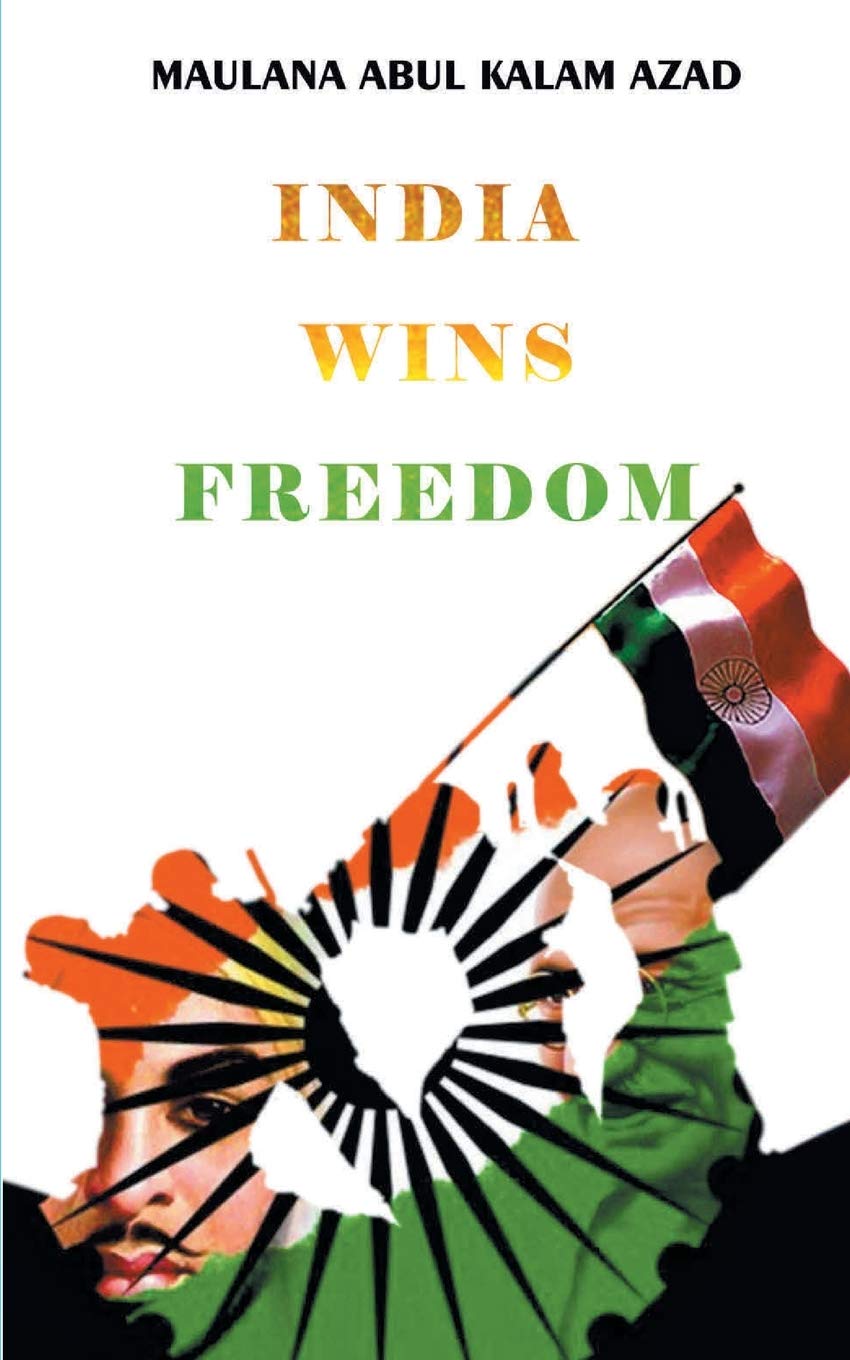
The book traces India’s struggle for independence against the colonial British government. This is an autobiography of Maulana Abul Kalam Azad, the most sizable and prominent freedom fighter of India’s freedom movement, narrated by Maulana in a series of conversations with Humayun Kabir.
Kabir was an alumnus of the Calcutta and Oxford Universities, he served as a lecturer in Andhra and Calcutta Universities. He was also a politician. In 1946 Azad appointed him to serve as his secretary and therefore he was closely associated with Azad. Later he served various responsibilities to the government of India as a cabinet minister. The author of more than 20 books in English and Bangla on philosophy, literature, politics and culture.
The book starts with a brief introduction of Azad’s personal life, background and about his intellectual development. Azad was born in Mecca in 1888 his forefathers came to India from Herat in Babar’s days. According to Maulana, he was from a core traditional family who believed in the old ways of life. He stated that when all the old bonds imposed on his mind by family and upbringing were completely shattered and he felt free of all conventional ties and decided that he would chalk out his path.
It was about that time that he decided to adopt a pen name “Azad” or “free” to indicate that he was no longer tied to his inherited beliefs. Later he was attracted to revolutionary politics and joined one of the groups. He toured Egypt, Turkey and France at the age of 20. After returning from the tour, he established a journal ‘Al-Hilal’ at the age of 14. It was first published in 1912.
India wins Freedom reveals some very important aspects of India’s freedom movement. What were the efforts of Congress to make India an independent state and how the Muslim league was one of the hurdles for congress? And what were the conflicts between the Congress and the League?
Congress’s main contribution was they had tried very hard to unite Indians against British colonialism. They had launched several mass movements to pressurize Britishers. For example, in 1920 Congress launched the “non-Corporation movement” under the leadership of Gandhi, in 1929 Congress passed the independence resolution and gave the British government one year’s notice of its intention to launch a mass movement if the national demand were not fulfilled. The Britishers refused to comply with Congress’s demand and in 1930 Congress declared that the salt laws would be violated and hence began the satyagraha movement.
And in contrast, the Muslim league’s approach was very much based on identity politics. Muslim league was established in 1906 in Deccan after the session of the Muslim Educational l Conference during Christmas. According to Azad two basic reasons behind the establishment of the Muslim league were, first, to strengthen and develop a feeling and loyalty to the British government among the Muslims of India. Second, to advance the claims of Muslims against Hindus and other communities in respect of service under the crown and thus safeguarding Muslims and rights.
However, history bears witness that Muslims had sacrificed a great deal for India’s independence and hence these claims of Maulana are questionable. Maulana also narrates that, British Government always used the Muslim League as a counter to the demands of the Congress. Maulana quotes, “Congress had taken a national stand on this question while the Muslim league demanded that the Congress should give up its national character and function as a communal organization”. Muslim League’s primary allegation was that Congress is national only in name.
Maulana was arrested several times for his activities as the tallest leader of congress. Maulana’s acceptance, influence in the Congress and his efforts to unite India remain unmatched.
For example, Mr. CR Das, Motilal Nehru and Hakim Ajmal Khan had formed the Swaraj Party and presented the council entry program ( to know it, refer to the book) which was opposed by the orthodox followers of Gandhi – congress thus divided between no-changers and pro-changers. It seemed that Congress would be divided. But, when Maulana came out from arrest he reconciled between the two groups. He was then 35 and asked to preside over this session. It was said that he was the youngest man to be elected president of Congress. He played the same character several times.
The book is quite helpful in understanding the different political narratives and efforts of the various political parties in the freedom struggle. The book depicts how big leaders of congress like Gandhi, Nehru had made big political blunders that ultimately led to the partition of the country. For example, Gandhi returned empty-handed from the round table conference. Gandhi made Jinnah a Star. When he was released from the 1942 arrest, he met Jinnah several times to resolve the communal issue. According to Azad, “This approach of Gandhi makes Jinnah a star. It was Gandhi who first used the words ” “Qaede Azam”. Before this Jinnah’s personality was in doubt and people had lost trust in him. But Gandhi had made him a star again and Jinnah gained full political benefit from it”.
And similarly, Nehru made the biggest mistakes in India’s political history. The “British Cabinet Mission” accepted by Congress and Muslim League to form an interim government in West Bengal, Sind and NWFP had all the powers except defense, communication and foreign affairs. This idea is primarily driven by Maulana Azad. In 1946 Nehru became president of Congress with the support of Maulana and he restricted himself to not to be president further. Maulana quotes, it was the biggest blunder of his political career.
In a press conference, Nehru answered a question to a journalist by stating that the British cabinet mission can be changed in the future by the majority in the Constituent assembly. And this statement was the bombshell for Jinnah that would prelude to partition, Maulana stated.
On August 16, 1946, in reaction to Nehru’s statement, Jinnah Declared “Direct Action Day” on that day bloody violence occurred between Hindus and Muslims and all the efforts of Maulana to unite the Hindus and Muslims would go in vain.
The book highlights the fact that all leaders of congress were in fact not secular, congress also had communal voices in her tent-like Sardar Patel and other leaders. Hence, the league’s allegation on congress, that Congress is national only in name was not entirely correct but then it was not even wrong completely.
The most inspiring part of the entire book is Azad’s relentless resistance against the two-nation theory. According to Jinnah and the Muslim league, partition was the only solution for the sake of Muslims in the region as a minority. Azad strongly opposed that point of view and told that the Idea of Pakistan is not only wrong from an Islamic perspective but also harmful for the Muslims in the region.
The last chapter of the book is titled ” The End of a Dream”. Maulana narrates, how Nehru and even Gandhi gave up by accepting the two nations’ theory with frustration. Maulana had tried to his last extent to break that idea. For that, he even presented the interim government system which was accepted by the Britishers or even by Muslim League. The book to a large extent will give you an unbiased view of India’s freedom struggle.
Before the partition, Maulana had made a few depictions pertaining to the result of the two-nation theory. It is shocking how much of his predictions have turned into a reality today.