

Title: Yeh Basti Azaboon Ki (Place of Agonies)
Author: Mansoor Ahmad Mansoor
Publisher: Mir Publications, Bandipora, Kashmir
Pages: 112
Price: Rs 200/-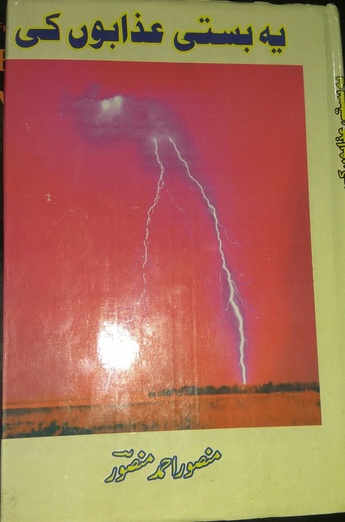
Hisham Matar is a Libyian writer. His memoir of the search for his father, The Return, won the 2017 Pulitzer Prize for Biography or Autobiography and the 2017 PEN America Jean Stein Book Award. He once said that when conflict is at its peak somewhere, at that place are not enough possibilities for artists, writers to write or express that.
When we fit this saying to our state, same was the situation when Kashmir conflict was at the peak in 1990s.This was very hard for writers to crack the nut and express their opinions through creative writing. Later on, this taboo of writing about resistance was almost worn out by Kashmiri writers like Basharat Peer, Mirza Waheed, Shahnaz Bashir etc. The English writings of these writers caught readers’ attention worldwide.
This is unfortunate aspect that our local literature, particularly the Kashmiri and Urdu, has been turning a blind eye to the happenings that have shaped modern Kashmir, especially during the past years. That is why when we search resistance literature in Urdu there are just a few who penned down their writings in the melodic line of resistance literature. One among those writers is Dr Mansoor Ahmad Mansoor who is concerned with the hardships, pangs and agonies that Kashmiris have suffered, especially, during the past twenty years.
The above mentioned book Yeh Basti Azaboon Ki (Place of Agonies) is the collection of short stories penned down by Prof Mansoor Ahmad Mansoor. This book can be reckoned as an excellent piece of writing as for as resistance literature in Urdu is considered. Mansoor Ahmad, author of this book is working as Prof in the Department of Urdu at Kashmir University. He completed his M.A, M.Phil and PhD degree from Kashmir University. During studies, he began writing articles about different issues for various Urdu dailies of Kashmir and he also authored many books that include fiction as well as non-fiction.
This book is a collection of 13 short stories. The stories in this book have been written in an easy and lucid language. The author in these stories talks about common Kashmiris. For instance in “Khwab, Khak Aur Khoon”, the author has drawn a graphic picture of how people felt during the 1990s when people got themselves shut up in their homes in broad day light. “There is silence, both out and inside the house. Every door has been shut up, it looks like people are sleeping in their homes, but the truth is they all are waking, but they are silent. There is no light and sound in this area, if there were no moon light it may appear like black island. If any ray of light comes out from the dark rooms, with in no time the sounds of shoes creates the panic”.
Likewise, in another story Yeh Basti Azaboon Ki (Place of Agonies) depicts the destruction that Kashmir experienced over the years turning village after village and town after town into desolate places as Prof Mohmad Aslam rightly translates some sentences taken from this story “The place was quiet. The lake was silent. The river had been flowing slowly for centuries. Life was also flowing like a silent stream. There were no gushes, whirlpools and storms in it. No windstorm had ever struck; there was even no threat of windstorms. One day, nobody knows how they reached the place like mysterious shadows. Destructive darkness engulfed the entire place” And when the inhabitant returns after some time, he feels that he has landed in a strange place: “I felt as if I was in a strange city. There was no sign of my place, streets and inhabitants…Everything had changed”.
Prof Hamidi Kashmiri, Urdu poet and former VC of Kashmir University says “The short stories of Mansoor Ahmad Mansoor resembles with the story of Intizaar Hussain. Just like Intizaar Hussain his writing style catches elements of parable and fable, occasionally veering into the surrealistic. Hamidi Kashmiri further says from the past few years his people have faced the unending brutal conflict and it evaded him to write the feelings of these people through short stories.
Prof Muhammad Zaman Azurda writer and teacher of the author writes these words about the book “If anybody will question me can we write Marsiya (Lamentation for the dead person) in prose? Or question me can there be Marsiya of any movement or can someone write Marsiya on Human Rights Violation. My answer to all these questions will be read this book and after that I didn’t need to verbalise more.
After reading this book what I realised that in Urdu we have writers who can narrate the tale of oppressed people and there is no doubt that people from outside Kashmir would get more knowledgeable about the sufferings of Kashmiris after reading this book than they do after listening to biased news from TV channels.
Nahin Hai Na-Umeed Iqbal Apni Kisht-e-Weeran Se
Zara Nam Ho To Ye Mitti Bohat Zarkhaiz Hai Saqi
(But of his barren acres Iqbal will not despair:
A little rain, and harvests shall wave at last, oh Saki!)


[…] https://thecompanion.in/test/book-review-tales-hardships-pangs-agonies-kashmir/ […]