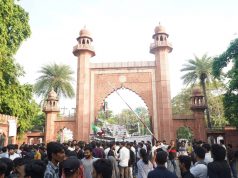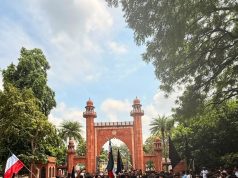

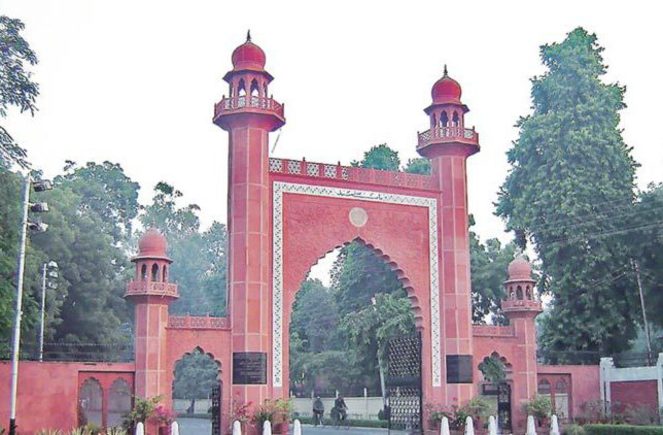
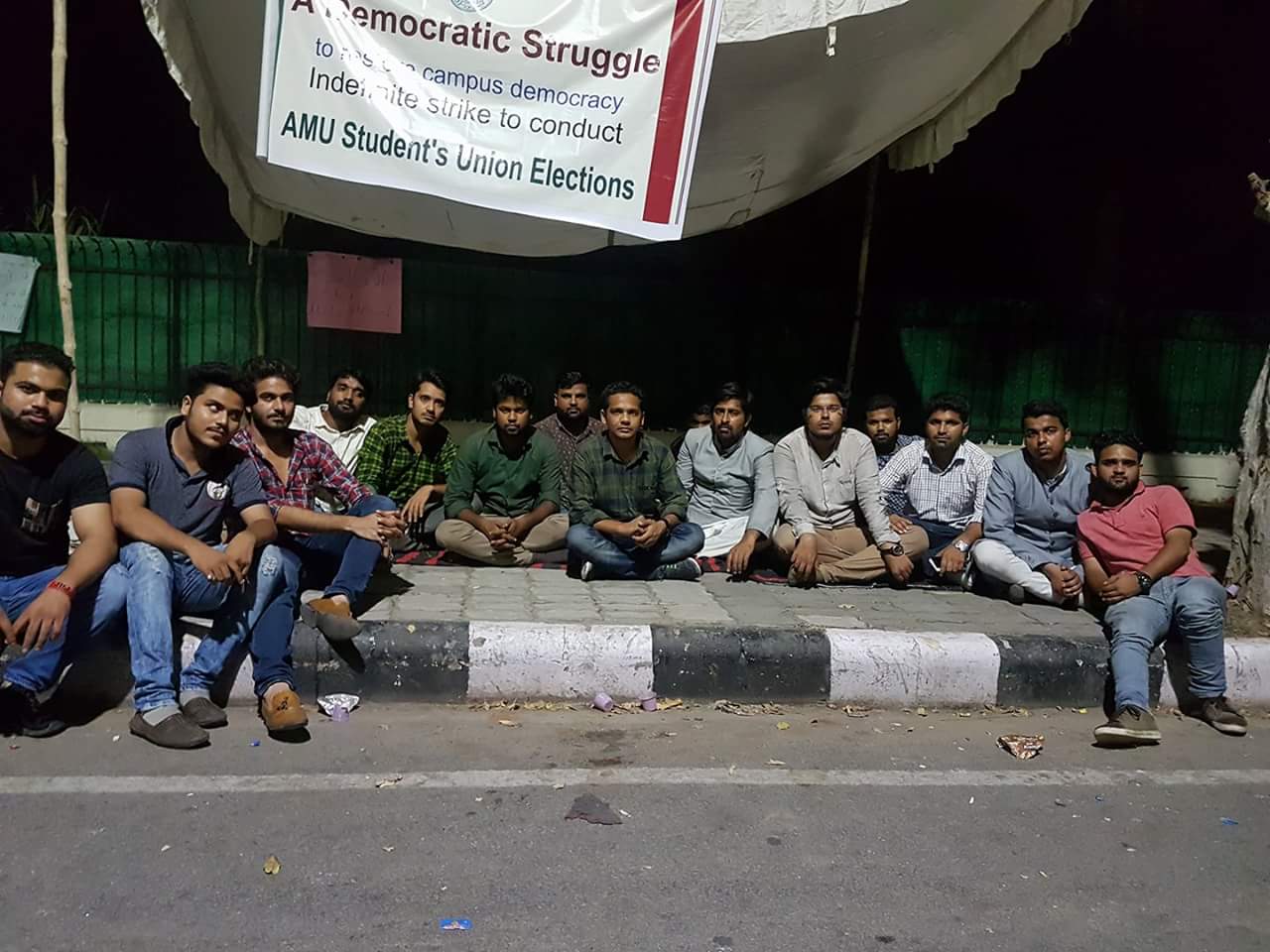
The students’ union elections in almost all central universities are done, and students from Aligarh Muslim University (a Central University) are still waiting for the administration to announce a date for the same. The wait grew so much exasperating that they had to sit in protest in front of the Vice Chancellor’s lodge. The protest lasted for more than 4 days, in between which the protesting student leaders offered Friday prayers on the road, under heavy downpour. This caught enough media attention for the Council of Deans to have a meeting to tackle the crisis.
This is, however, not the first time that the students had to go on a protest to ask for their democratic right to have students’ union elections. It has almost become a tradition, like many other “traditions in AMU”, to sit in “Dharna” before and during the elections. Last year too, student leaders protested to get the dates of election announced. Once the nomination was done, the administration again cancelled the election citing involvement of anti-social elements. Student leaders again sat on protest demanding to get election procedure resumed from where it was cancelled. Finally, the elections were held last year during the tenure of the then Vice Chancellor, Lieutenant General Zameeruddin Shah. However, the situation has now changed entirely. Now, the Vice Chancellor is Prof. Tariq Mansoor, former Principal of Jawaharlal Nehru Medical College, one of AMU’s own. Before the AMU crisis is discussed, let’s first understand the need of having students’ union elections in any educational institute for that matter.
Why AMU Needs Students Union
A Students’ Union empowers the students to make genuine demands, raise sincere concerns and questions for the upliftment of the university, keep the powers of administration under check and most importantly, groom better policy makers (politicians, in crude terms) for the future. Democratically electing representatives also develops a sense of intellectual responsibility which would help these students when they perform their duties of choosing their legislative representatives at state and national level. In addition, if we look at it from a larger perspective, it is the student activist bodies that have always performed the role of opposition in the country’s democratic functioning. The student unions around the country have always raised voice against the atrocious policies of the central government.
A common disagreement among few students is that these students’ union elections are a waste of time and money, as the chosen leaders hardly ever keep their promises, or work for the overall good of general students. They are also accused of being involved in creating disturbances and misusing their power (or manpower) in and around the universities. But it must be understood that not having elections is not the solution. If anyone is discontented with all the candidates contesting for elections, then they should ask for the provision of having “None of the Above (NOTA)” in the ballot papers, which is being practised in many universities. By not participating in elections, the students (or citizens, for larger perspective) lose the right to question or demand. India is a democratic country and all governing bodies are democratically elected. If one wishes to stay out of this democratic process, just because they are presumably sure that no good is going to come out of it, then they are also to be blamed if in future, “no good” actually comes out, because few pessimistic voters made a better candidate lose.
Shortcomings
That’s when the participants do not want to participate, but when the administration itself is not willing to conduct the elections, it raises many questions on their intention. Specially now, when “one of AMU’s own” is sitting in the Vice Chancellor’s chair, it is expected of him to be aware of strengths and weaknesses of this vast structure. And to keep the structure standing strong, one needs to give equal preference to all its pillars (students being the most important one, in a university). One cannot presume that the structure will survive if you are axing the most important pillar off its rights.
According to Lyngdoh Committee report (based on which many university elections, including AMU, are conducted), the students’ union election must take place during first 6-8 weeks after the college reopens for a new session. Apart from Lyngdoh Committee, AMU also follows AMU Students’ Union Constitution, wherein it is mentioned that the AMUSU election must be conducted within 75 days of commencement of new academic session. There are other rules viz a viz the age criteria, the attendance criteria, etc., which the AMU administration ardently follows but not the one which mentions when students’ union must be held. Thus, it is evident that the administration is defying both the norms that it should follow. The reason has been diverse in past years – from not having a proper time slot due to mid-term sessional exams to not having enough resources (human and financial) to conduct elections. This year, however, the administration went on to raise the bar of absurdity while defending the delay in elections. The Vice Chancellor, in an open letter to students, stated that the elections are being delayed because the admission to PhD courses (which are due till November this year) are not done yet, and having elections now would deprive those students of their democratic right of choosing a representative. Fair enough. But after the PhD admissions are done, the end semester examinations for the rest of the University would begin, after which the winter vacations will start. That means the elections would tentatively take place around February. Then why not delay it a little further (5-6 months more), and not deprive the new students coming in next session of their democratic rights? Moreover, how many PhD students are admitted annually? And how much is that compared to the number of students presently enrolled and eligible to vote. The answer to these questions would in itself tell that the intentions of the administration are not what they seem.
It is very unnatural to see the same administration being so concerned about research scholars, when it has come to defending their faults in delaying elections which has passed a rule that denies hostel accommodation to research scholars after 3 years for a course which naturally takes 4-5 years, which denies proper scholarship and funds for research to them. Taking refuge under the name of research scholars clearly shows that the administration either wants to delay the elections indefinitely or until a candidate “suiting-their-requirements” get admitted. The relationship between a supervisor and a research scholar can demean the entire stature of a student representative, if it is turned into that of a puppeteer and a puppet.
Recent Turn of Events
After 4 days of protest, the administration finally released the tentative schedule for the elections. The administration will appoint the Chief Election Commissioner by 30th of October that would be advised to conduct the elections within 13 days of appointment. Although this decision in itself contains many loopholes, like the setting aside of the Lyngdoh norm and AMU constitution norm of when to have the student union elections, and even if the elections are over by 15th of November, how would the end semester exams would be effected as according to norms, no university exam can be conducted before and after 15 days of student union elections. Yet, the student leaders present at the protest agreed to this decision.
A Way Forward
So finally, AMU will have its students’ union election, doesn’t matter how late. This brings us to the last question: Is it compulsory for students to protest every year to demand for elections? Can’t the university itself conduct the elections, without these pointless protests? The answer to both the questions is “No”. It is not obligatory to protest in order to demand such a thing which comes under our fundamental right. And the university also won’t take initiative to bring students’ union, because they don’t want any questions to be asked on the murky business that they are running. So what is the solution? The solution is that the elected student representatives this year bring an amendment into the AMU constitution, wherein it will be mentioned that before a union is dissolved, the chairpersons and the cabinet members would elect a Chief Election Commissioner from among the teaching faculties. It will require the approval of the Vice Chancellor. And from next academic session, it will be the duty of the Chief Election Commissioner to conduct the elections in 6-8 weeks of commencement of the session. This suggestion might need many improvements before it is penned down, but it would surely relieve the students from protesting year after year repeatedly for the same thing.
Long Live Democracy!