India is distinguished by a wide range of religious beliefs and customs. According to the 2011 census, 79.8 percent of India’s population practices Hinduism in various sects and denominations, whereas 14.2 percent practices Islam. Other religions are practiced by the remaining 6%. (Christianity 2.3 percent, Sikhism about 2 percent, and Buddhism, Jainism, and various indigenous ethnically-bound faiths).
Though India is constitutionally secular and equidistant from all religions, Hinduism is the deemed default religion of India, as evidenced by the use of Hindu liturgy and symbols in most government and publicly financed events, such as the founding of new cities and the launch of new military aircraft. Celebrations and decorations of police stations on Janmashtami and even the presence of temples within police stations and many other state institutions. Selective development of Hindu religious pilgrimage sites in the garb of promoting tourism by allocating special budgets has blurred the secular vision of India.
Though minorities like Muslims and Christians have always been seen as alien to India and faced backlash in one form or another from state and non-state actors, the steepest rise can be traced from 2014 after the formation of the government by the RSS backed Bharatiya Janata Party with its pro-Hindutva and anti-minority policies and laws.
Christians and Muslims are living in fear after rhetoric like ‘forced conversion’, ‘conversion racket’, ‘love jihad started swirling through media and government agencies. The targeted violence against religious minorities and their religious places has escalated which according to some experts is a communal tactic of BJP for political gains in the upcoming assembly elections in Uttar Pradesh and Uttarakhand.
Christians under Attack in India: A Fact-Finding Report
A report titled “Christians Under Attack in India” was released at Press Club of India on October 21, Thursday, by the Association of Protection Civil Rights (APCR), United Christian Forum, and United Against Hate at a press conference. The fact-finding team has done comprehensive work and incorporated detailed testimonies thereof the victims of some 90 incidents of hate crimes against Christians in India.
The report highlights that over 300 hate-based instances against Christians have been reported from across 21 states, particularly in North India, in nine months of this year. In 2021, Uttar Pradesh stands at the top with 66 such incidents followed by Chhattisgarh (47), Jharkhand (30), and Madhya Pradesh (26). Karnataka in the South, which is news for all the bad reasons of its CM remarks justifying violence against religious minorities, also finds a place with 32 incidents.
Around 23 incidents were reported of attack and vandalism of churches by mobs. The report also cites data of close to 85 incidents where public officials restricted or denied permission for religious activities of Christians alleging “conversion activities” or on the pretext of law-and-order situation.
Religious freedom declined in Post-Pandemic India
The report narrates the recent Church attack in Roorkee, Uttarakhand in the following words.
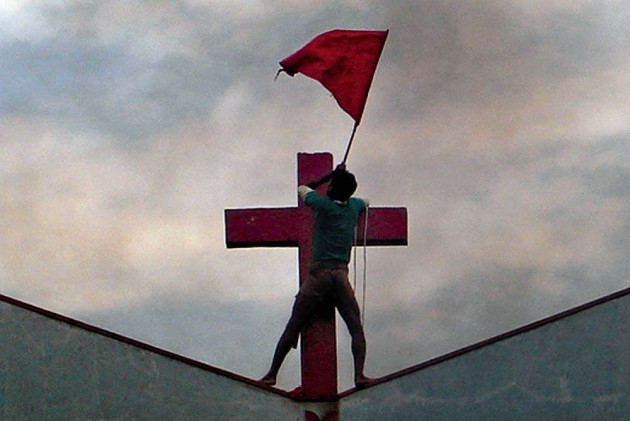
“It was an unusual morning for Sadhna and her two daughters, Eva and Pearl. The Church’s surroundings had scores of unusual visitors. Before the family could even think what was about to happen, a mob of reportedly 250 to 300 people attacked the Church.”
The Roorkee Church incident can also be looked at as the adverse implications of suspension of the right to assembly; particularly for religious activities for a long time during the Covid-19 pandemic. It also shows the incapacity and laxity of the state towards securing and restoring the religious rights of minorities.
According to the report, in 1988 a small Church was built in Roorkee and Dickens Rockwell Lance was the Pastor of the House of Prayers till his death due to COVID-19 in September 2020. The prayer services came to a halt due to the covid situation and government restrictions. The pastor’s family has claimed that there were no threats and no hate incidents in the past. It is only recently after resuming the prayer services of the church after a long time, they started receiving hateful and anti-Christian threats by unknown men alleging them of committing religious conversions and that the church is illegal and unlawful but the family refutes the claims and filed their written complaints to police a day before the attack but no security and help came from the police even on the day of the attack.
In the report, Eva, a survivor of the attack recounts the incident and said, “On Sunday morning right at 10 AM when prayer services started, a mob of around 250-300 people, a quarter of them women, invaded the Church, armed with sticks and iron rods while chanting religious slogans like Jai Shri Ram and Har Har Mahadev vandalized everything in the church including CCTV cameras and forcefully took away the DVR with them.
In the meantime, the police which completely failed every time in securing minorities and their rights came as a rescue for these hatemongers in no time. Soon after the attack, a counter FIR was lodged against the pastor’s family by a woman alleging forced conversion and the pastor’s family has been booked under several serious sections of the IPC- 153 (promoting religious disharmony), 395 (dacoity) 120b (criminal conspiracy) and other sections. Sadhna, the pastor’s wife who is a retired central government employee has dismissed the allegations against the church and her family as false and absurd.
“We take no donations and the church does not even have a bank account. Nobody offered that woman 2 lakh rupees. We do not know her. She has accused me of attacking her at 8:45 AM but my CCTV shows that I was not present there at that time. Do you think that we can do a dacoity?” questioned Sadhna
The report also narrates two incidents from Mau, Uttar Pradesh in detail. The first incident is on October 10 when a Hindutva mob from Bajrang Dal and Hindu Yuva Vahini attacked several people from the Christian community and escorted them to the police station complaining about forced conversion and violation of Covid protocols. A First Information Report (FIR no. 410/2021) has been filed for organizing a prayer meeting in a house. Seven individuals have reportedly been booked under the Prohibition of Unlawful Religious Conversion Ordinance, 2020 including Pastor Abraham Shakeel Ahmed, his wife Pratibha, Vijendra Rajbhar, and Geeta Devi, the couple in whose house the worship took place.
The second incident was also reported from Mau on October 12, Sister Gracy Monteiro, a Mirpur Catholic Mission school administrator, her colleague Sister Roshni Minj, and their driver were attacked by a right-wing extremist mob while boarding a bus to Varanasi at Mau’s town bus terminal. After assaulting and abusing them, the mob hauled them to the police station.
Sister Gracy Monterio said “There were just three of us. I was accompanying Sister Minj who was going home to Ranchi to visit her dying father. As we did not get the direct bus, we went to the Mau bus stand and SrMinj went to ask about the bus, while the driver and I stayed in the car. Then a mob came and attacked the driver, dragged him out, and forced us to walk to the police station. The attack was sudden and unprovoked. No policeman intervened when the mob attacked.”
She recalled, “Police asked us ‘are you converting’. After hours of the unnecessary struggle of proving our innocence, we were released without any apologies or any action against the mob that attacked us”
Impunity and Complicity of State
Although religious freedom is a constitutional right, its execution is heavily reliant on state governments, which oversee Law and Oder as well as education. Many states have come up with religious freedom laws commonly known as anti-conversion laws. Under the pretext of these laws, even the legitimate exercise of fundamental religious rights by Christians and Muslims enshrined in the constitution results in their harassment and persecution. Hindutva nationalists wielding political power in various states have made religious conversion either illegal or extremely difficult. The surge in violence against Christians and Muslims in these states is marked by alarming and pervasive impunity, as well as the apparent collusion of administrative and police officers.
Incorporation of explicit safeguards for minorities
Following the transfer of authority from the British Crown in 1947, India kept numerous colonial criminal laws. The Indian Penal Code (IPC) of 1860, the Criminal Procedure Code (Cr. PC) of 1861, the Evidence Act of 1874, and the Police Act of 1860 were all kept. According to experts, these laws do not include any explicit safeguards for minorities. The Indian criminal justice system has yet to incorporate international principles and standards about minorities.
Until then the Supreme Court of India remains the only hope of the religious minorities despite past benches giving several adverse judgments impacting religious minorities including one upholding anti-conversion laws known as Freedom of Religion acts. Christians await justice alongside Muslims in India navigating through the sweet and bitter minority experience with a question of what is being a minority in Indian democracy?