

Over the past few weeks a pandemic, COVID-19, has been the talk of the town which has unremittingly marched towards India in the last few weeks. While the world fights back against Corona virus, India has another war to fight that is the one for livelihood. As a preventive measure from spreading COVID-19, on 24 March, 2020 Prime Minister of India Narendra Modi announced a 21-day lockdown. The lockdown has been further extended till 03 May 2020. The lockdown has put everything to a halt. Almost everyone is affected by the lockdown but the effect on the people working in the unorganized sector is the severest. Since India is a developing nation and the majority of the population work in the unorganized sector, hundreds and thousands of workers have lost their earnings. They do not have fixed earnings, they earn per day and do not have savings for the next day. Daily wagers like rikshaw pullers, vendors, street vendors, cooks, workers in handloom industries, shopkeepers etc. are struggling amid this crisis. In 2018, India had approximately 461 million workers, with 80% of them working in the informal sector, such as in agricultural work and in micro, small, and medium enterprises (MSMEs), with not more than 10 workers. That is a staggering 369 million workers. The remaining 92 million workers are designated as being in the formal sector, but 49 million of them are employed as informal workers and called variously as contract labour and temporary staff, among others (National Statistical Office, 2019).
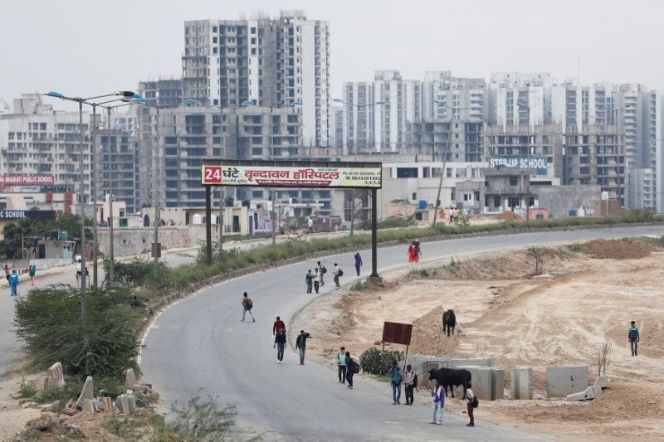
As Delhi border got sealed and public transport completely stopped, migrant workers who were left with no work and consequently no income had to resort to walking on feet hundreds of kilometers to reach their homes. This unplanned nationwide lockdown has sharply hit the employment and livelihoods of the the unorganised sector workers, leaving them and their families deprived of a square meal. The scene is undoubtedly a pathetic one where they neither have money in their pockets nor food for survival. The lockdown has led to a situation where death due to hunger and starvation, for thousands of people, can come before the infection of the virus reaches them.
Table 1. Financial Aid by Different Countries
| Country | Aid |
| Britain | $382 billion |
| US | $1 trillion |
| Germany | $610 billion |
| France | $335 billion |
| Canada | $56 billion |
| India | $22.6 billion |
Different countries of the world are providing considerable help for their people. Britain has unveiled a £330 billion (about $382 billion) stimulus package, and the US has committed $1 trillion, in addition to $50 billion in financial aid to states, cities and territories. Germany has released support of $610 billion, while France has guaranteed loans of $335 billion, and $50 billion worth of other measures. Canada, too, has announced a $56 billion aid package. Countries are giving priority to providing relief and support over fiscal discipline. Indian Finance Minister Nirmala Sitharaman on 26 March had announced a relief package for the poor and migrant workers in the country in light of the 21-day lockdown in the country to tackle the challenge posed by the coronavirus (Covid-19) pandemic. The Prime Minister Gareeb Kalyan scheme worth Rs 1.7 trillion will have two parts cash transfer and food security, said the Finance Minister. Covid-19 package to take care of the welfare concerns of the poor and migrant workers who have been suffering because of a nationwide lockdown. While announcing the lockdown the Indian government came up with two major steps for helping the poor i.e. they will get extra ration and money transfer in their bank accounts. But a considerable number of people do not have even ration cards and bank accounts. If the corona virus impact continues for few more months there is a possibility of severe job losses. Experts believe that it may take at least four to six months to recover from the impact. Brand expert Harish Bijoor pointed out that COVID-19 is a global issue and is going to shed jobs like a tree in late autumn. “The times are tough. Very tough. As has been seen in the past, there is a kind of inflationary pressure around. As more and more good people chase bad jobs, salaries will tumble and increments will vanish for a while. Jobs most at risk are high salary jobs at the top of the job chain. At the same time the entry level will postpone hiring as far into the future as possible. This is sheer job trauma staring at us in the near future,” said Bijoor.
Consumer, retail and services, automotive segment, travel and tourism micro retailers will be forced to shun their temporary workers resulting in losing thousands of jobs and ultimately the poor will have to face the brunt of the Covid-19 affect.
Praveen Khandelwal CAIT Secretary General suggested that short term corona cash loans at reduced interest rates should be given to domestic small industries to boost the production and to the traders for maintaining effective and uninterrupted supply. The government has taken several initiatives for tacking the situation of crisis in the country in the coming time such as Gareeb Kalyan scheme, cash transfers to subscribers of the Pradhan Mantri Shram Yogi Maan-Dhan (PMSYM) scheme etc. Instead of these initiatives the daily wagers, migrant labourers are facing hardship. Lockdown that seemed draconian for the poor is the crying need of the time but it would be better if the government comes up with more inclusive comprehensive relief packages for the poor than it has announced right now. The lockdown amidst this pandemic is considered to be much more troublesome than demonetization in 2016. Hunger, affliction, adversity and loneliness is visible in the eyes of the poor. Therefore, it is the duty of not only the government but also the citizens to do the needful in mitigating this catastrophe.
Some policy suggestions
Unexpected times call for unexpected measures. It is great time that the central government, using the present situation as a chance, instituted some administrative guidelines for shielding the people in times of crisis. It is imperative upon the government to instantly implement a countrywide more national economic relief package due to extension of nationwide lockdown. First and foremost is the free distribution of ration to all ration card holders, eligible for subsidised food, for a period of three months with immediate effect, under the National Food Security Act, 2013 (NFSA). Going by the current population, this figure would be around 183 million households (covering 67% of the total population). Currently, this entitlement is limited to only 5 kilograms (kg) of cereals per capita per month (or roughly 35 kg per household). It would be beneficial for people to not leave their homes more than absolutely necessary if a few more essential items such as sugar/jaggery, pulses, and cooking oil are added to this ration allotment (Kanan, 2020). The central government should immediately roll out a minimum cash transfer of Rs 5,000 per month to ration cardholders registered under the NFSA. If need be, the state government can add to this amount. This could be done through bank accounts registered under the Jan Dhan Scheme or e-wallet accounts, such as Paytm.
In addition, enormous employment providers such as infrastructure and textiles, exact packages for loan deferrals and wage subsidies should be considered. The government should constitute smaller industry-specific working groups to look into providing immediate measures for airlines, shipping, exporters, hotel and tourism. A Prime Minister Cares Fund can be used for expanding public health expenditure. Corporations should be allowed to transfer funds allocated for Corporate Social Responsibility (CSR) to this fund. With the need for social distancing, the Ministry of Corporate Affairs (MCA) and SEBI have allowed some temporary procedural relaxations.
References
K P Kannan, (2020), COVID-19 Lockdown: Protecting the Poor Means Keeping the Indian Economy Afloat, Economic and Political Weekly ISSN (Online) – 2349-8846
National Statistical Office (2019): “Annual Report: Periodic Labour Survey 2017–18,” Ministry of Statistics and Programme Implementation, Government of India, New Delhi.
Ministry of Labour and Employment (2019): “Report of the Expert Committee on Determining the Methodology for Fixing the National Minimum Wage,” Government of India.
Breman, Jan (1994): Wage Hunters and Gatherers: Search for Work in the Urban and Rural Economy of Southern Gujarat, New Delhi: Oxford University Press.
—(1997): Footloose Labour: Working in India’s Informal Economy, Cambridge: Cambridge University Press.


सराहनीय लेख,,,, सतही स्थिति एवं उसके निवारण पर कार्य करने की आवश्यकता है,,,
आप दोनों लोगों का अभिनंदन, एवं शुभकामनाएं
Good work. Keep it up.