The Hike Research Fellowship page on Facebook has over 33,000 members, clearly indicating the attention that the issues of research scholars has garnered in the recent time. The protest demanding a hike of fellowship started with an online petition filed in November, 2013 by Dr Sreevalsa, an IISc (Indian Institute of Science) alumnus. Pankaj Jain, research scholar from IISc, wrote an open letter to former Prime Minister Manmohan Singh which went viral and brought students/research scholars across the country in touch with what would become a burning issue for the scientific community. What are these issues and how far have they been addressed?
One of the issues that were raised immediately after the formation of NDA government was the hike in the stipend of the research scholars. Since 2010, the fellowships have not been increased, a grave situation considering the rate of inflation in the country since 2010. During its tenure, the Congress government had promised a 50% hike in fellowship but nothing had come of it. Recently, the research scholars took to protests, with about 20,000 tweets to Minister of Human Resource Development (MHRD) Smriti Irani. After relentless pressure by research scholars all over the country, different regulatory bodies under the go-ahead of MHRD announced the hike in the fellowship by 55%. However, there is a disparity, with the Department of Biotechnology (DBT) announcing a hike from October 2014 and the University Grants Commission (UGC) announcing a hike from December, 2014. The disparity showed the callousness and lack of concern towards research in country. Looking closely, this means that two research fellows working in the same department will get revised fellowships from different dates only because they avail fellowships from different bodies – UGC or DBT. The magnitude of the disparity, considering the number of student fellowships under bodies different than DBT, directly contravenes their fundamental right of access to equal funding for research. The announcements of the fellowships at different dates bring to light the disharmony in the research organization in the country. While UGC and DBT JRF and other grants were announced quite early, fellows availing MANF and RGNF looked like second-class citizens (for them hike will most likely be from January, 2015), not to mention the non-NET fellowship which is yet to be revised. Against this backdrop, research scholars across the country are demanding a hike from April 2014, as has been the case with the previous hikes.
Experience suggests that students availing non-NET fellowships find it harder to deal with both research and daily expenses. To present research papers across the country and outside and accessing libraries and laboratory expenses is nothing short of an Achilles heel for them
Here, one has to remember here that most research scholars in the country are on non-NET scholarships. Experience suggests that students availing non-NET fellowships find it harder to deal with both research and daily expenses. To present research papers across the country and outside and accessing libraries and laboratory expenses is nothing short of an Achilles heel for them. The research quality in such cases is directly proportional to the funding available. Unless and until their grants are increased, better research is a far-off dream. Imagine getting 8,000 rupees a month for all the expenses!
Another important and urgent issue raised by the students is that fellowships should be indexed. Scholars thus have demanded that there should be an annual increment, as is the case with other government bodies. They want a formula-based annual fellowship increment system. This stand is quite justified when one compares it to the starting salary for a graduate joining a mid- to large-size technology company in a city like Bengaluru or Hyderabad, where they offer anything between Rs 25,000 and Rs 40,000, with an annual increment of 15% in a normal year. Indexing of the fellowships will thus go a long way towards addressing the rising expenses of research scholars. It will make fellowships more regularized and sensitive to market fluctuations. Commenting on this annual incremental system, former IISc director Padmananbhan Balaram said that a two-year interval for hikes may not be difficult for the government. “There should be a way to index fellowships with inflation, based on a formula. I don’t think it is very difficult to do so, but there seems to be a psychological impediment in the government. Students are there for a relatively short period of time, and if you take so long to grant hikes, they may not get the benefits at all.”
Research scholars/scientists working in risky conditions should also get a risk allowance. Risk allowances should cover the health costs under such exposures. In addition, the contingency amount should be increased to Rs 50,000 and should cover the expenses of travelling abroad for presentations
Another issue that concerns the research scholars as well as postgraduate students is the inordinate delay in the disbursement of fellowships. The situation is worse in the state universities than central universities, where fellowships are not disbursed for years. One of my fellow researchers received his fellowship after completing his M. Phil. Holding back fellowships puts the scholars through lot of strain. They have to lose out on field trips, paper presentations and accessing reading material. At times, they are not able to do semester registrations due to the absence of timely stipends. The situation becomes grimmer in some cases, where students don’t have even enough money to meet their requirements of daily meals.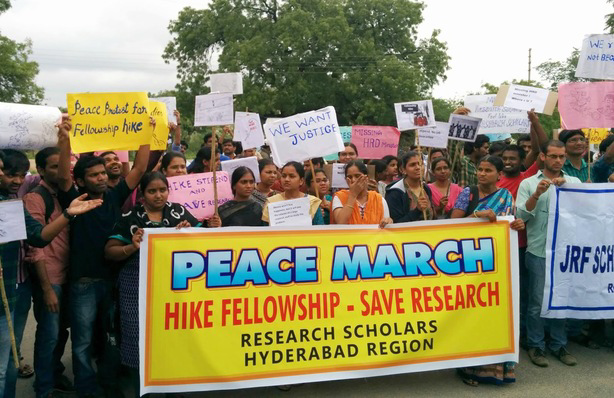
Research scholars/scientists working in risky conditions should also get a risk allowance. Risk allowances should cover the health costs under such exposures. In addition, the contingency amount should be increased to Rs 50,000 and should cover the expenses of travelling abroad for presentations. Lots of the research scholars are invited every year by reputed universities to present their research paper at international conferences but due to lack of the travel allowances, most scholars miss such opportunities. This prevents them from interacting with the other scholars in their respective fields, and deprive them an important chance to learn. Lots of scholars get opportunities to pursue post-doctorate work at such conferences and seminars. The complete list of the demands put forth by the student community is manifest in this post of the hike fellowship page: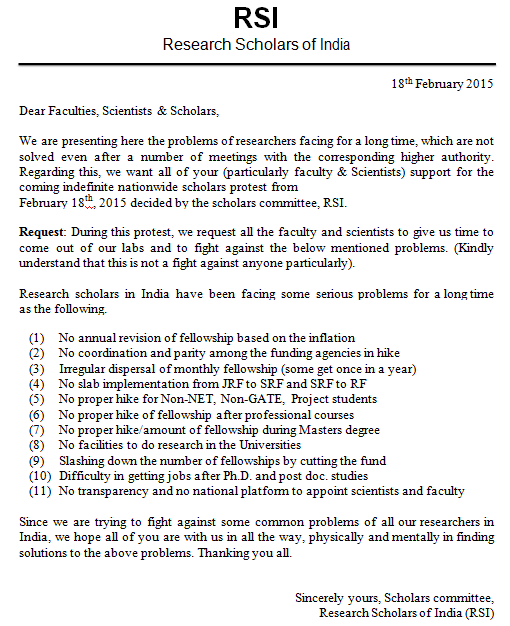
Courtesy: Hike Research Fellowship
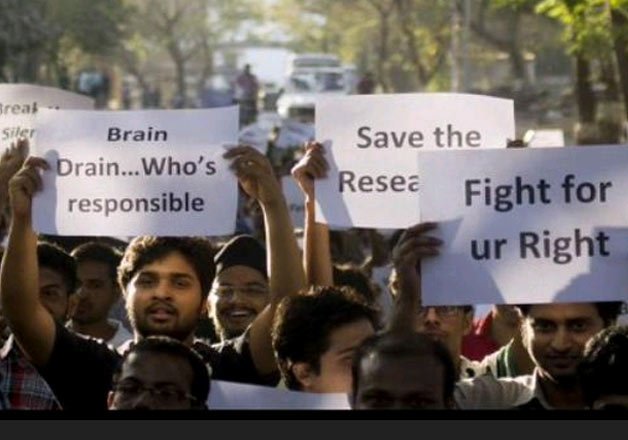
In order to get their issues addressed, student communities all over the country have participated in protests that range from twitter campaigns to sending 1 rupee cheques to Prime Minister, Finance Minister and HRD minister. From IISc Bengaluru to NEHU – Shillong, this is first time in the history of the country that students have organized themselves to get their issues addressed on such a large scale. On February 26, more than 2,000 students and research scholars from various institutions (including Raman Research Institute and Jawahar Lal Nehru Centre for Advanced Scientific Research) formed a human chain near the Indian Institute of Science seeking hike in fellowships (Times of India, Bengaluru, 25 February, 2015). The issue has gained so much importance that the reputed science journal Nature published two stories – one on its India blog, and another in its international section – on February 24, 2015, highlighting the plight of the research funding in India. All the issues mentioned above are the ones faced by the research scholars in every corner of the country, and they are going to trouble the ones coming after them as well. Nation’s growth is directly dependant on the research output of its institutions and unless favorable conditions are not created, the growth will not be steady but marred by recurrent hiccups. Present and future governments have to understand that most of the talented pool in the institutions comes from the poor family backgrounds, and any limitation on potential researchers will be a grave injustice to not only their life but to the overall growth of the country.