A 21st century revolution in communication technology is “Social media”, which has brought about unprecedented changes in individual and social lives of people and has had some great impact on politics. World has witnessed these impacts in America, India, Brazil, Pakistan, etc,. Some of the worlds major democracies and non-democratic countries have been influenced by social media.
E-democracy:
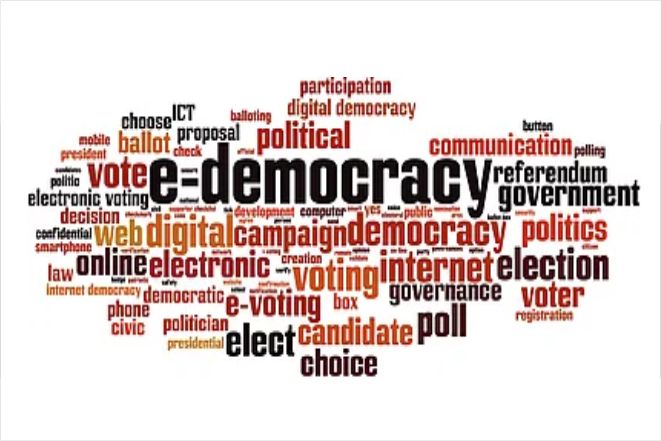
The use of social media and other forms of Information and Communication Technology in politics of countries, especially, in those which have a democratic form of government, can be termed as “E-democracy”. This concept is mainly concerned with the use of Information and Communication Technology (ICT) in Government processes (like elections through EVM machines, use of mobile apps to register forms/complaints etc.) and policies. However, often it is also being used to refer to “the use of Social media or other ICTs in the power gaining processes like elections (by manifestations online), in raising questions against government, in molding and even controlling the minds of people, in protests occurring digitally through rows and hashtags and in online campaigns like sign up or signature campaigns etc., which are impacting the government and opening the stage for all people to raise their voices”, which is the essence of any democracy.
Democracy:
For a better understanding of E-democracy, let us first recall “Democracy”. It is often rightfully defined, as Abraham Lincoln said, “of the people, by the people and for the people”. Democracy (from Greek “demos” means ‘people’ and “kratos” means ‘to rule’) is a form of government in which the people have the authority to deliberate and decide legislation. It is a form of state, in simple terms, where every policy/rule/decision will be taken after consulting and taking the opinion of all people.
There are two forms of democracies namely, Direct and In-direct democracies. Direct democracy is the actual pure form of democracy where every policy/rule/decision will be taken after consulting and taking the opinion of all people, which is a very difficult process and requires a lot of time, money and effort to be implemented. And in large countries like India, America, Pakistan, etc., (the modern world democracies) this form of government is practically impossible. To solve this problem of impracticality, a new concept of “Representative Democracy” or “In-direct Democracy” emerged, wherein people elect their representatives who in turn will vote or voice for all those who elected him/her.
Representative/ In-direct democracy and its shortcomings:
But the representative form of democracy has brought along with it a lot of challenges. The Representatives are becoming more and more greedy for power forgetting their purpose. corruption is increasing day by day, politicians are playing cheap tricks to retain power, wasting lot of money in campaigning, etc. One can find many examples of officials siphoning money from government social welfare schemes like Mahatma Gandhi National Rural Employment Guarantee Act and The National Rural Health Mission in India.
In March 2018, it was revealed that the amount of Indian black money currently present in Swiss and other offshore banks is estimated to be ₹300 lakh crores or US$4 trillion (The Economic Times), most of which belongs to politicians. Examples of political party rivalry, by misuse of power, can be seen in India (along with other democratic countries) where the ruling party often tries to weaken the opposition, the use of “President’s rule” in states where the governing party is not the one ruling at the center, ordering of CBI raids against opposition leaders, political activists etc., are common in India.
Social media, the best possible solution:
But, the recent advancements in the social media and ICTs, according to some people, has the potential to check the short comings of Representative form of democracy, as it provides a platform for people to raise their voices in an efficient and ‘time and money saving’ manner. It has the potential to change the opinions of the people, influence government policies, expose government scandals and shortcomings and even change the government in power. Social media can spread awareness among people which in turn has the potential to increase political pressure. A lot of examples can be seen in the last few decades around the globe where the social media has played a very crucial role in politics.
Examples from around the globe:
The Arab Spring, a revolutionary wave of demonstrations and protests in the Middle East and North Africa (Arab countries) between 2010 and 2012, has had a significant role of social media in itself. It played a crucial role by facilitating communication and interaction among participants of political protests. Demonstrators used social media to share information about their activities and raise local and global awareness of ongoing events. Research from the Project on Information Technology and Political Islam found that online revolutionary conversations often preceded mass protests on the ground, and that social media played a central role in shaping political debates in the Arab Spring.
#MeToo Movement, a social media campaign against sexual abuse, sexual harassment, and rape culture, is a great manifestation of the power of social media. To date, there have been more than 2.3 million #MeToo tweets from 85 countries; on Facebook, more than 24 million people participated in the conversation by posting, reacting, and commenting over 77 million times. This movement spread awareness around the world and people started questioning their governments for laws on sexual harassment, as a result a lot of legislations have adopted and enacted new laws in this regard. In a country like China where the Government regularly suppressed the discussions on women rights, #metoo gave a courage to women of China to speak up and forced the government to enact new laws for the safety of women and provisions against the sexual misconduct at workplace.
All this proves that the social media platforms are increasingly becoming the primary ground for public discourse and mobilization of public opinion and a tool where people are able to talk about the issues of day-to-day life and also of national importance. Social media today is no longer just an innocent space to connect with friends and family. Instead, it has metamorphosed into becoming an influential space for political activity and creating new political dialogue.
Social media and Indian politics:
In Indian context, social media benefitted Indian politics in many ways: spreading awareness among people, reducing the communication gap between people, faster spreading of news, shaping mentality/ideology of people etc., all of which in turn will help the democracy in India to develop. Many protests against the government have been largely aided by the social media in India. For example, the anti-CAA and NRC protests have benefitted a lot in spreading awareness among communities about the ill effects of these policies. The very recent Hijab row is also a great example of how social media can be helpful in spreading awareness, reaching out to masses and getting support from all over the world.
Although social media has a lot of advantages in terms of politics, it does come with a downside. Political polarization is one such great trouble. Social media along with its positive side, also has the potential to Polarize people of any nation and even lead to violent communal riots. The Delhi riots are a recent sorrowful example. Another ill effect of social media is of propaganda setting by the political parties. According to “Google Transparency Report”, political parties in India in the last two years have spent around 800 million dollars on election ads. They used methods like micro-targeting which enabled them to spread toxic discourses to select audience to incite them. Misinformation and fake news are another setback.
Conclusion:
These shortcomings also show how powerful social media can be in Political sphere. Hence, humanity as a whole should recognize the power of social media and its influence on politics and try to make the best out of it. Especially those living in democratic countries like India should try to use it in the most efficient ways possible to try and protect themselves from the tyranny of government or executive and arbitrariness of legislature.