

After successfully implementing economic backwardness based reservation (thereby diluting the core logic of social backwardness based reservation), another major attack on social backwardness based reservation has occurred in the form of the change in formula (roster) to calculate reserved seats for appointment of faculty in colleges and universities across India. This change will impact all state and central universities (and colleges) which are regulated by UGC.
While the earlier formula known as 200 point roster used college as unit for calculation of reserved seats , the new formula takes department as unit for calculation of reserved seats for ST, SC, OBC.
1. The introduction of new formula (department wise roster) in faculty appointment will effectively end the reservation in faculties/teaching position in the field of higher education. In 200 point roster system college/university rather than department was taken as unit for application of reservation. All departments ( big and small) were clubbed together to arrive at aggregate figure for a college/university in case of 200 point roster for calculating reserved seats. This was done to ensure that benefit of reservation goes even to small departments(less than 4). But in department wise roster system where department is taken as the unit for application of reservation in colleges and universities. In case of University faculties, reservation will be applicable not only by department but also according to position( assistant professor, Associate Professor, Professor).This will lead to drastic conversion of reserved seats to unreserved/Open category seats.
Example, in the case of department consisting of 14 positions, the following will be applicable according to policy of reservation. Since OBC has 27% reservation, first OBC seat will be created when the department reaches size of 4.Then second OBC post will be created when department size reaches 8 and the third OBC seat will be created when it reaches 12 post. Similarly for SC , first SC post will be created when department size reaches 7. For ST, the first seat will be created only when department size reaches 14.
In case of 14 size department, both 200 point and department wise roster formula will provide same number of reserved seats. The problem is that the size of departments in most colleges tend to be around seven and very few departments’ size go above 14. So, in case of very small departments, which has less than four faculty positions, no reserved seats will be created ever. Similarly, for department of size of less than 7, there will be no seat for SC. Worse is the case for ST, which requires department size of 14.
Table: 1 Allocation of posts according to social categories
| Vacancies/Seats | 1 | 2 | 3 | 4 | 5 | 6 | 7 | 8 | 9 | 10 | 11 | 12 | 13 | 14 |
| Reservation Application | UR | UR | UR | OBC-1 | UR | UR | SC1 | OBC-2 | UR | UR | UR | OBC3 | UR | ST1 |
2. Things will be much worse than this in case of Universities since the unit will be further split in terms of posts (Assistant Prof, Associate Prof., Professor.). This implies that all those departments of Universities, which does have three assistant professor or associate professor seats, reservation will never be applied. In case a department has six assistant professors or associate professors, only 1 post will be reserved for OBC and reservation for SC and ST will never be applied. Worst is in case of Scheduled Tribe candidates as first post will be created only when the department has more than 13 assistant professors or associate professors. Very few university departments can meet such requirement. Hence, it implies 100 percent end of reservation for ST in Universities.
If all these seems far-fetched, the recent advertisement of Indira Gandhi National Tribal University( Source: 14th April, 2018-Indian Express, page no. 10) shows the gloomy reality. Figure 1 clearly shows that 95% of reserved seats would be converted into unreserved seats if new formula is implemented.
Figure 1
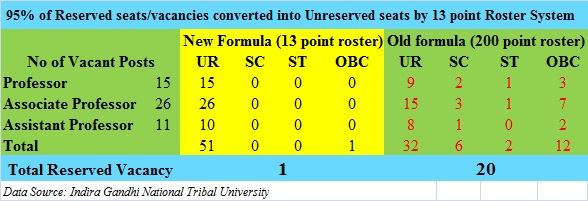
Figure 2
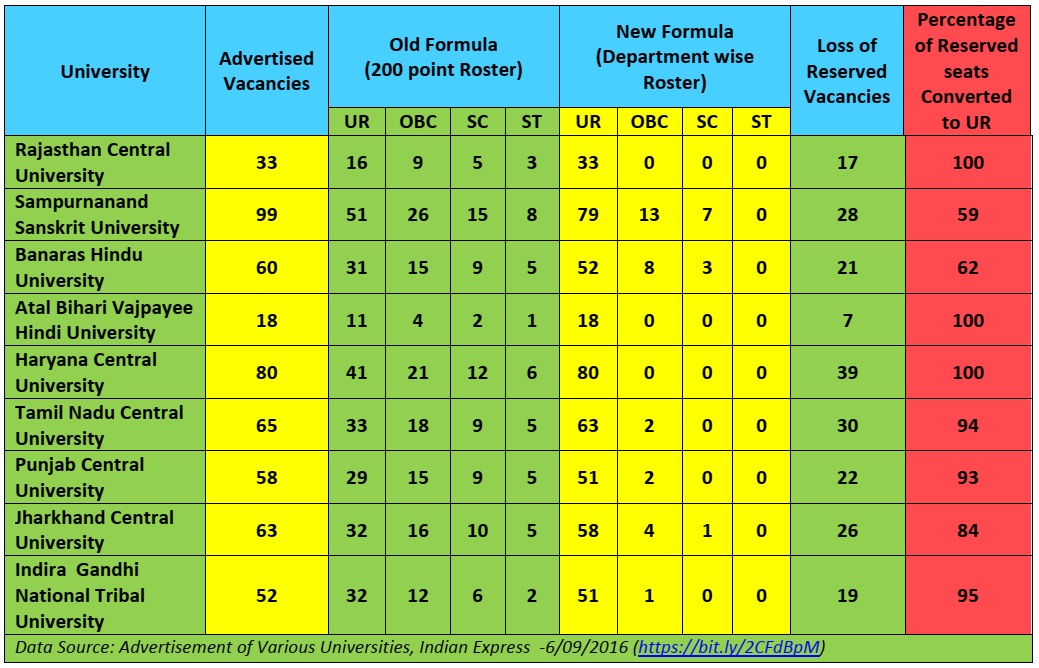
Figure 2 shows how the change in new formula for calculating reservation will convert almost all reserved seats to unreserved (UR) seats. The data for analysis has been compiled from recent vacancies advertised in nine central universities. The last column shows that if new department wise roster is implemented then out of nine universities, in six universities more than 90 % of reserved vacancies will be converted into unreserved vacancies. This clearly demonstrates beyond any doubt that how the implementation of new department wise roster will effectively end reservation at faculty appointments across colleges and universities in India.
All this is happening in a context where the representation of SC, ST, OBC (even after implementation of reservation using 200 point roster) is abysmally low in higher education. So, the implementation of this new department-wise roster will completely obliterate the Adivasis, Dalits and Shudras from process of knowledge production, thus maintaining the century old Brahmanical monopoly over knowledge production.
Allahabad High Court had ordered (dated 7/04/2016, AFR court no. 37, writ no 43260 of 2016, Vivekanand Tiwari Vrs Union of India) to change 200 point roster to 13 point roster as it was challenged by a candidate in the court last year. UGC immediately implemented the court order but after strong protests by various sections, the government was forced to challenge it in the Supreme Court. As such, the government had filed SLP on Supreme Court for 200 point roster system which has been rejected by the Supreme Court. Now, the government can easily bring an Ordinance to save the 200 point roster system. But given the current trend of dismantling social backwardness based reservation by the government itself, such move seems unlikely. Only a strong and united protest against such drastic change in implementation of reservation can compel the government to reverse the decision of Supreme Court and implement 200 point roster system via executive Ordinance. Such Ordinance has already been used to overturn Supreme Court judgement in case of amendment of SC/ST act.Hence by implementing the New Department wise roster system, this government has effectively ended reservation in higher education.

On which legal grounds did the Allahabad High Court found it just to imply 13point roster in place of 200point one..?
writer is biased against general community .
This article is an undoubtedly informative article. Although I wouldn’t disagree that the 8th para reflects a biased stance upheld by the writer.
वाह…. जो सबसे दीन है – ST – उसका नंबर सबसे बाद में…… सच कहूँ तो यह आरक्षण देश और समाज को खा जाएगा
Fake Agenda article and see his level of education and understanding which is clear form the first table where this biased and low IQ person has implemented 13 point roster to posts of professor and Associate professor having 15 and 26 vacancies respectively. 13 point roster is applicable to only such posts which have cadre strength of less than 14. Any amount of reservation will not benefit a liar like the author of the article.
Dear sir I think these activities are so hord for future .and think again to deeply on this matter .
At the time of appointment, there is a post of UR. A person of category UR applies and is selected.
After few 15 to 20 years, the caste of that person comes in OBC.
Now in roster, in which category person should be included?