Kudos to Mr Vishal Bharadwaj and Mr Basharat Peer for adapting Shakespeare magnum opus “Hamlet” into “Haider” with a background of insurgency hit Kashmir of 1995. With a brilliant screenplay, picturisation , music & acting, what adds more to the film are the revolutionary poems of Faiz Ahmed Faiz which clearly resonates with the agony and plight of Kashmiris resisting the extrajudicial killing and disappearance by the hands of Indian Army.
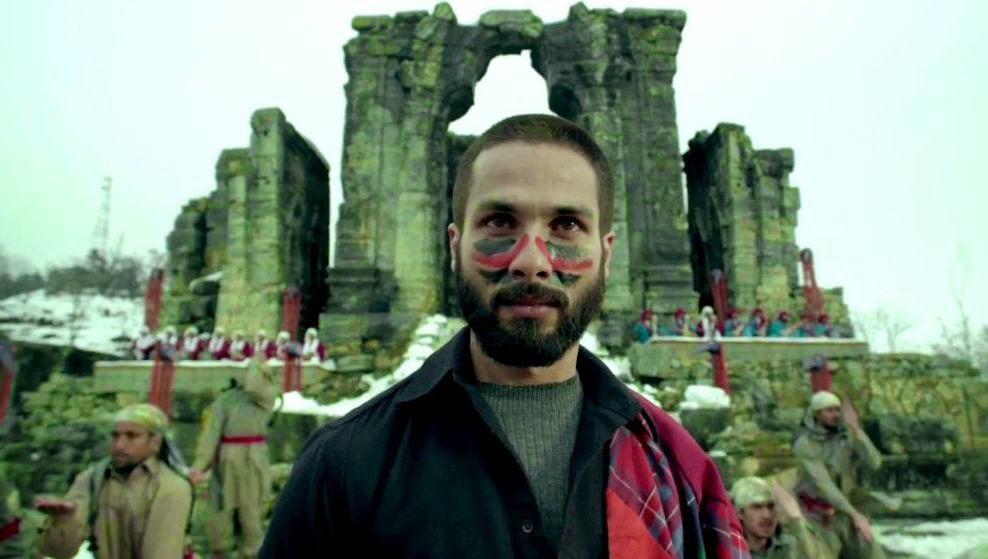
Haider (Shahid Kapoor) who is studying in Aligarh returns to Kashmir receiving the news of his disappeared father, whom the army had picked up, leaving behind no trace of his whereabouts. With his home destroyed where he spent his childhood & his father missing whom he loved deeply, he receives a greater shock when he sees his mother Gazala (Tabbu) with his uncle Khurram(K K Menon).
One can easily figure out prince Hamlet, Gertrude and Claudius in the plot. Not to forget beautiful Arshee (Shradha Kapoor) a journalist, the sweetheart of Haider and a source of motivation for his poetry easily cognized as Ophelia of Hamlet.
Haider didn’t give up. He struggles and starts searching for his disappeared father. We see him wandering from one army camp to another with the hope of finding any clue about his father who is missing from past 20 days. In his quest he encounters a lady who herself is in search of her young boy who is missing from long time. They both show each other the photos of their loved ones and without uttering a word they share each other’s pain. Shahid’s acting was remarkable at that moment. With the back ground song “Jhelum”, Haider moves further to find a lorry full of corpse probably killed by the army. With trembling hands he searches for his father, and suddenly a young boy probably 14-15 years in age lying between the corpses opens his eyes, running with delight he yells “I am alive!! I am alive!!”. The scene depicts a different Kashmir as a “hell created out of man-made mayhem” against our pre conceived notion of “God made heaven on earth”.
Haider film has successfully described the sufferings of Kashmiri civilians in the hands of Indian army. Mr Bharadwaj should be appreciated for bringing the quandary of half widows (the wives of disappeared men) in the movie.
Finally Haider decides to lodge an FIR at the local police station and demands that the detained or arrested person must be presented at the local police station or his location must be informed to his family with the least possible delay. Arshee’s father Pervez Lone (Polonius in Hamlet) the inspector, tries to convince him that if you lodge an FIR, your father will get into more trouble. It’s no wisdom to take enmity with army. He tells Haider, when two elephants clash (India and Pakistan in this case), it is only grass which gets trampled (Kashmir here). The film has successfully described the sufferings of Kashmiri civilians in the hands of Indian army. Mr. Bharadwaj should be appreciated for bringing the quandary of half widows (the wives of disappeared men) in the movie. He has introduced this term among common Indians.
Though the movie does appear slow in its first half but with the advent of Roohdaar (Irfan Khan) the movie gains momentum. Roohdar seems to be the ghost of King Hamlet in Shakespeare’s play. Roohdar, however, is not a ghost, he is a companion of Haider’s father Dr. Hilaal Meer (Narendra Jha) in the Indian army’s detention camp. A mysterious personality who considers himself immortal like a spirit(Rooh). He has a message for Haider from his father, a message of revenge, blood in retaliation to his father’s blood. Initially Haider refuses to believe and starts to leave but when Roohdaar utters “gulo me rang bhare, baade nau bahar chale”, a poem often sung by Haider’s dad, he stops. Then he narrates the whole truth to Haider that how his own uncle betrayed his father and lured his mother. The raid of Indian Army at his house was no co-incidence. Khurram was the sneaker of Indian Army and Gazala the sneaker of Khurram. During the narration Roohdar describes the actual infamous PAPA-2 (an Army interrogation cum torture centre), guised as MAMA-2 in the movie. The description of inhumane treatment of detainees often alleged for supporting separatists will make you feel sad.
It’s worth mentioning about Shahid’s brilliant solo street play where he quotes the Article 2 of Geneva convention 1949, U.N Security Council resolution 47 and Article 370 of Indian Constitution to question the right to existence of Kashmir. “Hum hain k hum nahi?, hum hain to kaha hain?? nahi hain to kaha gaye or gaye to kislie or kab?? Janab hum the bhi ya the hi nahi??” He also criticizes the AFSPA (Armed Force Special Power Act) which grants legal authority to Indian Army to commit atrocities against any individual in the name of public order.
In a short play of only two minutes he describes how both India and Pakistan has failed to bring any good to Kashmir as both claim their own rules without asking the will of Kashmiris who only want freedom from both side. Never has the plebiscite taken place as prescribed by U.N.
Also what one learns from the movie is that “Revenge only leads to revenge. Unless you are emancipated from your revenge, no freedom can liberate you”.
The song Bismil in which Haider narrates the treachery of his uncle Khurram resembles the incident when prince Hamlet did a play to narrate the story of how his uncle Claudius kills his father. Also what one learns from the movie is that “Revenge only leads to revenge. Unless you are emancipated from your revenge, no freedom can liberate you”.
With 41 cuts and censors, the movie, apart from portraying the pain, rage, madness and revenge of Haider, has still managed to address the agony of Kashmiris though much subtle and subverted. A highly politicized film targeting the Indian army as the perpetrators of crime and torture is indeed a daring attempt challenging the prejudices.
Appraisal from a large section of society clearly portrays that India is getting mature enough for handling such politically sensitive movies, which is a good sign. But the film is bound to receive criticism from the common people who know little about the complex situation of Kashmir and from right wing so called patriots for depicting the army as Antagonist. What must be kept in mind is that patriotism should not pave a path towards jingoism.
struggled and started searching for