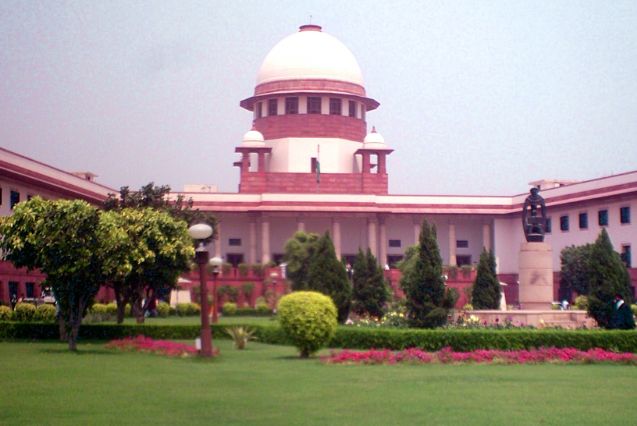
The judiciary is rightly known as the guardian and protector of the rights of its citizens. The role of the judicial system is more comprehensive and broader to check the imbalances in new legislation and bills. New legislation or any bill once passed in the parliament has to pass through the constitutional touch or test by the hands of the judiciary as the finality or validity of the law. Judiciary, in India has played a vital role to safeguard the rights, and prevent the violations of different human rights. One of the main features of the judiciary is the Judicial Review and also a basic structure of Indian Constitution held by the Supreme Court in Minerva Mill’s case (AIR 1980, SC 1789), an innovative mechanism to toss each issue by examining them very solicitously. In this regard, the Constitution guarantees its citizens to approach the Supreme Court under Article 32 and High Courts under Article 226.
Whenever, a law gets amended or a new bill is passed in the parliament, the last say in this regard is of judiciary. With this empowerment and errands, Indian Judiciary is one of the third pillars of the Indian democratic system. However, when judges are being transferred at midnight because they work as independently and honestly as one shows towards the true character of an institution. Moreover, when the orders and directions of the Supreme Court are not being followed, like the apex court held that Right to internet is a fundamental right affixed with Article 19. On 12th January while hearing a petition on internet restrictions in J&K. In response to that order the J&K government in a recent argument refused, reiterated and reversed it and told Supreme Court that Internet is not a fundamental right. When such disobedience of orders became a routine in some particular cases where there lies the interests of the governments and rights of common masses vitiated, then we can say “all is not ok”. Something really is happening in a wrongful way. In simpler words we may assume that the judiciary is in hijacking position and democracy of the nation is at risk.
At these modern times when justice is betrayed, when justice is denied in one way or the other and people are afraid of stern happenings as indicated by the recent events and reports of deaths thereof when Delhi violence took place in which about 51 people died, 200 plus injured, properties destroyed that included four mosques, which were set ablaze by the rioters, there were no intervention of government to stop mob and safeguard further violation of rights of the victims. The negligence shown towards Kashmir when it comes to restoration of high speed internet for different professionals particularly to doctors and students in order to keep health system alive and kicking amid this adversary virus (COVID-19) is yet another case of judicial hijacking. It was reported from the doctors of Kashmir that we are unable to download the guidelines of World health Organization (WHO) related to Corona virus. When the whole world has accentuated measures to impart ad teach through online portals to students., children in Kashmir are not getting internet facilities to remain in touch with the studies through online portals. The violation of fundamental rights is at peak in both cases. In such circumstances the judiciary must come for the rescue and to safeguard further derogation ad deterioration of basic human rights of its citizens.
It seems some parallel force is working to disrupt the smooth implementation of the laws by creating such fuss and confusion. It is evident when all the important matters have been in queue. Since August 05th 2019, judicial matters like Aticles 370, 35A and other pertaining to the High speed internet for J&K were called off for the next hearings. However, the journalist Arnab Goswami’s unimportant petition has been heard that in an immediate effect and wherein stranded migrant workers have been neglected in an open roads and streets during this health crisis. When people are being divided in the name of religion, caste and race for the vote banks and power, like the stigma of tableegi jama’at, treated as the medium of transmission of the corona virus and called out by different names even knowing the fact that this pandemic doesn’t look at religions or other cultures.
The same were claimed by the Justice Chelameswar and other three judges in an unprecedented press conference back years, as the present political regime has not left judiciary uninterrupted and is intervening into its spheres and the institutions like RBI, CBI and trying to overrule all constitutional bodies so that they can rule according to their whims and fancies. Under such circumstances the judiciary has a pivotal role to play in order to check and balance the democratic setup in pure form. Without intervening the field or subject of the other organs of the state, judiciary must act as a watchdog at its place to safeguard the rights of its citizens.
The clash between the legislature and judiciary is not a new one in India, it rather has a long history since the inception of the constitution. The first argument came to the fore in the very first case of the Shankari Prasad V. Union of India ( AIR,1951, SCC 455). In this case, the Supreme Court ruled out that the power to amend the constitution under Article 368 also includes the power to amend Fundamental Rights and that the word “law” in Article 13(4) includes an ordinary law made in the exercise of the legislative powers and doesn’t include constitutional amendment which is made in exercise of the Constituent power. Therefore, a constitutional amendment will be valid even if it abridges any of the fundamental rights. So, in this case, the Supreme Court concluded the legislature is supreme. This was followed in the case of Sajjan Singh V. State of Rajasthan (AIR, 1965, 845), in which legislature was again declared as supreme. But in the landmark case of Golak Nath V. State of Punjab (AIR 1967, SCC 1643) it was held that parliament has limited power and can’t amend any of the fundamental rights. This tussle continued and different parts of the constitution were amended and were struck down by the Judiciary.
Finally this issue was resolved in the landmark judgment of Kesavananda Bharti case (AIR 1973, 4 SCC 225) in which it was held that although parliament can amend any part of the constitution (including fundamental rights) but its basic structures can’t be amended.
An attempt was made to establish a committed judiciary by the parliament in 2014 when a bill was passed to establish NJAC (National Judicial Appointing Commission) to replace the present collegiums system of appointing judges but the Supreme Court rejected the NJAC Act and the 99th constitutional amendment which sought to give to the politicians and civil society a final say in the appointment of the judges to the High Courts.
The political regimes have time and again tried to intervene in the premises of the Judiciary and have almost diluted it’ sanctity. This claim finds credence from remarks made Justice Chelameswar, Kurian Joseph, and MB Lokur in January 2018 that all the important cases regarding government were being distributed selectively among judges. This can’t be just a coincidence when under the Chief Justice ship of Rajan Gogio cases like Babri masjid, citizenship Amendment Act (CAA) and Article 370 were allowed to flow in favor of the government. Later on after few months, he was nominated as a member to the Rajya Sabha by the current political regime. We should not forget that all these matters were main agenda in the manifesto of the BJP.
The present government has left no stone unturned in the way of the wear and tear of the essence of this institution as they find this a stumbling block in the way of the realization of their vested interests and mobilization of their voters whom they have promised during campaigns to fulfill their demands whatsoever they could be. To meet the demands of the voters is not an issue until it vitiates the law of the land, which is above everything.
Doctrine of separation of powers is a basic principle that provides the trio organs (legislature, Executive and Judiciary) their separate fields and subjects of works and they are supposed to work accordingly. Once they interfere in each other’s works they remain no more democratic. When any government succeeds in usurpation of powers, especially those of judiciary, it dents ethos of governance on which the affairs of country should be conducted.