

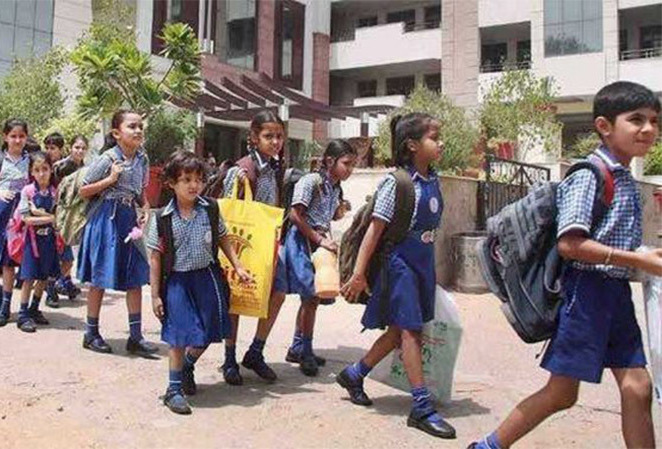
Education is one of the basic criteria by which the development of a nation can be gauged. The quantum of money a nation spends on education, defines how much interested it is in future building. It is not the responsibility of only individuals to strive hard and invest in education, but it is also one of the basic responsibilities of a civic government. In most of the developed countries we find a major chunk from the country’s budget being allocated to education sector. The presence of prestigious institutions reflects the country’s progress and prosperity.
The education sector is the one, which requires fund allocation and strategy formulation, by rising above electoral politics and populism. If the education sector is viewed from the prism of electoral politics, it spells a doom in the long run. Unfortunately, in India the field of education and learning lies neglected, thanks to electoral politics and by the fact that spending on it could not be encashed in the form of political gains.
The result we see in the form of universities and colleges lying crippled due to paucity of funds and lack of timely policy making. Education, even though being in concurrent list could not get the due attention which it ought to have gotten.
However, as the saying goes ‘better late than never’, a positive step in this regard was taken by the Telangana government, which announced the free education from KG to PG scheme.
If the government is sincerely interested in implementing what it has announced, it will surely be a shot in the arm, for the education sector in Telangana. In fact, it was the decision which should have been made a long ago, however, this would certainly help in mitigating the educational woes of Telanganites.
The scheme promises to provide free and quality education to all, of course, which is the duty of the state. But for the scheme to succeed and achieve its objectives, much needs to be done beyond populist announcements. The government needs to work upon the following points to achieve its objectives:
- Policy formulation
- Infrastructure development
- Alleviating the shortage of teachers and teaching staff
Policy formulation: At present the education scenario suffers from lack of a comprehensive education policy. Due to which we see an irregular pattern of development in various sub-sectors of education field. In place of policy, local factors and politics define the trajectory of educational development, throughout the state.
As a result, we see imbalance between the occurrence of institutions of social sciences and technical institutions. Added to the situation, the occurrence of technical institutions happens in a few places creating a form of technical clusters.
To stop this haphazard growth and cluster-isation of selected institutions, the government must prepare a clear policy as to how much share it wants to allot to each sector namely the technical, social science etc. Also the government must present a policy to promote affordable and quality education to every income group.
Infrastructure development & maintenance: Dim and damp buildings, broken furniture, peeling off walls-these are the attributes used to represent government institutions. Without playing the blame game of as to who was responsible for this grim situation, the government must make statutory provisions to improve and develop the existing and proposed infrastructure. Many a time it is observed that an educational institution is established initially with a fair expenditure, but later on due to unavailability of funds the maintenance of infrastructure falls into neglect. Also it happens that due to non-sanctioning of funds at appropriate time, the infrastructure sees further degradation.
To avoid this, a proper mechanism for allocating timely and sufficient funds for the purpose should be established. When private players with far lesser resources than the government, could effectively maintain top class infrastructure, why can’t the government agencies?
Alleviating shortage of teaching staff: One of the major drawbacks of government institutions is the scarcity of teaching staff. In various surveys conducted by different agencies, it was observed that the distribution of teachers and lecturers is not even. The government talks about 1:30 ratio, but how could a single teacher handle multiple classes parallely? The system of distribution and appointment of teachers needs to be revised and refined. Also, there exist urdu medium schools apart from Telugu medium schools, for which the government must take steps to conduct separate recruitment and prepare a separate roster.
Apart from recruiting new teachers it is to be ensured that the knowledge base of existing faculties is continuously enriched and regenerated. They have to be made abreast with current trends and latest developments in the field of education.
Since the announcement of this scheme, almost two academic years have passed, but clarity seems to elude. The only progress in this regard has been the establishing of residential schools and colleges. Though it is highly commendable that the government has established high quality institutions and is spending about a lakh rupees per student annually, but the problem is that the reach of these institutions is limited. These institutions currently function from VI to VIII standard, and at intermediate and degree levels in few locations. Due to which the major chunk of state’s poor still remains away from quality education.
It is recommended that apart from setting up residential institutions, the government develops the existing institutions to such a standard that even the upper middle class families would prefer to join their wards in these institutions.


Which class is eligible for kg to pg scheme in telangana
Is the admission procedure started for class 2? How to apply for kg to pg school?
It’s administration for 9th class students