The Nakba did not originate in 1948. Its origins lie over two centuries ago. This sweeping history starts back in 1799 with Napoleon’s attempted advance into Palestine to check British expansion and his appeal to the Jews of the world to reclaim their land in league with France. The narrative moves through the 19th century and into the 20th century with the British Mandate in Palestine and comes right up to May 15th 1948 in the 21st century and the ongoing ‘nakba’ on the ground.
Nakba is literally translated as catastrophe or calamity meaning afflicted with disaster. Before the forced mass expulsion and the ethnic cleansing of the native population of Palestine to establish and enforce an illegal independent Jewish state on May 15th 1948, the term was used in the literal meaning. Since then, with the addition of the definite article “al” which in Arabic language is used to make a proper noun, the term al-Nakba has been used to define the forced displacement of hundreds of thousands of Palestinians from their homeland.
Even after 72 years, no policy or resolution has even de-escalated the suffering, pain and distress of Palestinian refugees afflicted upon them from al-Nakba, let alone the justice, which is why Palestine conflict is considered as one of the most enduring conflict in the modern history. Arnold Toynbee a renowned British historian writes “The tragedy in Palestine is not just a local one; it is a tragedy for the world, because it is an injustice that is a menace to the world peace.”
The British had colonized Palestine since the Balfour decleration of 1917 to the 14th of May 1948. Lobbyists and politicians like barren Edmund de Rothschild, Lord Walter Rothschild and Chaim Weizmann had great influence in the British cabinet. In 1915 Herbert Samuel a British Politician, Zionist leader and a key persona-identity in “legally” establishing the state of Israel submitted the first memorandum to the British cabinet under the title “The future of Palestine”. He recommended in the memorandum that the time was not right to establish an autonomous Jewish state and that Palestine must be annexed to the British empire; describing this as the most ‘welcome solution’.
On 27th November 1947, the United Nations General Assembly voted to adopt the UN Resolution 181 also called as the ‘Partition Plan of Mandatory Palestine’ which suggested the partition of British controlled Palestine into Arab and Jewish Independent states with the Jerusalem as a ‘Corpus Separatum’ a latin word for a ‘separated body’ as it was placed under the international regime conferring it a special status due to its shared religious importance. The Resolution passed in the Assembly divided the land as 55% of the total land for the settlement of 32% of the total population consisted of the Jews mostly migrated from Diaspora to Palestine, and 45% of the total land for the 68% of indigenous population.
Also read The Question of Palestine And Significance of Solidarity At Present
This raised discontentment amongst Palestinians which consequently resulted in clashes between both the communities in general and Haganah, the paramilitary organization which later became the core of IDF (Israel Defense Forces) and the local volunteers of Palestine resistance, in particular. Haganah later that year planned and conducted 13 organized military operations to eradicate and expel the Palestinian population amongst which the Plan Dalet (named after the fourth letter of Hebrew) was of immense importance as it aimed at maximum conquest of land and expulsion of Palestinian population. Although intent and purpose of Plan Dalet is subject to much debate and controversy, Ilan Pappe in his book “the ethnic cleansing” asserts that Plan Dalet was a ‘blueprint for ethnic cleansing’ and that the aim of the plan was in fact the destruction of both rural and urban areas of Palestine.
These clashes between both the communities remained till 1949 and are often called as the ‘Palestine war 1947’ or ‘First Arab-Israel war 1947-1949’. It eventually resulted in the creation of State of Israel on 15th May 1948, which is why the day in Israel is considered as the Independence Day or ‘Yom Hatzmaut’ in Hebrew. Although it has been observed that the Independence Day in Israel is celebrated as per the Hebrew calendar and not the Gregorian which is the reason why its not celebrated on 15th May every year.
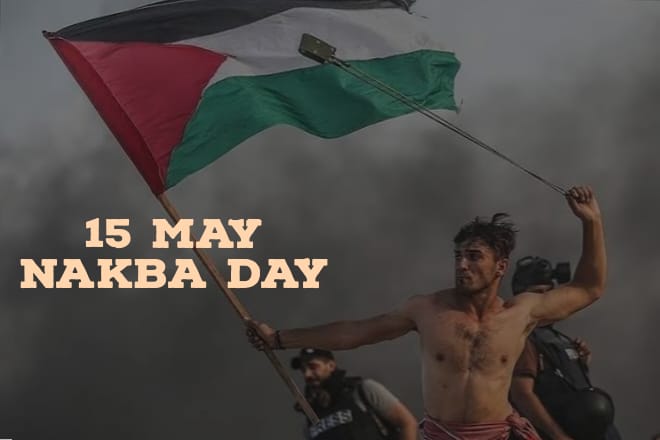
While the creation of a Jewish State expelled 700,000 Palestinians and precipitated them to migrate to the neighboring countries like Jordan, Lebanon, and Egypt to live their lives in the refugee camps . Those who resisted were simply killed. Over 13,000 Palestinians were killed and over 30,000 injured. The same day amongst Arab is considered and commemorated as Catastrophe and called as Nakba Day or ‘Yaum-an-Nakba’ in Arabic. It happens after every 19 years that both Israel and Palestine share the celebrations and commemorations respectively on the same day.
Also read The Zionist Settler Colonial Project : From Balfour To Jerusalem
Palestinians never commemorated the Nakba Day until 1998 as there always phare a ray of hope for them that they would get back to their devastated homes, to restore normalcy in their lives and find peace and prosperity, to grow and compete in the growing advanced world, but certainly never find one. It was Yasser Arafat who first inaugurated the commemorations of the day on 15th May 1998. On the evening before the first Nakba Day, Prime Minister Benjamin Netanyahu commented that “Israel was not responsible for the Palestinian tragedy, their leadership is.”
Musallam Bseiso a Palestinian intellectual and politician said “Despite the long period of time that has elapsed, I am still certain that Israel will not be around forever. But this would require a change in the Arab world and the mobilization of people to fight.”
The resemblance of Nakba and the Palestinian struggle is significant and noteworthy in the 21st century. It is an aide-memoire to the process of ethnic cleansing, the expulsion of 70,000 thousand Palestinians from their homeland, and gallantry of their resistance that continues to this day. Nakba signifies hope that one day the clash of civilization would come to an end, Zionism shall perish and that Palestine would be free.